Canton Smart Townus 2 Review: Can It Replace Traditional Hi-Fi?
Some like it hot, some like it big, and some like it even bigger. But is the trend toward ever-larger high-end audio systems still relevant in 2026?
The audio world has shifted on its axis over the last decade. Streaming has become the undisputed lifeblood of modern music collections, active speakers have matured from simple studio monitors into serious audiophile components, and many music lovers now prefer elegant simplicity over equipment racks overflowing with separate boxes and thick, expensive cabling.
Few companies have adapted to this cultural shift as successfully as Canton. The Hessians call it a “smart” approach, a wonderful mix of clever design and raw power. With the Canton Smart Townus 2, the German manufacturer relies on its decades of traditional loudspeaker engineering while packing the cabinets with cutting-edge wireless technology, sophisticated digital amplification, and deep smart connectivity.
The name itself is a playful combination of “Town” (the modern, urban lifestyle) and “Taunus” (the picturesque Hessian region where Canton has been based since its founding). While the moniker is lighthearted, the engineering behind it is serious. Having recently moved to a smaller living environment where massive floorstanders were no longer an option, I found myself tired of “heavy metal” hi-fi and ready to embrace a leaner layout. I ordered the youngest minimonitor in the line to see if it could truly replace a separate rack. After extensive living-room testing, I can comfortably say this compact system redefines what “complete” means in the sub-$2,000 active category.
Inklang Ayers Two Wireless Review
Design and Build Quality
The Canton Smart Townus 2 is beautifully executed and feels considerably more premium than its asking price suggests. Canton’s manufacturing has expanded significantly over its 50-year history, utilizing specialized European production lines (including in-house chassis assembly in the Czech Republic), and that manufacturing maturity shows here. Every seam is neatly aligned, the cabinet corners are elegantly rounded to optimize high-frequency dispersion, and the magnetic fabric grilles snap cleanly into place on a screwless front baffle.
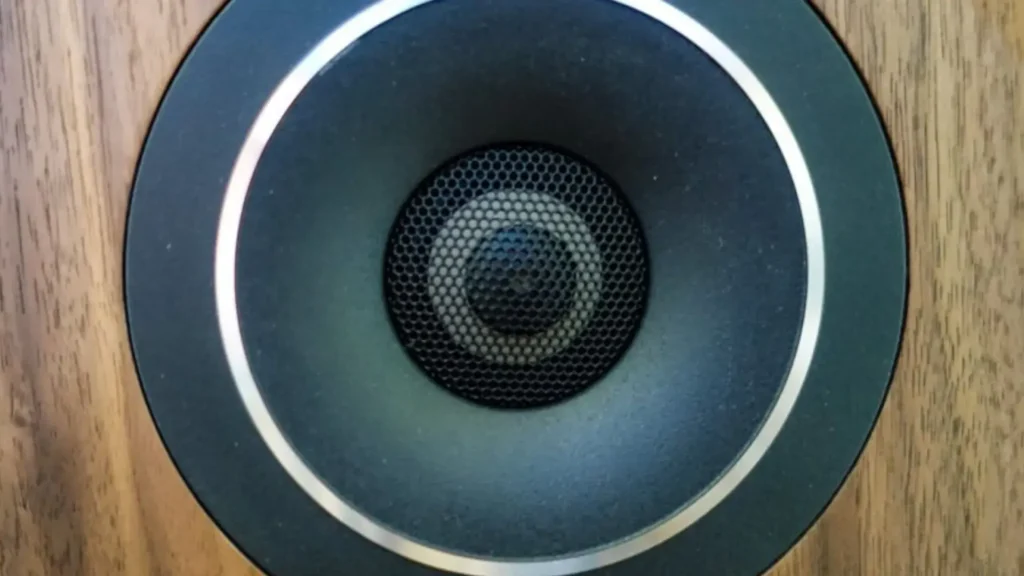
The matte white and gloss black options are sharp, but it’s the rich real-wood walnut veneer that steals the show. It is an absolute eye-catcher that wouldn’t look out of place next to high-end furniture or luxury monitors costing three times as much. For urban music lovers who want a highly stylish speaker that blends into a contemporary living space rather than visually dominating it, Canton hits a home run.
Technology, Construction, and Amplification
Behind the attractive grille sits a driver combination that head developer Frank Göbl and his team have continuously optimized using computer modeling.
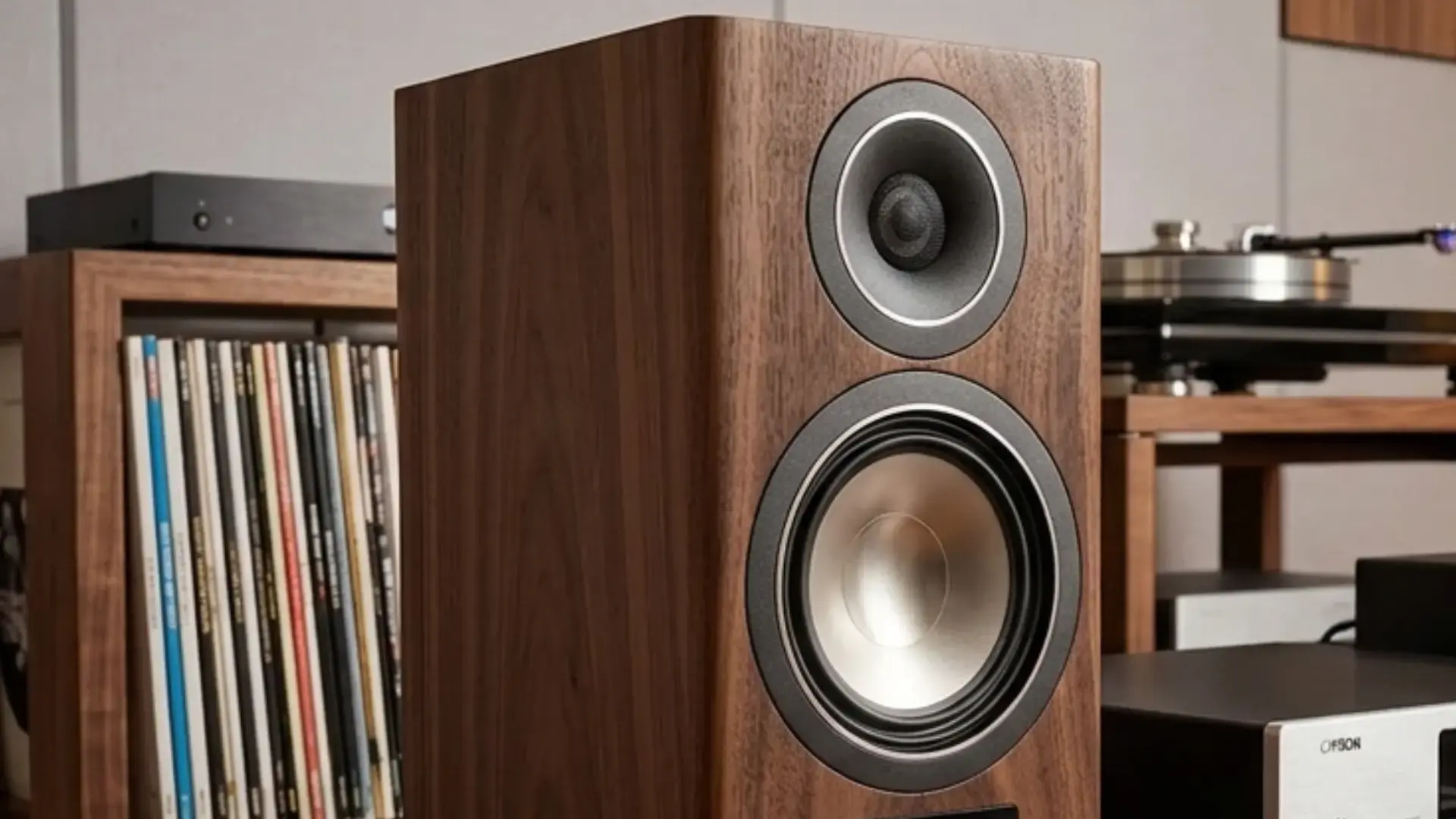
High frequencies are assigned to a rigid 25mm ceramic dome tweeter. Below the 3kHz crossover point, a 154mm titanium midrange/woofer handles the heavy lifting. Göbl is historically skeptical of paper woofers or sensitive silk domes, preferring the blistering speed, extreme stiffness, and incredibly low distortion characteristics of metal alloys and ceramic oxides. The driver is mounted to a patented, latest-generation Wave Surround to allow for massive excursion without losing structural control.
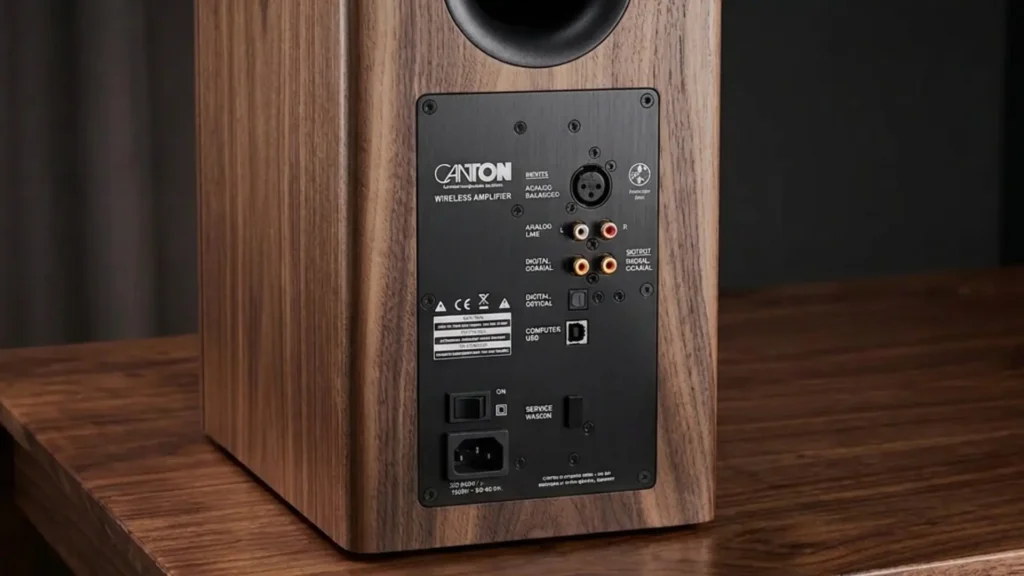
The true marvel, however, sits hidden inside the active backplate:
The Power Metric: Each speaker contains its own Class D module delivering an astonishing 350 watts of dynamic system power.
To achieve this level of headroom in a traditional passive hi-fi setup, you would need to buy a serious pair of heavy transistor monoblocks. The fact that Canton integrates individual, perfectly matched amplification, a digital preamplifier, and an advanced DAC into two compact boxes for roughly €1,299 borders on financial heresy. It honors the core audiophile ideal of shortest possible signal paths—no massive runs of thick speaker cable required.
Connectivity and Smart Features
One of the system’s greatest strengths is its immense flexibility. The “Master” speaker acts as your primary digital brain, handling all source traffic and then beaming a perfectly synchronized, lossless 24-bit wireless signal across to the “Slave” speaker. You only need to run a power cord to each unit.
Comprehensive Inputs
- Wireless Lifestyle: Bluetooth with aptX decoding lets you stream casually straight from a phone.
- The Desktop Hookup: A high-performance USB input utilizing XMOS technology lets you dock your PC or Mac directly to turn the pair into elite desktop studio monitors.
- Traditional Digital & Analog: Optical, digital coaxial, and standard RCA stereo connections accommodate external DACs, CD transports, or streaming hubs.
Home Theater & Multi-Room Capabilities
Canton doesn’t view these simply as two-channel bookshelf units; they are part of a broader ecosystem. Because the master module includes built-in Dolby Audio and DTS decoding, you can connect your TV via an optical cable and experience beautifully processed virtual surround or an enhanced dialogue “Voice” setting.
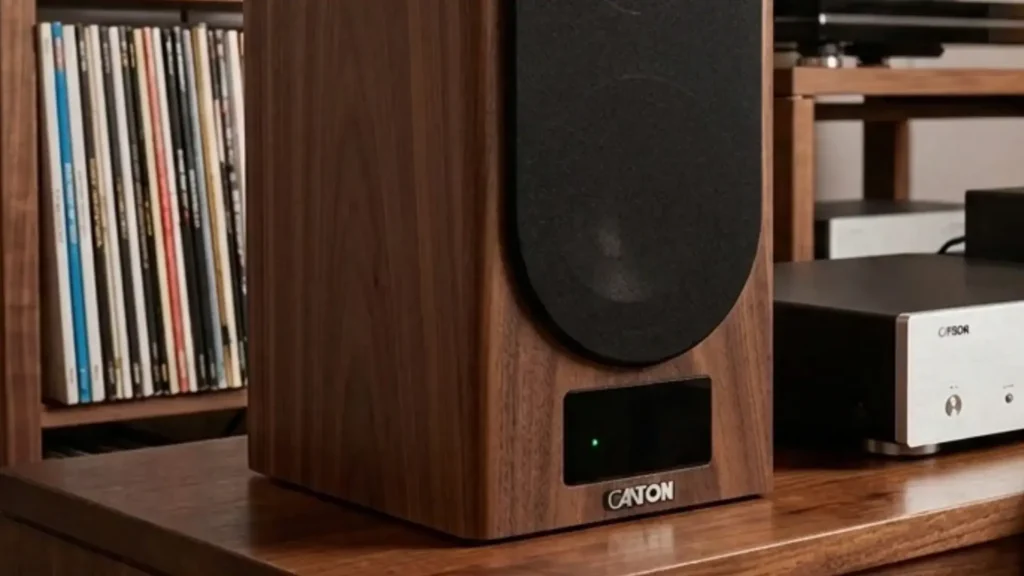
Even better, the internal wireless network allows you to link other Canton Smart items seamlessly. You can expand these into a multi-room group or assemble a massive wireless home cinema layout over time, utilizing an active soundbar as a center channel, the Canton Smart Townus 2 as rears, and a wireless Smart subwoofer on the floor.
Setup and the User Experience
Getting the system up and running is generally a breeze, though it does have a distinct operational language. The physical layout expects the Master speaker to sit on the left channel and the Slave to occupy the right.
Pylon Audio Jade 20 Speaker Review
In my unique living space, this configuration didn’t work with my physical wiring paths. After encountering an initial setup hiccup, I placed a call to Canton’s hotline. In under three minutes, an absolute pro on the support desk walked me through the internal software settings using the integrated front LED display, swapped the channel assignments digitally, and solved the problem permanently.
Operation is handled by a simple, highly streamlined remote control. Canton wisely uses this unified control platform across all its Smart devices, meaning if you buy into the ecosystem, you only have to learn the rules of the interface once.
Listening Test
Rather than treating these like delicate desktop toys, I chose to feed them high-quality digital feeds and high-grade vinyl pressings through an external phono stage, utilizing a Roon core and the speaker’s internal DSP to perfectly balance the output to my room.
Noah Kahan – Stick Season (2024 Vinyl Pressing)
The Townus 2 pins Kahan’s raw, raspy voice dead-center in the room with absolute authority. The banjo and fingerpicked acoustic guitar stretch wide across the soundstage, but they maintain precise boundaries rather than bleeding into an artificial wall of sound. The transitions from intimate verses to the booming folk-rock chorus are rendered effortlessly, with no hint of dynamic compression or mid-bass smear.

Taylor Swift – Cruel Summer (2025 Live from LA Vinyl Edition)
This tracking is currently trending heavily on Discogs, and the Townus 2 shows exactly why a live recording benefits from active control. The synthetic bass pulses hit with surprising, rhythmic agility. The ceramic tweeter keeps Swift’s upper vocal register completely airy and clean, preserving the crowd acoustics while remaining explicitly clear of harshness or sibilance.
Zach Bryan feat. Kacey Musgraves – I Remember Everything (Boys of Faith 2025 Reissue)
An exceptional test for imaging. The acoustic guitar strumming and raw harmonica float entirely free of the speaker cabinets. Bryan is planted slightly left-of-center while Musgraves enters precisely on the right. The presentation has an intimate, holographic “live in the room” perspective where you can hear the natural, unvarnished grit of the vocal mics.
Benson Boone – Beautiful Things (2025 Pulse Vinyl Edition)
The quiet piano introduction is crystal clear, but the track’s real test is Boone’s sudden, soaring vocal leaps into his upper register. The Canton Smart Townus 2 does not soften the edges; it delivers the raw power and slight strain of the performance flawlessly. When the kick drum slams in, the timing between the ceramic and titanium membranes is completely cohesive.
Miles Davis – Kind of Blue & Mahler’s Symphony No. 2
Acoustic instruments sound deeply organic. The double bass tracks cleanly, and the horns carry a realistic metal bite without sounding brittle. When pushing the speakers with large-scale orchestral tracks like Mahler, the soundstage expands beautifully outside the physical boundaries of the enclosures.
Bass Limitations and Real-World Restraint
No compact enclosure can break the laws of physics. The Townus 2 hits incredibly tight, tuneful, and precise down to its mid-bass limits, but it is not a structural subwoofer substitute.
However, Canton’s acoustic restraint here deserves praise. Rather than boosting the mid-bass to create an artificial “thump” that muddies the midrange, the low end remains completely integrated and natural. For jazz, classical, string quartets, and traditional rock or pop music, the depth is more than adequate. If your musical diet requires sub-30Hz organ pedals or electronic sub-bass drops that shake the foundation, you can easily tap into Canton’s integrated bass management and drop in a dedicated active sub later.
Comparative Landscape
When weighing the Canton Smart Townus 2 against its prominent active peers, its distinct identity becomes clear:
- vs. KEF LSX II LT / LS50 Wireless II: KEF offers incredibly wide off-axis imaging due to their Uni-Q concentric drivers, but Canton counters with massive amplification headroom (350W per side vs KEF’s split architectures) and far deeper home theater integration, including native Dolby/DTS decoding.
- vs. Triangle AIO Twin / DALI Oberon 1 C: While the Triangle and DALI active systems sound incredibly smooth and traditional, they lack the sophisticated multi-speaker expanding capability, advanced DSP room configuration, and high-resolution USB DAC inputs found on the Canton.
Final Verdict
The Canton Smart Townus 2 is one of the most compelling, logical, and highly effective active loudspeaker solutions available in 2026. By embedding heavy-duty amplification and smart decoding architecture into an elegant, real-wood compact monitor, Canton offers modern music lovers a premium high-end experience without the aesthetic clutter of separates.
It is a dynamic, punchy, and transparent performer that keeps the focus entirely on the music rather than the hardware. As a bonus, Canton offers a 30-day risk-free home trial via their online store, though once you hear them side-by-side with your old separate components, it is highly unlikely you will send them back. For many listeners looking toward a streamlined future, the Smart Townus 2 is all the hi-fi system they will ever need.
Quick Specifications
| Specification | Canton Smart Townus 2 |
| Type | Active 2-Way Bass Reflex Wireless Bookshelf |
| Tweeter | 25mm Aluminum Oxide Ceramic Dome |
| Woofer / Midrange | 154mm Titanium Driver (Wave Surround) |
| Amplifier Power | 350 Watts Class D per Speaker |
| DSP / Processing | Built-in Room EQ, LipSync, Bass Management |
| Decoding Formats | Dolby Audio®, DTS Digital Surround®, 24-bit/96kHz PCM |
| Wired Inputs | 1 x RCA Analog, 1 x USB (XMOS®), 1 x Optical, 1 x Coaxial |
| Wireless Connectivity | Bluetooth 3.0 (with aptX® decoding), Wireless Speaker Link |
| Dimensions (W x H x D) | 190 mm x 350 mm x 280 mm |
| Weight | 6.8 kg (15 lbs) per speaker |
| Finish Options | Satin Matte White, High-Gloss Black, Walnut Real-Wood Veneer |
| Price | ~€1,299 / $1,500 per pair (+€100 for Walnut) |