The Whole Truth About Speaker Cables (To Be Honest, Not Quite All: But Enough)
I’ve watched this debate unfold for years on audiophile forums.
Someone claims cables sound different.
Someone else replies with “+1.”
Then comes the inevitable line:
“If it’s the same copper, it can’t possibly sound different.”
What fascinates me is this — the loudest skeptics rarely mention actual listening comparisons. Their argument is theoretical. Absolute. Closed.
Meanwhile, those who believe cables matter almost always refer to real auditions.
After hundreds of comparison sessions and years of DIY cable design, I’m firmly in the second camp.
Not because of mysticism.
Not because of imagination.
Because of physics.
Why Ohm’s Law Doesn’t Tell the Whole Story
Years ago, while installing car audio systems, a retired Soviet-era signal technician saw the 2-gauge power cable we were running to an amplifier.
He smiled and said:
“We used cables like this to connect radio stations broadcasting halfway around the world.”
That moment stayed with me.
Because sound reproduction is not simply about current delivery, it’s about control, timing, and electrical interaction with a reactive mechanical system.
Ohm’s law explains resistance.
It does not explain dynamic behavior under load.
And loudspeakers are not static loads.
Damping Factor: Where Speaker Cables Start to Matter
A loudspeaker driver is essentially an AC motor.
It converts electrical energy into mechanical movement.
The moving assembly has mass.
Mass creates inertia.
Inertia must be controlled.
The amplifier’s damping factor describes that control.
What is the Damping Factor?
Damping Factor = Speaker Impedance / Amp Impedance + Cable Resistance
Example:
- Speaker: 4 ohms
- Amplifier output impedance: 0.02 ohms
4 / 0.02 = 200
That’s excellent.
But here’s what most forum arguments ignore:
Speaker cable resistance adds to the amplifier’s output impedance.
Even small increases reduce the effective damping factor.
Reduced damping factor means:
- Slightly less control over cone motion
- Looser bass behavior
- Less precise transient control
Now the conversation moves beyond theory.
It becomes measurable.
Does Speaker Cable Thickness Matter?
Many enthusiasts say:
“2.5mm² cable is enough. Speakers use less power than amplifiers.”
But this argument focuses only on power handling.
The real issue is resistance.
Thicker cables reduce:
- Series resistance
- Voltage drop
- Damping factor loss over long runs
This becomes especially relevant when:
- Running 4-ohm speakers
- Using long cable lengths
- Pairing with high-current amplifiers
The goal isn’t “more power.”
It’s a preserving system control.
The Speaker Is a Mechanical System, Not Just a Load
A loudspeaker behaves differently once installed in an enclosure.
In a sealed box:
- The air acts as an additional spring
- System stiffness increases
- Resonant frequency (Fc) rises
- Total Q (Qtc) increases
There is no universally “good” or “bad” Q value.
Everything is a trade-off.
Why does this matter?
Because amplifier control interacts directly with mechanical behavior.
Electrical damping and mechanical suspension are connected.
And anything inserted between the amplifier and the driver, including cable, becomes part of that equation. When the speaker cone moves, it generates its own electricity (Back-EMF) that flows back toward the amplifier. The cable needs to be a low-resistance ‘drain’ for this energy so the amplifier can effectively brake the woofer. If the cable resistance is too high, that energy stays in the driver, leading to ‘bloated’ or ‘slow’ bass.”
Does Cable Insulation (Dielectric Material) Affect Sound?
Every cable uses insulation.
That material affects electrical properties such as:
- Capacitance
- Dielectric absorption
- Charge storage behavior
Common materials:
PVC
- Inexpensive and common
- Higher dielectric absorption
- Can oxidize copper over time
Polypropylene
- Lower dielectric losses
- More stable electrically
- Often more neutral in performance
Teflon (PTFE)
- Excellent dielectric properties
- Very low absorption
- Used in high-end cable designs
Some boutique manufacturers even use natural materials like cotton or linen due to their extremely low dielectric storage, though these are rare in mass production.
As cable length increases, dielectric behavior becomes more influential. This isn’t just about signal loss; it’s about ‘smearing.’ High-capacitance insulation can store and release energy slightly out of sync with the musical transient, leading to a perceived loss of air or ‘darker’ high frequencies. Again, not magic. Electrical interaction.
Cable Geometry: The Quiet Variable
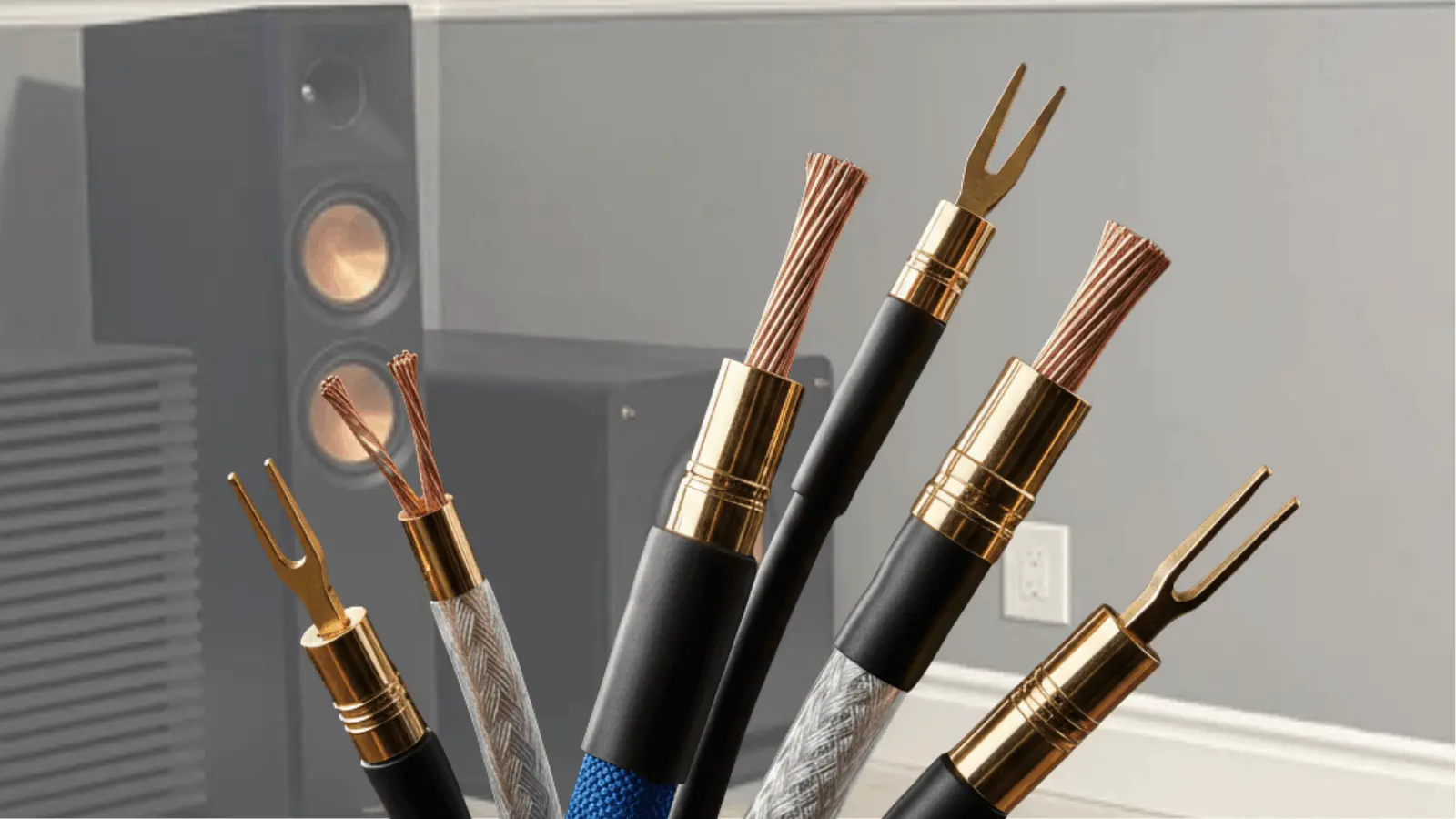
Two cables made from identical copper can still behave differently.
Why?
Because the conductor arrangement affects:
- Inductance
- Capacitance
- Electromagnetic interaction
Design variations include:
- Twisted pairs
- Parallel conductors
- Spaced geometries
- Multi-strand bundles
- Flat ribbon layouts
Wider spacing reduces interaction but may alter coherence.
Tighter geometries increase interaction but improve integration.
There is no single “perfect” design.
There are only engineering trade-offs.
So… Do Speaker Cables Really Change the Sound?
After years of comparative listening and hands-on experimentation, my conclusion is measured:
Yes, under certain conditions, they can.
Not as tone controls.
Not as miracles.
A cable cannot add detail that isn’t in the recording; it can only minimize what is lost between the amp and the driver.
But as subtle, system-dependent variables.
When dealing with:
- High-resolution systems
- 4-ohm loads
- Long cable runs
- High-current amplification
Cable resistance and geometry become part of the audible chain.
The mistake is not skepticism.
The mistake is assuming the system is simpler than it actually is.
Final Thoughts
The debate about speaker cables will likely never disappear. It resurfaces every few months, usually with the same certainty on both sides. One camp insists the matter is closed because the equations appear simple. The other points to the listening experience and system behavior that cannot be dismissed so easily. The truth, as is often the case in audio, lives somewhere in the interaction between theory and practice.
A loudspeaker is not a resistor. It is a moving mechanical system driven by constantly changing electrical signals. An amplifier is not an abstract voltage source. It reacts, it controls, it interacts. And the cable connecting them is not invisible — it becomes part of that relationship, whether we acknowledge it or not.
This does not mean cables are miracle upgrades or tone-shaping tools. It does mean they are electrical components with measurable properties that can influence system behavior under certain conditions. In highly resolving systems, with demanding loads or long cable runs, those properties can move from theoretical to perceptible.
Perhaps the real divide in this discussion is not between believers and skeptics, but between assumption and experimentation. Audio has always rewarded careful listening more than rigid certainty. Before dismissing or defending any position, it may be worth asking a simpler question:
Have I actually tested this in my own system?
Because in the end, reproduced sound is not experienced on paper. It is experienced in the listening chair.