Remember the Marantz NA-11S1? It Was a Digital Music Powerhouse
There was a time when buying a high-end digital music player meant choosing between a dedicated CD player, a computer-based music system, or a separate DAC. Marantz had a different idea. With the NA-11S1, the company set out to bring virtually every important digital playback option into one beautifully engineered component.
Priced at $3,499, the Marantz NA-11S1 was a flagship network audio player, music streamer, and DAC designed for listeners who wanted more from their digital music collections. It supported high-resolution FLAC and ALAC files, offered DSD playback through USB, accepted external digital sources, and even provided access to internet radio and popular streaming services.
Developed as part of Marantz’s Reference range, the NA-11S1 also carried the company’s familiar emphasis on build quality and careful engineering. Manufactured in Japan, it was intended to sit alongside other premium components rather than simply serve as an accessory for a computer-based audio system.
And while its feature list was impressive, the real question was whether the NA-11S1 could deliver the kind of sound quality expected from a $3,500 digital source component.
A Reference Music Player With Ambitious Digital Credentials
I have been impressed by the Marantz SACD players I have reviewed over the years, including the flagship SA-11S3, which offered three digital inputs and competed with source components costing considerably more at its $4,000 price point.
Marantz has continued to explore different approaches to digital playback, as demonstrated by the flagship Marantz SA-10 SACD player and the more affordable Marantz CD6007 CD player. Both offer an interesting perspective on the company’s long-standing commitment to high-quality digital music reproduction.
The company’s integrated amplifiers have also been consistently enjoyable, with models offering different power outputs and feature sets at competitive prices.
Marantz, together with Ken Ishiwata, was also looking toward the next generation of digital playback. Networked audio and music stored on computers and hard drives were becoming increasingly important, and the earlier NA7004 had introduced the company’s approach to standalone DLNA/UPnP-compatible network streaming.
The NA-11S1 took that concept considerably further.
Marantz’s interest in network audio has continued with newer products such as the Marantz Model M1 and Marantz PM7000N, which offer different ways to bring streaming and digital music playback into a modern hi-fi system.
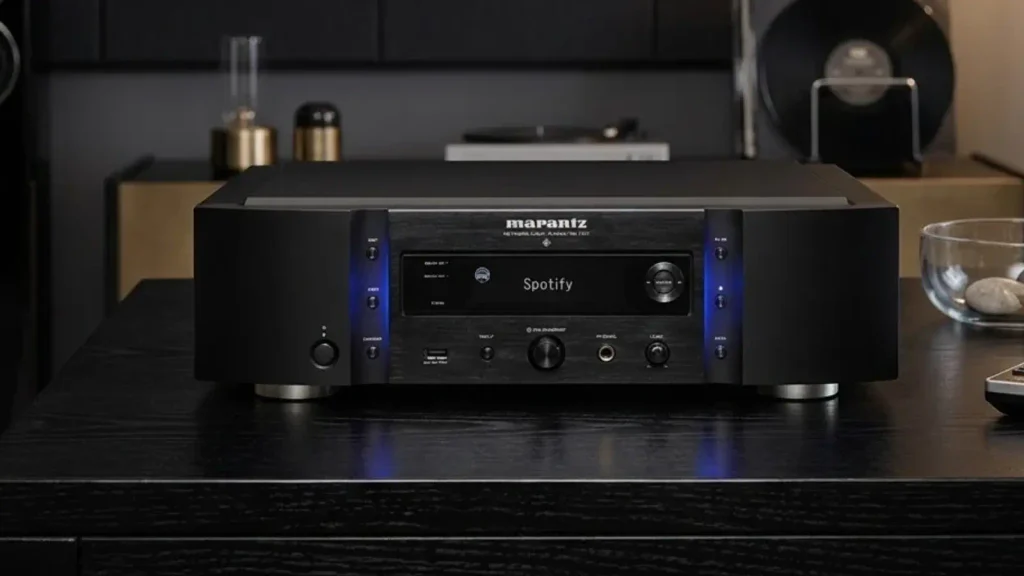
Rather than being just another network streamer, it was designed as a complete digital playback centre. It combined network music playback, a built-in DAC, multiple digital inputs and outputs, USB connectivity, DSD support and a headphone output.
At $3,499, it was clearly aimed at a different audience from entry-level network players.
Connectivity and Supported Music Formats
The NA-11S1 covers an impressive range of digital sources. Connect it to a home network through Ethernet, and it can access music stored on a computer or NAS, supporting WAV, FLAC up to 192 kHz, and ALAC up to 96kHz.
It also handles WMA, AAC, and MP3 files.
AIFF is not specified as a supported network playback format, but it can be played through the rear USB-B connection. This connection is designed for computer-based playback and supports both AIFF and ALAC across their available sample rates.
There is also DSD playback through USB, provided the connected computer is running compatible playback software.
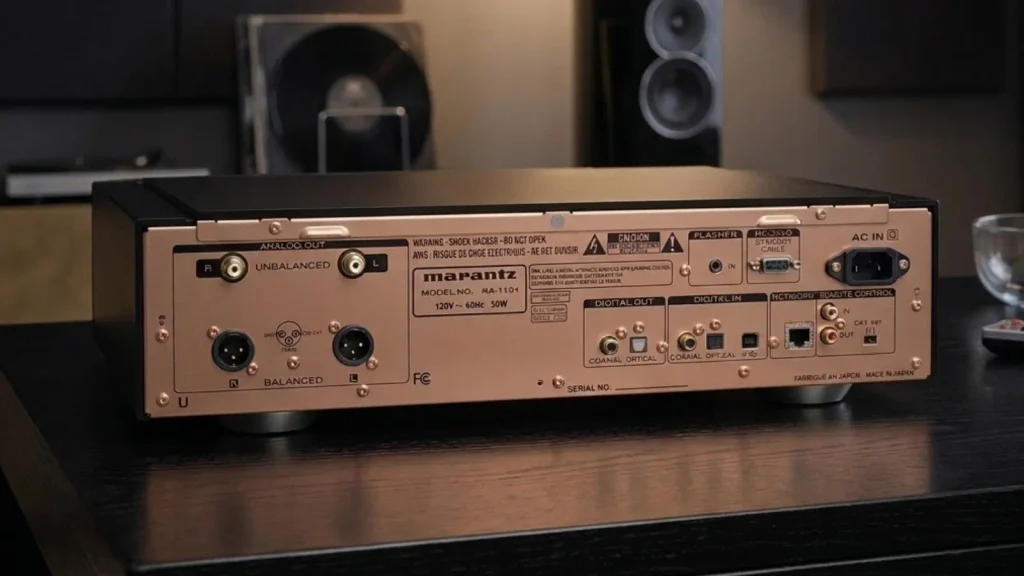
For external digital components, Marantz provides optical, coaxial and USB inputs. A front-mounted USB connection allows listeners to connect portable storage devices, iPods, iPhones and iPads.
The rear USB connection is particularly interesting because it allows the NA-11S1 to function as a high-end USB DAC for a computer.
On the output side, there are S/PDIF digital outputs, balanced XLR and unbalanced RCA analogue connections, plus a headphone jack.
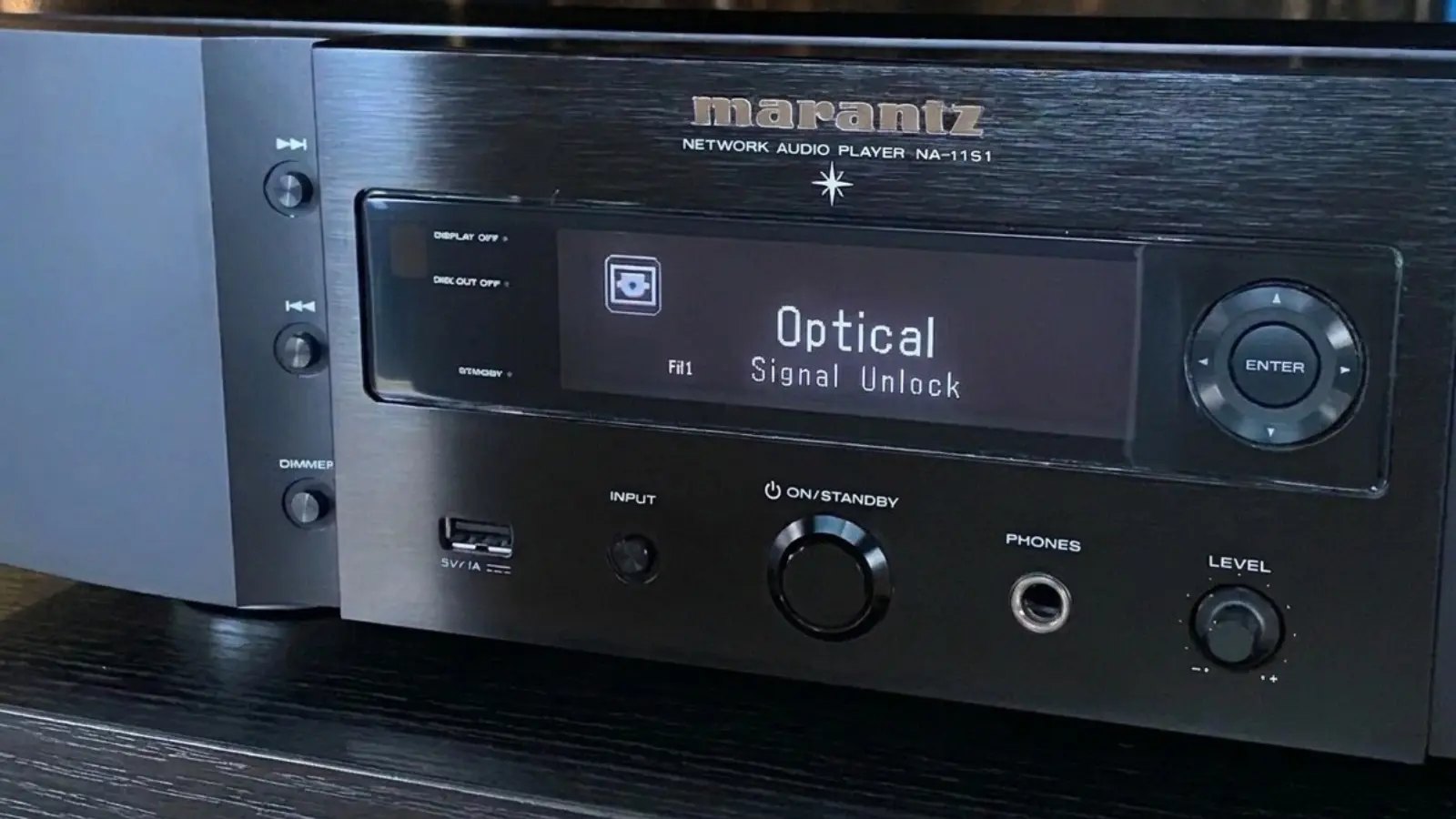
A substantial metal remote control is included. However, because the front-panel display is difficult to read from across a listening room, the Marantz control application becomes the more practical way to browse and manage music. Fortunately, it is a very good application, available for both iOS and Android.
Setting Up the Marantz NA-11S1
Getting the NA-11S1 running as a network player is relatively straightforward, provided you have a few essentials in place.
First, a stable Ethernet connection is required. Secondly, your computer or NAS needs compatible music server software so the Marantz can discover and access your stored music.
I used both Twonky and the freeware MiniMServer, installed on a Mac Mini. The player can also work with JRiver Media Center and other compatible server applications.
Once the NA-11S1 finds your music library, browsing and playback are handled through the Marantz application on a smartphone or tablet connected to the same home network over Wi-Fi.
One important detail is that the NA-11S1 does not have built-in Wi-Fi for network music streaming. Marantz clearly considers Ethernet the preferred connection, offering a more stable approach to network playback.
For my listening sessions, I placed the NA-11S1 on Symposium Acoustics Rollerblock Jr. supports, with a Shakti Stone on top. The system also included an Element Cable Red Storm AC cord, Stager Silver Solid RCA interconnects and a high-quality CAT7 Ethernet cable.
Once everything was connected, the player remained in the system for several months without needing further adjustments.
It never dropped off the network, and even a firmware update during this period took less than 15 minutes to download and install.
After completing the setup, I could choose between two digital audio filters and a DC filter.
How Does the Marantz NA-11S1 Sound?
The NA-11S1’s most impressive quality became apparent when streaming FLAC music over Ethernet.
Regardless of the sample rate, the music gave me the impression that I was hearing deeper into the recording than with almost any other digital source component I had in my system.
There was a level of detail and musical insight that made extended listening particularly enjoyable.
At the time, one of the few comparable products in my experience was the Bryston BDP-1. However, the Marantz offered a rather different proposition, combining network playback with an onboard DAC, multiple digital inputs and outputs, headphone connectivity, and DSD support.
For another perspective on high-end digital playback, our Bryston BCD-3 review explores a dedicated CD player designed for listeners who still appreciate physical music collections and premium digital conversion.
That made it considerably more versatile as a central digital component.
DSD Playback Is Where the Marantz Really Shines
One of the NA-11S1’s most interesting features is its ability to handle DSD files through the rear USB connection.
To explore this, I connected an HP laptop running Windows 7 and JRiver 19 to the Marantz using a KingRex USB cable.
I listened to a variety of DSD recordings from High Definition Tape Transfers, Oppo, Blue Coast Records and several non-commercial recordings.
The results were astonishingly good.
I have previously gone on record describing DSD as the best digital playback has to offer, and the NA-11S1 did little to change that opinion. It handled the recordings beautifully and demonstrated just how capable its USB implementation could be.
The biggest limitation was not the player itself but the relatively small selection of commercially available DSD titles at the time.
Nevertheless, the Marantz really shone with DSD material. For listeners building a high-resolution music collection, this was a particularly compelling feature.
Front USB Playback and Apple Device Compatibility
I also tested the front USB connection with everything from ordinary thumb drives to high-capacity portable hard drives.
This input supports FLAC, WAV, ALAC, WMA, and MP3 files up to 96kHz.
File access was quick, playback was reliable, and the sound quality was excellent.
Interestingly, I preferred the sound of the front USB connection to using my Squeezebox Touch to stream the same files optically into the NA-11S1.
Connecting an iPad or iPod was equally straightforward. With ALAC files loaded, playback was in no way compromised.
Jerry Garcia’s excellent solo album, Reflections, sounded wonderful. The track “It Must Have Been the Roses” was particularly enjoyable, delivering a presentation comparable to what I had heard from several excellent CD players.
Marantz also included AirPlay, allowing users to stream their iTunes libraries wirelessly.
Taken together, the connectivity options made the NA-11S1 an unusually flexible digital source component.
Internet Radio, Pandora and Spotify
The NA-11S1 also offers internet radio and access to several online music services.
Navigating internet radio and Pandora was fun and straightforward. A basic Pandora account was sufficient, while Spotify required a Premium subscription.
I particularly enjoyed exploring internet radio stations from around the world. The selection opened up access to an enormous variety of broadcasts, making it a genuinely entertaining addition to the player.
These features might not be the main reason someone buys a Reference-level Marantz component, but they certainly add to its versatility.
Verdict: Was the Marantz NA-11S1 Worth $3,499?
Very few digital audio components can genuinely offer something for almost every type of listener. The Marantz NA-11S1 came remarkably close.
It combined network streaming, high-resolution file playback, USB DAC functionality, DSD compatibility, removable storage support, Apple device connectivity and multiple digital inputs in one carefully engineered component.
More importantly, it sounded fantastic.
Its lack of built-in Wi-Fi for network music playback might disappoint some users, although AirPlay provides a wireless alternative. Marantz clearly favoured Ethernet as the preferred connection for stable network performance.
The control application was another highlight. Simple, responsive and free of the glitches I encountered with some competing solutions, it made managing a large music library considerably easier.
The NA-11S1 was also built to a very high standard and supported firmware updates, giving it the flexibility to accommodate improvements over time.
At its original $3,499 retail price, this was certainly not an inexpensive way to enjoy digital music. However, for anyone seeking a comprehensive, high-quality digital hub that could handle an impressive range of sources and music formats, the Marantz NA-11S1 made a compelling case for itself.
It was a beautifully executed Reference component, and one I could confidently recommend auditioning.
Pros And Cons:
Pros:
- Excellent sound quality and musical detail
- Supports high-resolution FLAC and DSD playback
- Built-in high-quality DAC
- Solid Japanese build quality
- Easy-to-use control application
Cons:
- No built-in Wi-Fi for network streaming
- Small, difficult-to-read display
- Price
Marantz NA-11S1 Specifications:
| Specification | Details |
|---|---|
| Product type | Network player, music streamer and DAC |
| Model | NA-11S1 |
| Network connectivity | Ethernet |
| Network compatibility | DLNA/UPnP |
| Supported network formats | WAV, FLAC, ALAC, WMA, AAC, MP3 |
| Maximum FLAC resolution | 24-bit/192kHz |
| Maximum network ALAC resolution | 24-bit/96kHz |
| USB computer playback | AIFF, ALAC and DSD |
| Digital inputs | Optical, coaxial and USB |
| Front USB | USB storage and Apple devices |
| Digital outputs | Optical and coaxial S/PDIF |
| Analogue outputs | RCA and balanced XLR |
| Headphone output | Yes |
| Wireless playback | AirPlay |
| Internet services | Internet radio, Pandora, Spotify and SiriusXM |
| Control | Marantz remote application and metal remote |
| Original retail price | $3,499 |