I Finally Heard What KEF’s Reference 5 Can Really Do, and I Wasn’t Ready for It
KEF’s Reference 5 has been the flagship of the company’s passive loudspeaker range since 2014, but the pair KEF sells today isn’t quite the speaker that got reviewed when it launched. In 2022, KEF folded its Metamaterial Absorption Technology — first proven in the LS50 Meta two years earlier — into the Reference and Blade lines, revising how the tweeter handles its own rear wave, shifting the crossover points, and renaming the result the Reference 5 Meta. Here’s what’s actually in the version KEF ships now, and how it differs from the speaker that came before it.
From 207/2 to Reference 5 Meta
KEF’s Reference name dates to 1973, and the company has used it for its most ambitious conventional loudspeaker engineering ever since — everything above it in KEF’s hierarchy is hand-built, low-volume work like Blade and Muon. The architecture underneath today’s Reference 5 arrived in 2014, when KEF retired the older “/2” generation. The outgoing flagship, the Reference 207/2, was a four-way design built around a 250mm lower-midrange driver and a pair of 250mm woofers, standing 1226mm tall on a 400mm-wide cabinet and weighing 66kg. The 2014 platform replaced that with a leaner three-way, four-woofer approach around a smaller Uni-Q array derived from the Blade — taller at 1350mm, but barely a fifth as wide, and 6kg lighter despite the added height.
The Meta refresh in 2022 didn’t touch that basic architecture. What it added was Metamaterial Absorption Technology behind the tweeter, along with a revised crossover.
The Uni-Q Driver and Metamaterial Absorption Technology
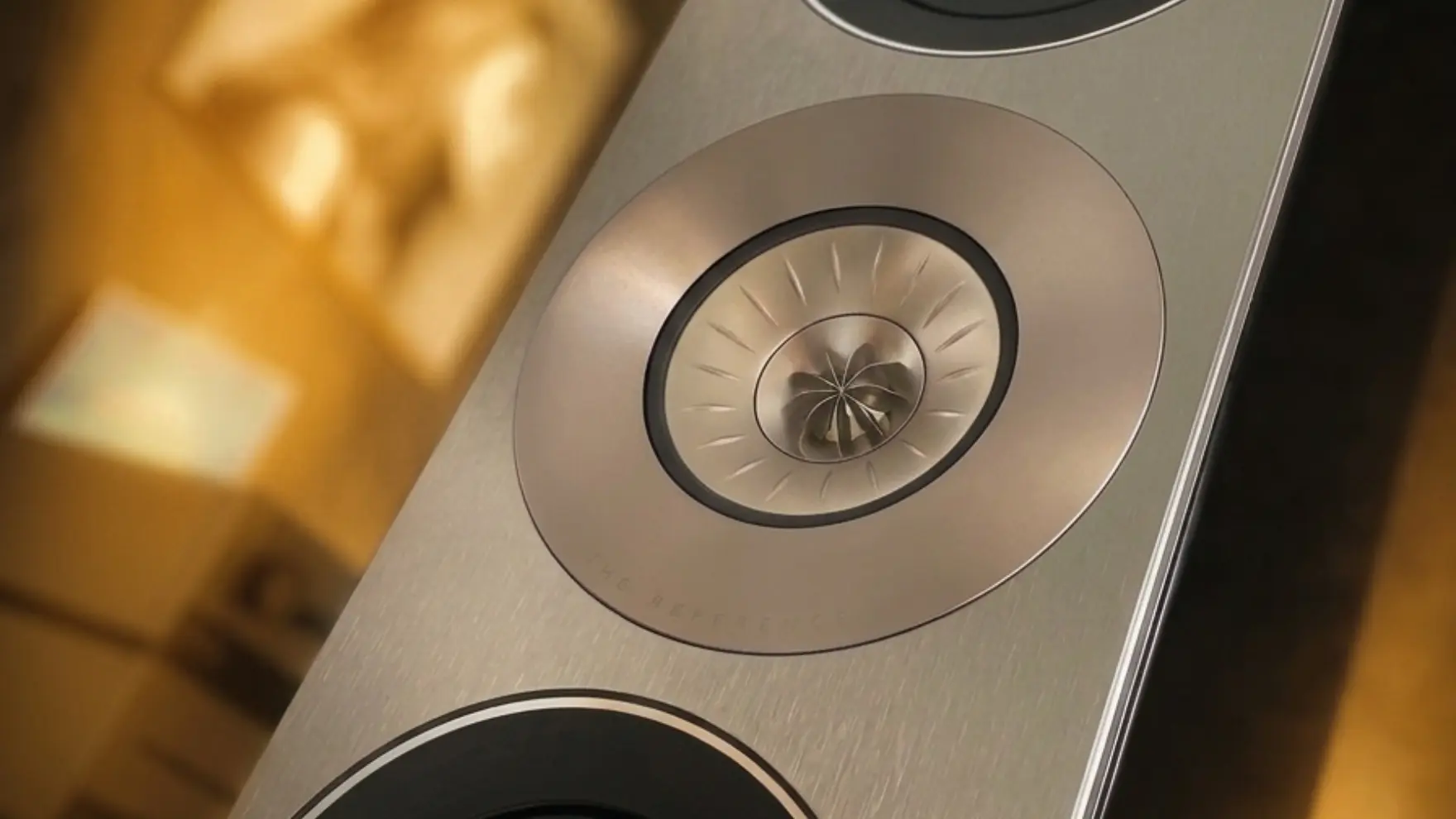
At the center of the baffle sits KEF’s 12th-generation Uni-Q array: a 25mm vented aluminum-dome tweeter mounted coaxially inside a 125mm aluminum-cone midrange, so both drivers share a single acoustic center instead of behaving as two separate sound sources. It’s the same point-source concept KEF has refined for decades, and the reason coaxial KEF speakers are typically singled out for stable, precise imaging — tweeter and midrange output arrive at the listener from effectively the same point in space.
How KEF Fixed the “Dry” Sound of the Q Series with the Q750
What’s new to this generation is what happens behind the tweeter dome. MAT is a maze of roughly thirty channels of differing lengths, tuned to absorb the sound radiating backward off the dome before it can reflect forward and color the treble — KEF claims close to complete absorption above 620Hz. The technology debuted in the LS50 Meta in 2020 before KEF brought it to the Reference and Blade lines in 2022. Fitting it wasn’t a trivial swap: the added mass behind the tweeter was reportedly causing a deformation issue at the tangerine waveguide mount during development, which KEF had to reinforce as part of the update.
Bass: Four Woofers and Adjustable Port Tuning
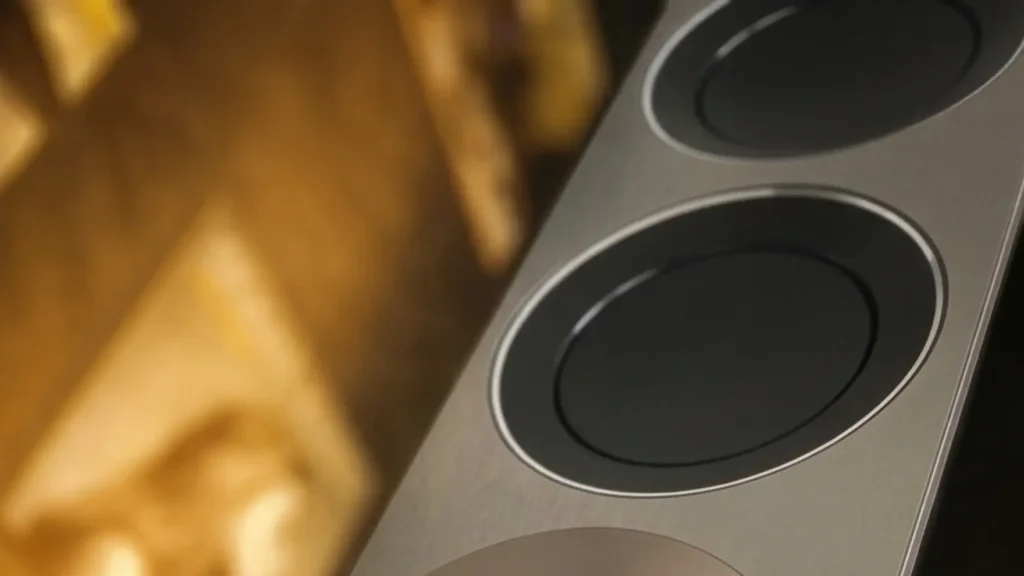
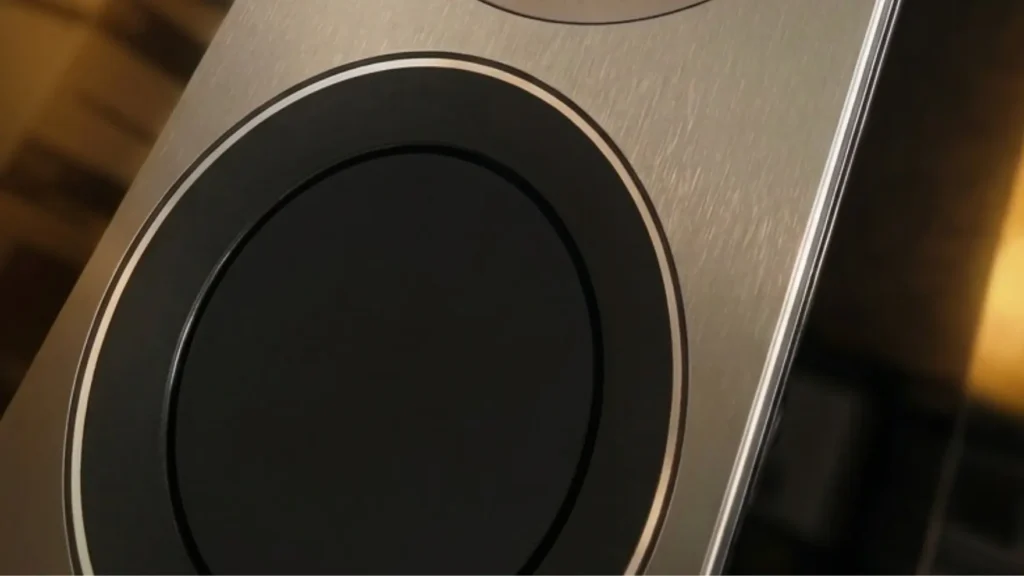
Below the Uni-Q, four 165mm aluminum-cone woofers split into two enclosed chambers, two above the array and two below, in a D’Appolito layout that keeps the acoustic center stable across the woofers’ operating range. KEF fits dual rear-mounted ports with interchangeable lengths, so owners can trade a little low-frequency extension for tighter, more room-friendly bass or the reverse — free-field output reaches roughly 35Hz with the shorter ports or 32Hz with the longer ones (both -6dB), while KEF’s quoted in-room bass response extends to 25Hz. It’s a practical answer to the fact that no single port alignment suits every room, letting a buyer tune the speaker to their space rather than work around it.
A Simplified Three-Way Crossover
The outgoing 207/2 split duties across four ways and three crossover points. The Reference 5 Meta hands everything below 450Hz to the four woofers and crosses to the tweeter at 2.1kHz, leaving the Uni-Q to cover the entire midrange by itself. Fewer transition points generally means fewer opportunities for phase and timing mismatches between drivers — the usual engineering rationale for collapsing a design from four ways to three, and consistent with KEF’s stated approach of removing variables rather than adding them.
Sound Character: What to Expect
A note on sourcing: Ampreviews hasn’t yet logged in-room time with this specific pair. What follows reflects KEF’s stated engineering goals and how outlets with bench access have characterized the Meta version, not an original listening test. We’ll update this section once we’ve spent real time with a pair.
On paper, and by outside accounts, the design is chasing genuine neutrality rather than a house sound — which tracks with how much of the engineering is aimed at removing coloration rather than adding character: the point-source Uni-Q, the heavily damped cabinet, the simplified crossover. Reviews of the Meta refresh have generally described it as highly resolving without tipping into harshness, with the kind of stable, precise imaging you’d expect from a true coaxial point source. What we can’t speak to firsthand yet is how that holds up over a long session in a real room with a specific amplifier — that’s the part no spec sheet or outside review substitutes for, and it’s what we’ll add once we’ve put in the time.
Finishes and Price
The Reference 5 Meta ships in three cabinet finishes — satin walnut, gloss black, and gloss white — paired with driver-ring colors that include silver, copper, and grey (gloss white pairs with a blue driver ring; KEF’s related Reference 1 Meta also offers a champagne option, so it’s worth confirming whether that extends to the 5 before publishing a definitive list). KEF additionally offers Foundry Edition specials in Blue Ice White and Copper Black Aluminum, named for Kent Engineering & Foundry — KEF’s own founding name — rather than tied to any series anniversary.
Pricing at the Meta’s 2022 launch was $22,000/pair. Four years of currency and tariff movement can shift high-end audio pricing meaningfully, so that figure is worth confirming with a dealer before it goes live as a hard number.
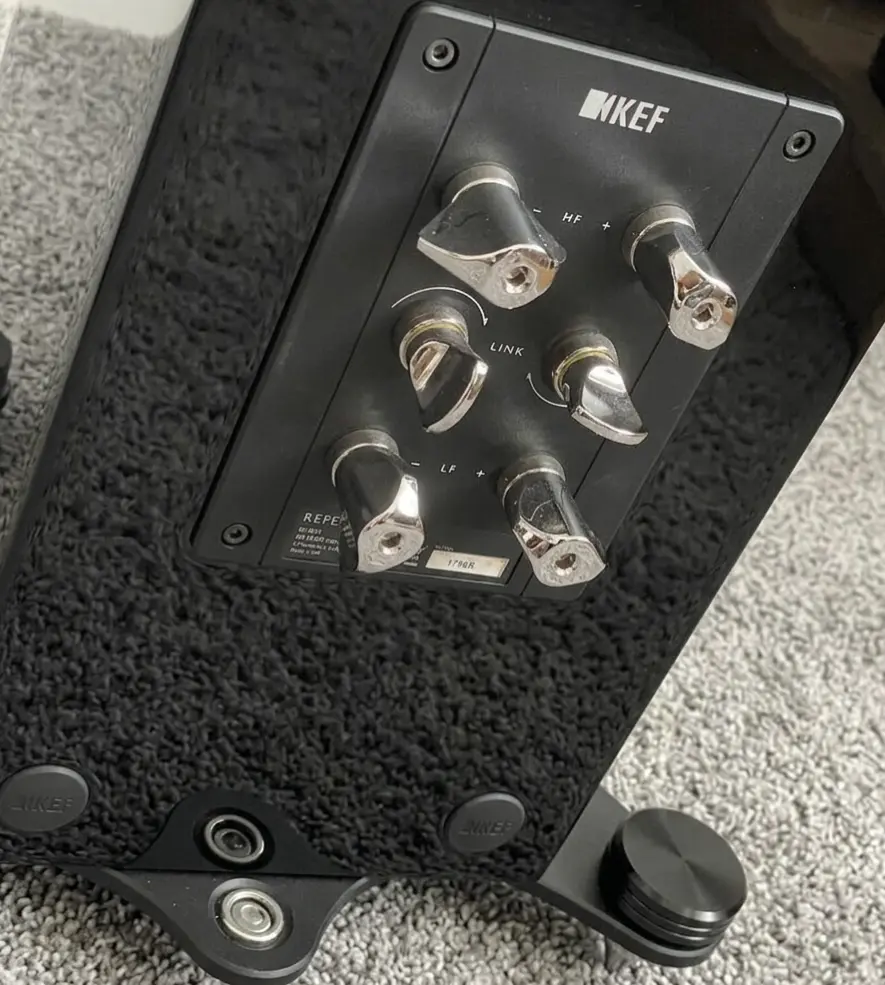
Final Verdict:
The Reference 5 Meta is what happens when KEF applies its newest driver technology to a design language it’s been refining since the 1970s: a tall, narrow flagship built around a single coaxial point source, four woofers, and a crossover pared down to two transition points. It sits below the hand-built Blade and Muon lines in KEF’s hierarchy, but within KEF’s conventional Reference range, it remains the company’s fullest expression of what a passive loudspeaker can do. Whether it earns a place in a specific room and system is the question a spec sheet can’t settle — but the engineering case for it is a strong one.
KEF’s Reference 5 Specifications:
- Configuration: Three-way, six-driver, reflex-loaded floorstander
- Tweeter: 25mm vented aluminum dome with MAT (12th-gen Uni-Q)
- Midrange: 125mm aluminum cone, coaxial with tweeter
- Woofers: Four 165mm aluminum cones
- Crossover points: 450Hz, 2.1kHz
- Frequency response: 40Hz–35kHz (±3dB)
- Sensitivity: 88dB (2.83V/1m)
- Impedance: 4Ω nominal, 3.2Ω minimum
- Recommended amp power: 50–400W
- Weight: 60.2kg (132.7 lb) each
- Dimensions (H×W×D): 1350 × 205 × 462mm with grille and terminal; 1402 × 323 × 467mm with plinth
- Launch price: $22,000/pair (2022 launch — confirm current pricing before publishing)