KEF Q1 Meta Review: Is the $399 Deal Worth It?
Quick take: At full price ($699.99), the Q1 Meta is a good but unremarkable entry in a crowded field. At its frequent street price of $399.99, it’s a different story — KEF’s current 12th-generation Uni-Q driver array and Metamaterial Absorption Technology (MAT), the same core tech used in far pricier speakers, in a small, nicely finished cabinet. The strengths are imaging, vocal placement, and stereo separation; the trade-off is real bass limits from the 5.25-inch driver and a 4-ohm load that rewards a decent amplifier. Best suited to smaller rooms, desktops, or as part of a system with a subwoofer.
Some speakers earn their reputation in review columns. The KEF Q1 Meta has earned much of its reputation somewhere else: in shopping carts.
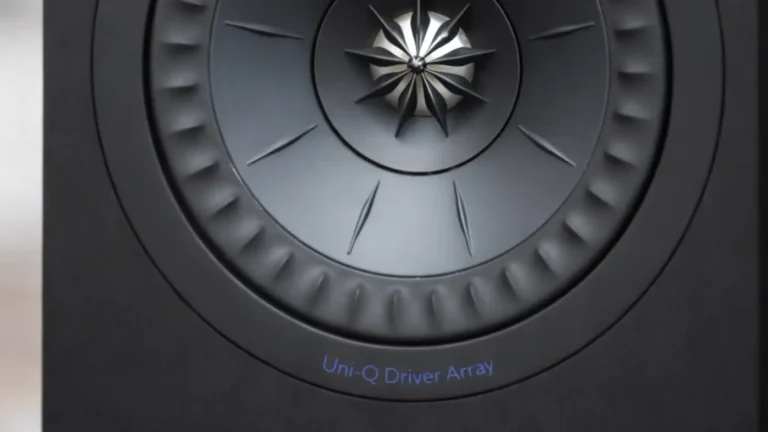
For the past couple of years, this compact KEF bookshelf speaker has repeatedly turned up at around $399.99 a pair in the U.S. — well below its $699.99 list price. That alone gets the attention of anyone shopping for a serious pair of compact speakers, but what makes the Q1 Meta interesting is what’s behind that price. It isn’t an old budget design being quietly cleared out. It carries KEF’s current 12th-generation Uni-Q driver technology and Metamaterial Absorption Technology (MAT) in one of the company’s smallest, most affordable speakers.
That raises a simple question: is the Q1 Meta genuinely an exceptional bargain at $399.99, or has the constant discounting just become part of the Q Series story?
To answer that, I went beyond the usual shopping-page specs and KEF’s own marketing language and worked through the available independent coverage, owner discussions, and manufacturer technical data on the speaker. This piece is built from that research rather than a personal listening session — so the track-by-track notes further down describe what the Q1 Meta’s design and independent listening reports say about how it performs, not a first-hand test in my own room. What emerged was a fairly consistent picture of a compact loudspeaker with one particular talent: pulling the listener’s attention away from the box and toward the music.
A familiar KEF playbook
If you’ve followed KEF for any length of time, the Q1 Meta story feels familiar.
The Q150 built a reputation as the speaker you waited to buy on sale. Its $599.99 list price was regularly undercut by much lower street prices, and the pair dropped toward $300 more than once between 2021 and 2024 — enough that it became one of those budget recommendations that seemed to come up in every audiophile discussion.
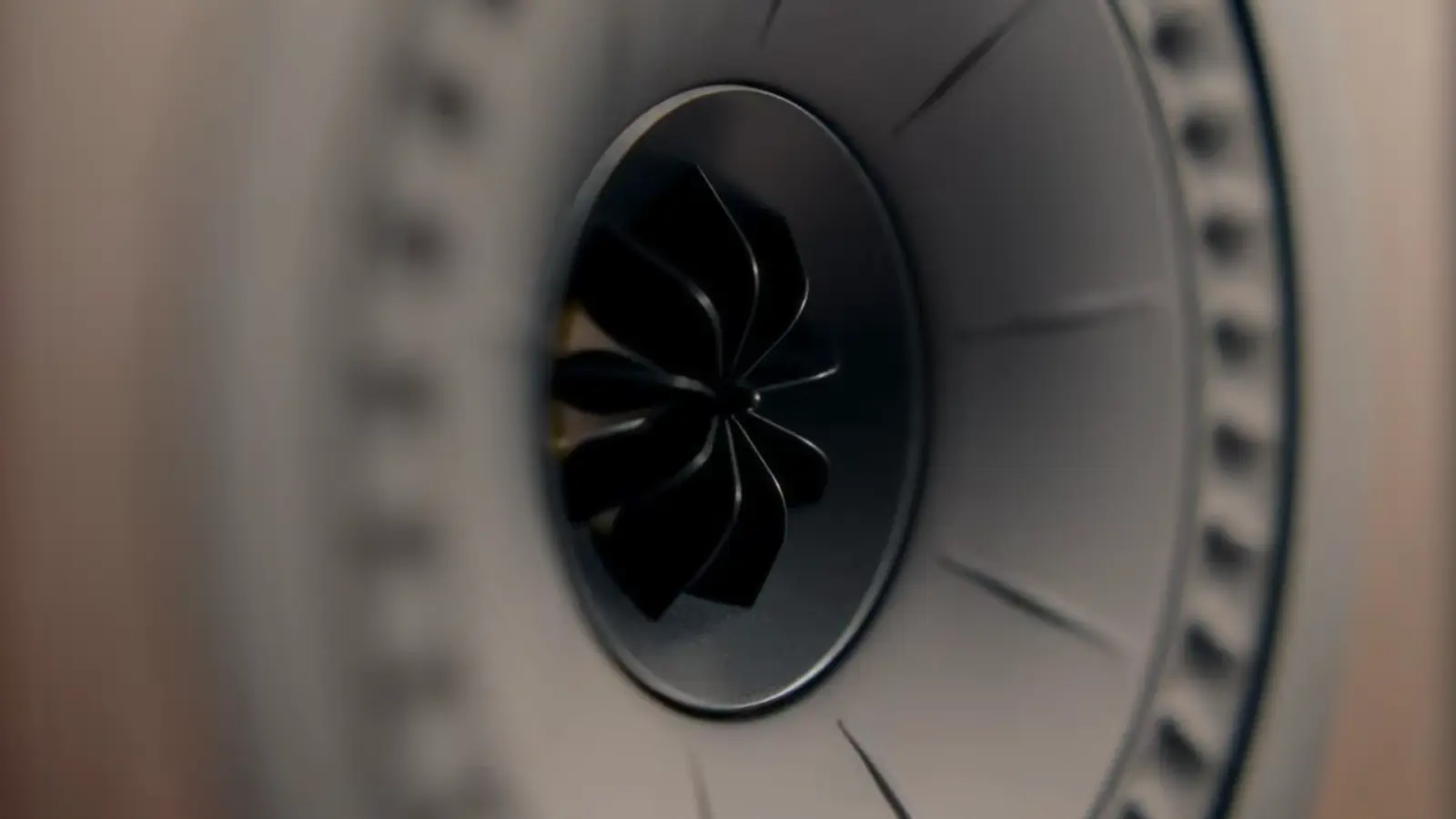
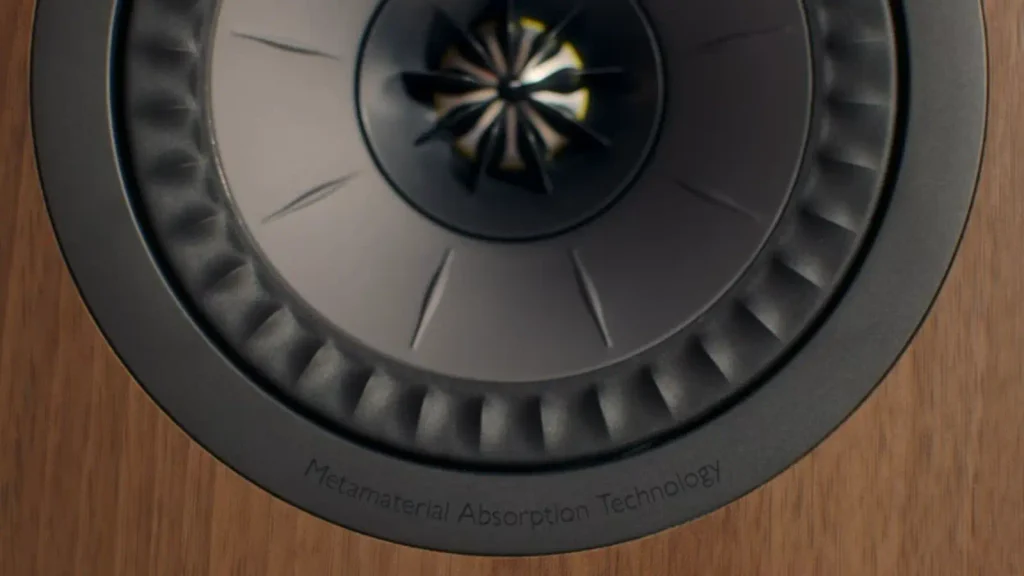
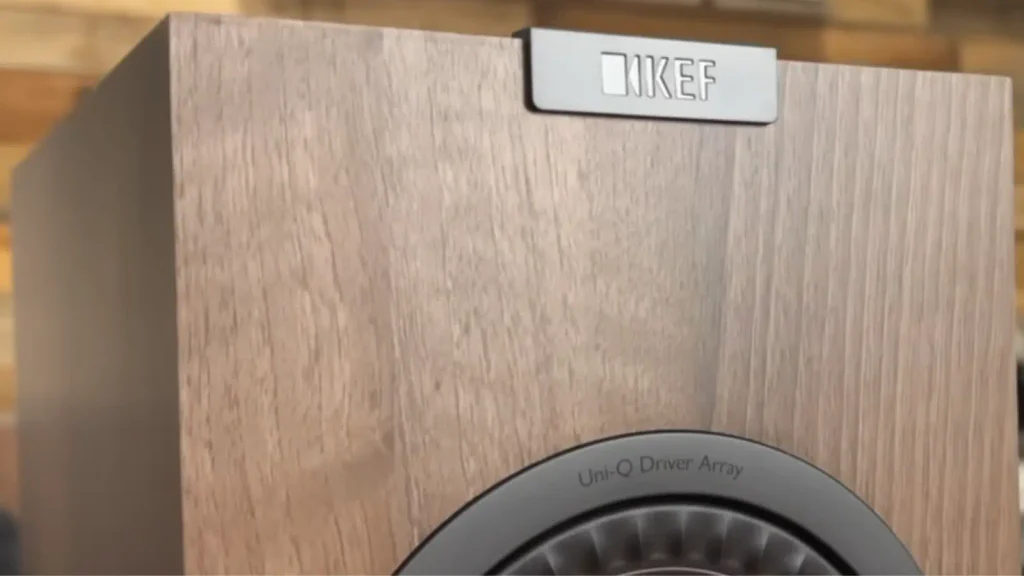
The Q1 Meta is the next generation of that idea, built around noticeably more advanced hardware. Introduced in late 2024 as part of KEF’s redesigned Q Meta series, it officially replaced the Q150 and brought KEF’s 12th-generation Uni-Q driver array together with MAT to this price point for the first time. The Uni-Q arrangement places the tweeter at the acoustic centre of the mid/bass driver, while MAT is designed to absorb unwanted rearward radiation from the back of the tweeter — KEF states that its metamaterial structure absorbs 99 percent of that unwanted sound.
Finding that kind of technology in a speaker that regularly sells for less than $400 is worth pausing on. MAT wasn’t developed as a cheap trick for the Q Series — it appeared in considerably more expensive KEF designs first, before working its way down the range. That gives the Q1 Meta a slightly unusual proposition: it looks like an entry-level bookshelf speaker, but some of the engineering underneath comes from much higher up KEF’s catalogue. It’s probably the first thing worth remembering when you see the Q1 Meta sitting on a dealer’s shelf.
Small box, Serious Engineering
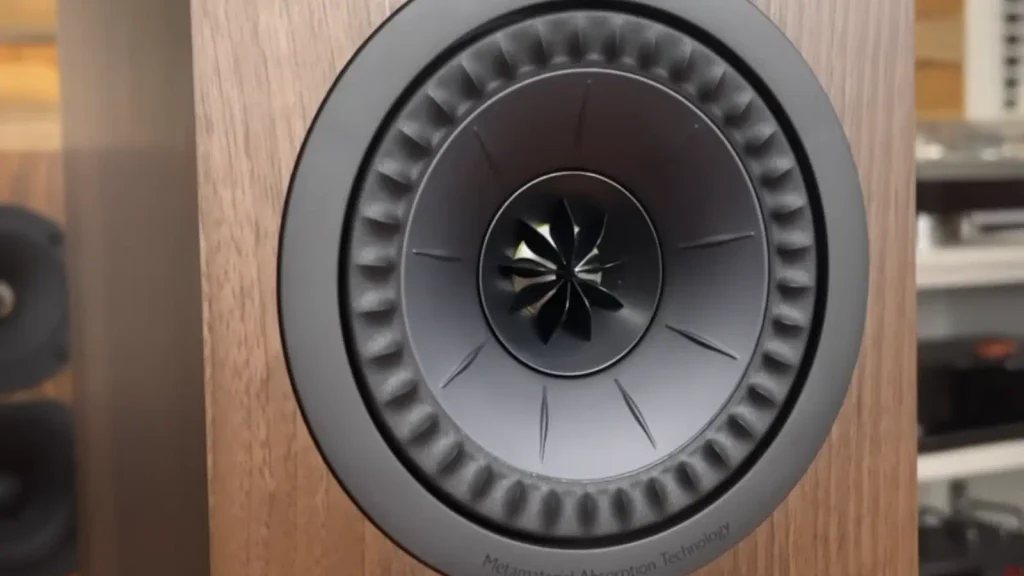
The Q1 Meta is a compact two-way bass-reflex design (full specs in the table above), with a crossover set at 2.1kHz between the 5.25-inch aluminium mid/bass driver and the 1-inch vented aluminium dome tweeter integrated into the Uni-Q array.
On paper, those are respectable numbers for a cabinet this size — though they’re worth interpreting realistically. A 5.25-inch bookshelf speaker is still a 5.25-inch bookshelf speaker, and no amount of engineering changes how much air that small driver can move. The Q1 Meta produces useful bass, but it isn’t meant to replace a serious floorstander for deep, physical low-frequency energy.
What it does have going for it is where KEF concentrated its engineering budget. The Uni-Q arrangement is about more than placing two drivers in the same spot — it’s built to act as a coherent acoustic source with broad, consistent dispersion, while MAT handles the unwanted energy produced behind the tweeter.
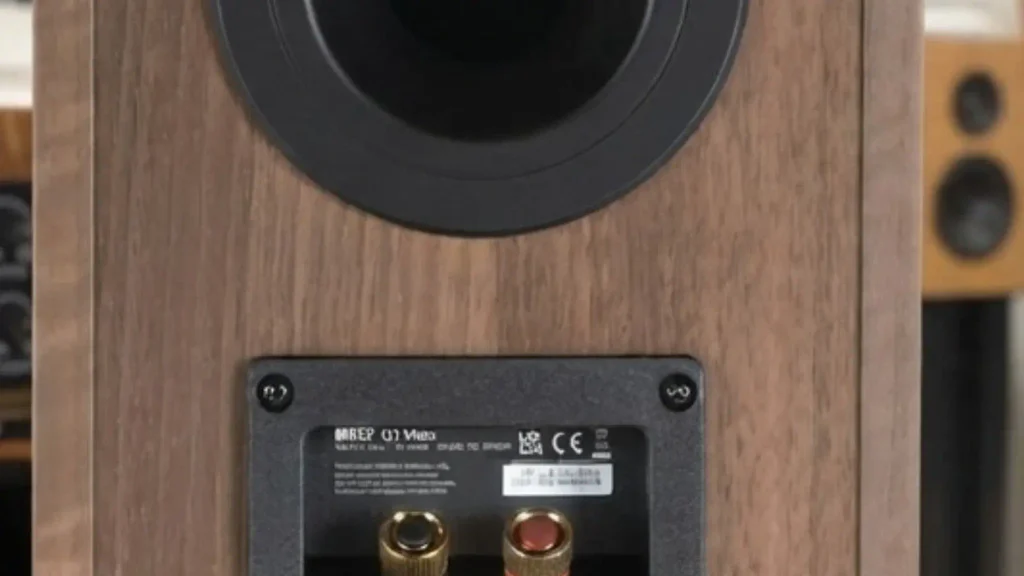
The cabinet holds up its end too. All three finishes — Satin Black, Satin White, Walnut — have rounded edges that look more refined than the price suggests, and magnetic grilles, port bungs, and rubber feet are all included. At 6.1kg (13.4 lbs) per speaker, there’s enough physical substance that it doesn’t feel like a lightweight budget box.
One spec is worth paying close attention to before building a system around it: sensitivity sits at 86dB with a 4-ohm nominal impedance (dropping to a minimum of 3.2 ohms), and KEF recommends 10 to 150 watts of amplification. None of that demands a huge power amplifier — it just means the amplifier deserves some thought. A decent integrated amp comfortable with a 4-ohm load handles normal use fine; a weak amplifier pushed hard into these speakers is a less attractive combination.
Where the Q1 Meta really makes its case
The most consistent observation across the available listening reports is clarity — which isn’t a huge surprise, given KEF has spent decades refining the Uni-Q concept and the Q1 Meta is a compact expression of that same philosophy.
The first thing listeners tend to notice isn’t enormous bass or aggressively bright treble. It’s the sense that individual elements of a recording occupy their own space: vocals sitting firmly between the speakers, acoustic instruments staying separated rather than blurring into a single mass, and stereo information that remains easy to follow even off-centre.
That’s the physical design and the listening impression lining up: the Uni-Q array is doing what KEF built it to do, and MAT is keeping the tweeter’s unwanted rearward energy under control. The result is a presentation weighted toward clean detail and stable imaging rather than warmth or weight.
It won’t flatter every recording, though. A clean, revealing presentation has a side effect — poor recordings stay poor recordings. Load up a lot of aggressively mastered material, and the Q1 Meta won’t smooth it over into something pleasant. Listeners after a thick, warm, deliberately forgiving sound — the classic “British bookshelf” stereotype — may find the Q1 Meta’s priorities of clarity and spatial precision over warmth run in a different direction.
Putting music through the Q1 Meta
A speaker like this makes more sense once you move past the spec sheet and consider what happens with real recordings. The impressions below draw on the same pool of independent listening reports referenced throughout this piece, applied to five familiar tracks that tend to expose different things in a compact speaker — rather than a first-hand session in my own room.
Norah Jones’ “Don’t Know Why” is a natural place to start: a beautifully recorded, sufficiently sparse vocal track that makes the centre image easy to judge. The voice should sit naturally between the two speakers, with the guitar, piano, and surrounding ambience staying distinct rather than collapsing into the vocal — exactly the kind of recording the Q1 Meta’s Uni-Q architecture is suited to, with the vocal taking its proper position without erasing what’s around it.
Nick Drake’s “Pink Moon” tells a different story. There’s very little production to hide behind, so the guitar, vocal, and room ambience effectively are the performance — which is where the Q1 Meta’s ability to separate small details becomes most apparent, without making the recording feel artificially dissected.
Move to something denser and Dire Straits’ “Money for Nothing” puts far more information through the system: guitar, percussion, vocals, and dense production all competing for space. This is where imaging matters most, keeping the arrangement easier to follow even as the recording gets busier.
Then comes the inevitable bass test. Daft Punk’s “Get Lucky” exposes the Q1 Meta’s physical limits faster than its specifications suggest. The bass is there, and the small KEF keeps it reasonably controlled, but there’s a point — well short of what a subwoofer-equipped system could deliver — where the driver’s limits stop being something you notice and start being something you feel.
That’s where a subwoofer changes the conversation. Handing off the deepest bass frees the Q1 Meta to concentrate on midrange and upper bass, and with the crossover set correctly, the small KEF starts to feel less like a speaker straining to do everything and more like one part of a complete two-channel system — a combination that makes a lot of sense for a compact setup.
The Q1 Meta needs the right system around it
It’s worth resisting the temptation to pair the Q1 Meta with an enormous stack of electronics just because KEF put sophisticated technology inside the cabinet. Something like the Cambridge Audio CXA81 Mk II makes more sense: enough power for a compact speaker like this, while keeping the system proportionate. A WiiM Pro Plus can handle streaming duties without turning the source into the most expensive part of the setup.
If deeper bass matters, adding an SVS SB-2000 Pro changes the character of the system substantially — the Q1 Meta stays on proper stands while the subwoofer takes over the lowest frequencies.
Give the KEFs some breathing room rather than pushing them against a wall; 20 to 30 inches from the front wall is a reasonable starting point, adjusted from there according to the room, with a modest amount of toe-in to begin. The Uni-Q array’s dispersion means you don’t need to aim the speakers aggressively at your ears — which is also why the Q1 Meta makes sense beyond a traditional two-channel listening room. A desktop, bedroom, or surround system can benefit from the same broad-dispersion characteristics without needing a large listening space.
Q1 Meta versus Q150
The Q150 is the comparison that refuses to go away.
It was one of KEF’s most successful entry-level models, and its sale prices became almost as famous as the speaker itself — regularly dropping into the $280–$350 range over its life, against a $599.99 list price. Even today, a heavily discounted used or new-old-stock Q150 can complicate what looks like a simple decision.
The Q1 Meta is more than a cosmetic update, though. It brings a newer generation of the Uni-Q array, adds MAT, and updates the cabinet details, with magnetic grilles included as standard. Owners and reviewers comparing the two directly have also reported gains in detail retrieval and vocal dynamics.
One genuine difference worth knowing before you upgrade: the KEF Q150 runs an 8-ohm nominal load, while the Q1 Meta drops to 4 ohms (minimum 3.2 ohms). That’s not a downgrade exactly, but it does mean an amplifier that coasted with a pair of Q150s may work noticeably harder with the Q1 Meta.
None of this makes every Q150 obsolete — a good pair bought cheaply can still make sense. But once the Q1 Meta reaches its common $399.99 street price, the gap between the old bargain and the new generation narrows enough that the newer technology is hard to pass up.
Q1 Meta versus Q3 Meta
The Q3 Meta is where things change.
Its larger 6.5-inch (165mm) mid/bass driver — versus the Q1 Meta’s 5.25-inch (130mm) — gives it more physical scale and deeper bass reach, along with a bump to 87dB sensitivity and a wider 15–150W amplifier range. That makes it the more obvious choice for a larger room without a subwoofer.
Choosing between them isn’t simply a matter of picking the bigger speaker, though. On a desktop, in a bedroom, in a smaller listening room, or as part of a surround setup, the Q1 Meta’s compact footprint is an advantage in its own right. And if a capable subwoofer is already part of the system, the case for the larger Q3 Meta gets weaker — the Q1 Meta gives you the same current Uni-Q and MAT technology without the bigger cabinet.
For the right room, that’s a compelling trade.
Where the Q1 Meta falls short
The biggest limitation is straightforward: bass. A 5.25-inch driver can’t move the amount of air needed to fill a large room with deep, physical low frequencies unassisted — larger bookshelf speakers and floorstanders will always have the advantage there.
The second consideration is amplification. On their own, 86dB sensitivity and a 4-ohm nominal impedance (minimum 3.2 ohms) aren’t alarming numbers, but they do mean the amplifier deserves more thought than it would with a more efficient 8-ohm speaker.
And the Q1 Meta simply isn’t voiced for listeners chasing a soft, warm, romantic sound. Its strengths are clarity, separation, and imaging — if those are what you value, the personality makes sense. If you’d rather a speaker rounded off aggressive recordings and added warmth to everything you played, there are better-suited options elsewhere.
Pros and Cons
Pros:
- Current 12th-generation Uni-Q array and MAT — technology shared with far pricier KEF speakers
- Standout imaging, vocal placement, and stereo separation for a $399.99–$699.99 speaker
- Nicely finished cabinet (Satin Black, Satin White, Walnut) with magnetic grilles included
- Broad, even dispersion suits off-axis seating, desktops, and small rooms
- Frequent discounting to ~$399.99 undercuts most rivals with comparable driver technology
Cons:
- 5.25-inch driver has real bass limits; needs a subwoofer for deep, physical low end
- 4-ohm nominal (3.2-ohm minimum) load makes amplifier choice more important than with an 8-ohm design
- Clean, revealing balance won’t flatter poorly mastered recordings
- Not the right choice for listeners who want a warm, forgiving sound signature
- The deal depends on catching a discount — walnut and full-price stock sit at $699.99
So why does the $399 price matter so much?
This is really the interesting part of the Q1 Meta story.
At $699.99, the speaker enters a crowded market full of capable bookshelf speakers competing for the same buyers. At its common $399.99 street price, the conversation changes: now it’s a compact KEF with the company’s latest Uni-Q architecture and MAT technology, in a properly finished cabinet, selling for less than most people would expect given what’s inside it.
That’s not to say there’s nothing else worth buying at $399.99 — there is plenty. But the Q1 Meta’s specific combination is hard to reproduce elsewhere: KEF’s coaxial driver architecture, MAT, compact dimensions, and a well-known brand name, all arriving together once the price drops into budget territory.
That’s also why the repeated discounting is more interesting than it first looks. It doesn’t necessarily mean the speaker is struggling to sell. It may just mean KEF has a clear read on exactly where the Q Series moves best.
Conclusion:
The KEF Q1 Meta isn’t a miracle speaker, and it doesn’t pretend to be one. A 5.25-inch driver isn’t going to substitute for a floorstander; room-shaking bass still requires help, and a weak amplifier is still a weak amplifier. What the Q1 Meta actually offers is more useful than any of that: KEF’s familiar Uni-Q concept, MAT technology, and a compact, nicely finished enclosure, all wrapped up in a price that regularly drops low enough to make the whole package hard to ignore.
At $699.99, the Q1 Meta is a solid compact bookshelf speaker in a very competitive class. At its common street price of $399.99, it’s a different proposition entirely. Pair it with a capable amplifier, give it some room to breathe, and add a subwoofer if your music demands real low-frequency weight — and the Q1 Meta can anchor a genuinely serious compact system.
Maybe that’s the real reason these speakers keep finding their way into shopping carts. Not because they’re perfect. Because when KEF puts this much of its current engineering into a speaker this small, and then drops the price to $399.99, the Q1 Meta becomes the sort of speaker that makes you stop comparing specifications and start thinking about where you can put a pair.Kef
KEF Q1 Meta Specifications:
| Spec | KEF Q1 Meta |
|---|---|
| Design | Two-way bass reflex |
| Tweeter | 1 in. (25mm) vented aluminum dome, 12th-gen Uni-Q, with MAT |
| Mid/bass driver | 5.25 in. (130mm) aluminum cone |
| Crossover frequency | 2.1 kHz |
| Frequency response (±3dB) | 51 Hz – 20 kHz |
| Frequency range (-6dB) | 47 Hz – 20 kHz |
| Typical in-room bass (-6dB) | 42 Hz |
| Sensitivity | 86 dB (2.83V/1m) |
| Impedance | 4 ohms nominal, 3.2 ohms minimum |
| Recommended amp power | 10 – 150 W |
| Harmonic distortion (90dB/1m) | <2% from 140 Hz up; <1% from 170 Hz – 20 kHz |
| Max output | 108 dB |
| Weight | 13.4 lbs (6.1 kg) per speaker |
| Dimensions (H x W x D) | 11.9 x 7.1 x 10.9 in. (302 x 180 x 277 mm) |
| Finishes | Satin Black, Satin White, Walnut |
| List price | $699.99/pair |
| Common street price | ~$399.99/pair (varies by finish and retailer) |
| Released | Late 2024, as part of the Q Meta series refresh |