Why the KEF Q500 Still Matters: Inside KEF’s Most Important Q Series Redesign
Some speakers arrive with hype. Others arrive with ideas that shape what comes next. The KEF Q500 belongs firmly in the second group.
When KEF introduced the Q500, it marked a decisive turning point for the Q Series. The name remained familiar, but the engineering philosophy behind it had undergone a shift. This generation was not about cosmetic refinement—it was about rethinking cabinet architecture, bass loading, and the Uni-Q driver itself.
Check Out: Kef Q150 Review
Development spanned more than two years and resulted in a comprehensive nine-model lineup. With hindsight, it’s clear that this redesign laid important groundwork for KEF’s later thinking. The Q500, the smallest floorstander in the range, remains one of the clearest expressions of that moment.
A Cabinet Redesign That Actually Changed the Outcome
The most obvious departure from earlier Q models is the enclosure. KEF abandoned the curved rear panels of previous generations and returned to a classic rectangular cabinet. Visually, it’s more restrained. Acoustically, it’s far more purposeful.
With the same footprint, the simpler geometry increases internal volume by nearly 30%. That extra air volume is not a marketing footnote—it directly contributes to deeper bass extension and lower distortion without aggressive tuning. This single decision explains much of the Q500’s sonic character.
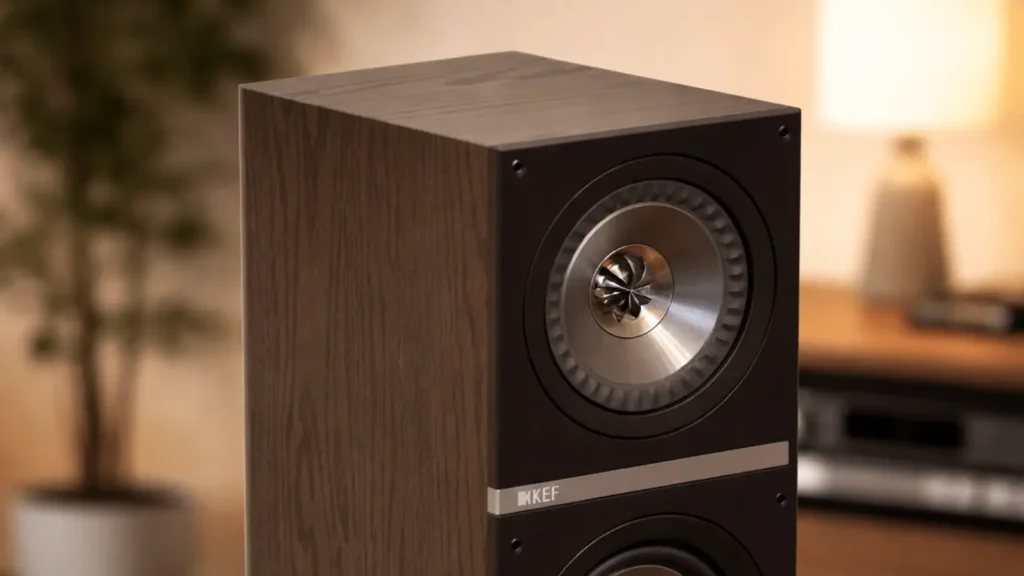
Remove the grille, and it becomes clear that the redesign went far beyond the box.
ABR Bass: Why Passive Radiators Matter Here
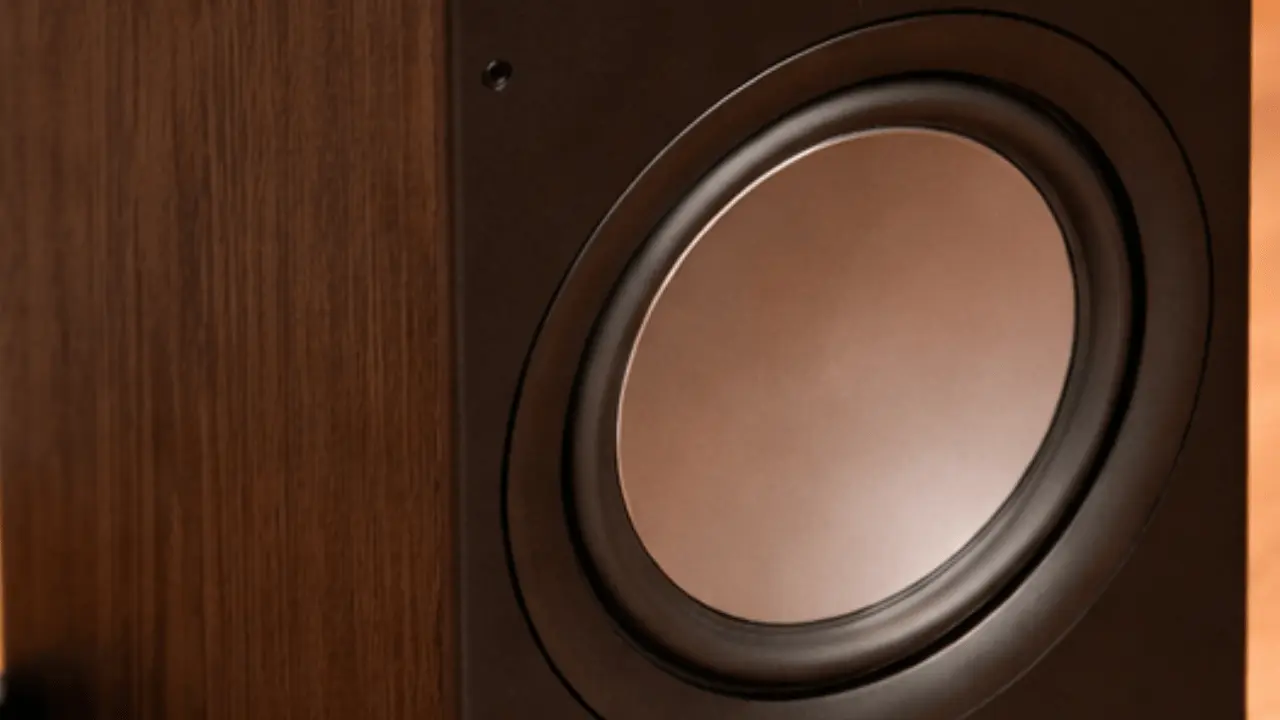
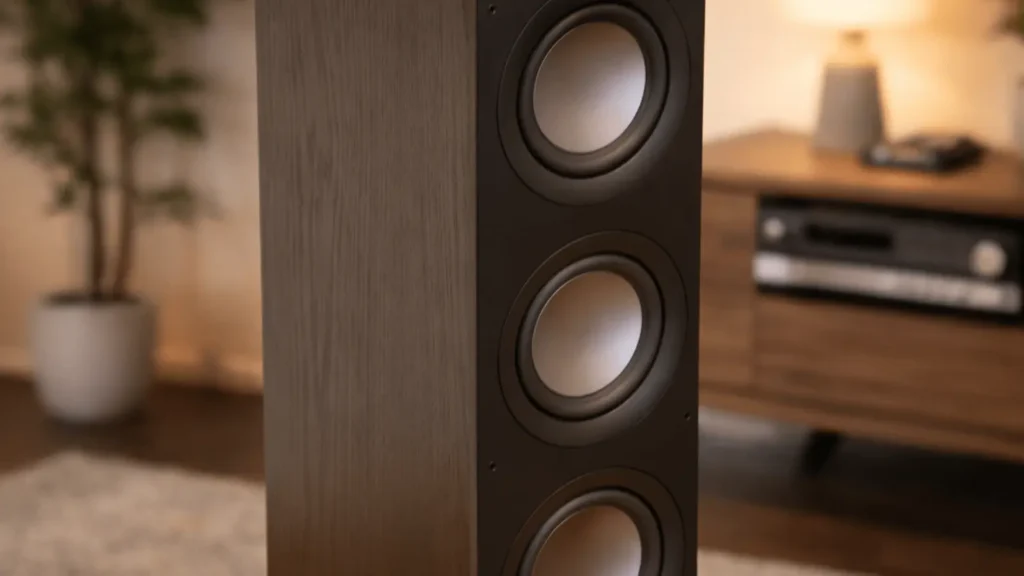
Low frequencies are handled by three 13 cm drivers: one active woofer and two passive radiators. KEF’s Auxiliary Bass Radiator (ABR) system replaces a traditional bass-reflex port, and the advantages are easy to hear.
Compared to ported designs, the ABR approach delivers:
- Faster transient response
- No port turbulence or “chuffing.”
- Cleaner decay
- Lower effective resonant frequency
Crucially, the entire bass system is housed in its own isolated internal chamber, preventing interaction with the Uni-Q driver above. The cones themselves use aluminum-coated cellulose in an inverse-dome profile, combining stiffness, low mass, and effective resonance damping.
The result is bass that is generous but controlled—powerful without becoming loose or overblown.
Uni-Q, Evolved Without Losing Its Identity
The Uni-Q driver has always been KEF’s signature, but in the Q500 it reached a new level of refinement.
The tweeter is derived from KEF’s higher-end designs and features:
- A 25 mm dual-layer dome (larger than earlier Q models)
- A stronger magnet system
- Rear venting to reduce distortion
Dispersion is managed by the Crown Wave Guide, while the flat Z-flex surround minimizes diffraction. The visible transverse ribs allow a shallower surround profile, ensuring the tweeter’s output remains unobstructed.
The midrange cone uses titanium-coated aluminum, a lightweight aluminum voice coil, and a magnet assembly roughly twice the mass of its predecessor. Together, these changes finally eliminate the subtle horn-like coloration that once divided opinion around older Uni-Q implementations.
Smarter Crossovers, Not More Parts
Improved driver modeling allowed KEF to simplify the crossover network rather than complicate it. High-quality film capacitors and coreless inductors are used throughout, preserving transparency without inflating cost.
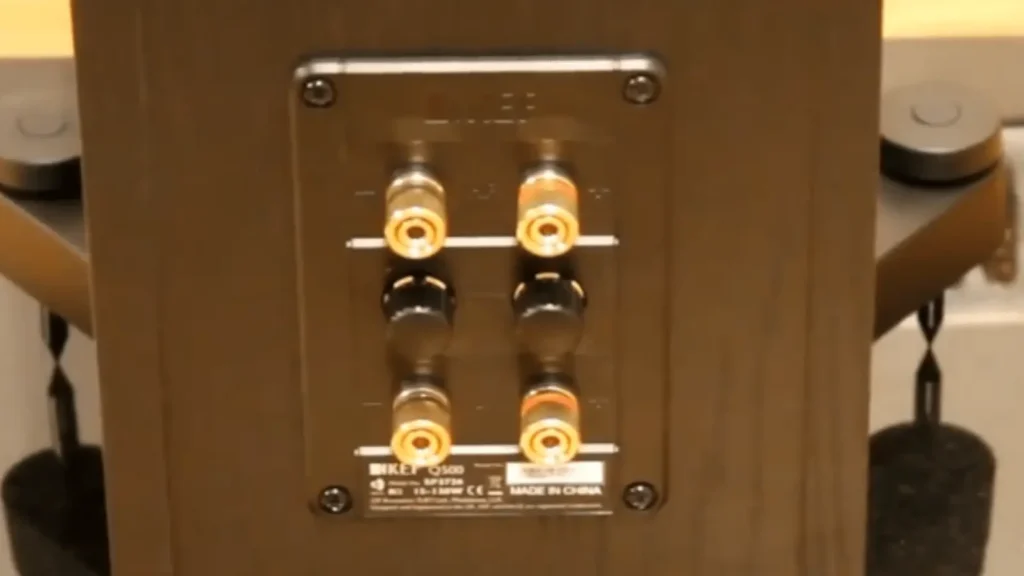
Around the back, four binding posts are connected by captive screw-type shunts instead of traditional jumpers. When bi-wiring, the shunts are completely removed, ensuring long-term contact integrity. Plastic feet with integrated spikes provide basic but effective floor decoupling.
Listening: When the Speakers Step Aside
After a short warm-up period, the Q500’s defining strength becomes obvious: spatial realism.
On well-recorded material, the speakers seem to dissolve into the room. Images float freely, detached from the enclosures, forming a soundstage that extends well beyond the speaker line. Careful placement matters—early reflections play a role—but once optimized, the three-dimensional effect is striking.
Percussion recordings are particularly revealing. Drum strikes occupy precise positions in space, while cymbals bloom with layered reverberation that feels naturally suspended rather than artificially etched.
This is where the Uni-Q concept pays off: coherence across the frequency range translates directly into believable spatial cues.
You May Like: Kef Q750 Review
Bass Balance: Powerful, With a Caveat
Bass quality is one of the Q500’s strongest assets. It is fast, textured, and free from the overhang often associated with ported enclosures.
With large orchestral works or big-band jazz, however, the tonal balance can tilt slightly downward. In home-theater setups, limiting the front channels to 60–70 Hz avoids overlap with a subwoofer. In two-channel systems, gentle tone-control adjustment—if available—can restore perfect balance.
The key point is this: the bass is never sloppy, only generous.
Measurements That Back Up the Experience
Objective data aligns closely with what you hear:
- Frequency response remains within ±3 dB across most of the range
- Off-axis dispersion stays impressively linear out to 50 degrees
- Real-world sensitivity is closer to 90 dB, higher than the published figure
Impedance behavior is well controlled, making the Q500 easier to drive than its specifications suggest. In practical terms, a clean 50 watts per channel is sufficient to energize a medium-sized room.
Why the Q500 Still Matters
The KEF Q500 was never designed to shock on first listen. Instead, it focuses on coherence, spatial accuracy, and long-term musical engagement—qualities that age far better than exaggerated detail or headline-grabbing bass.
By rethinking cabinet volume, isolating the bass system, and refining the Uni-Q driver, KEF created a floorstander that quietly influenced what followed. Even today, it stands as a reminder that thoughtful engineering—not novelty—defines lasting loudspeaker design.
For listeners who value soundstage realism and tonal balance over short-term spectacle, the Q500 remains an intelligently conceived and deeply satisfying loudspeaker.
KEF Q500 Specifications
| Specification | Details |
|---|---|
| Type | 2.5-way floorstanding loudspeaker |
| Drive Units | 1 × 130 mm Uni-Q midrange with 25 mm aluminum dome tweeter, 1 × 130 mm active bass driver, 2 × 130 mm passive radiators (ABR) |
| Acoustic Design | Auxiliary Bass Radiator (ABR) |
| Frequency Response | 40 Hz – 40 kHz (±3 dB) |
| Sensitivity | 87 dB (2.83 V / 1 m) |
| Nominal Impedance | 8 Ω (minimum ~4 Ω) |
| Crossover Frequency | 2.5 kHz |
| Maximum SPL | 110 dB |
| Recommended Amplifier Power | 15 – 130 W |
| Cabinet Construction | MDF cabinet with internal bracing |
| Terminals | Bi-wire / bi-amp capable, gold-plated binding posts |
| Dimensions (H × W × D) | 870 × 180 × 272 mm |
| Weight | Approx. 14.5 kg per speaker |
| Finish Options | Maple, Cherry, Oak |
| Country of Manufacture | China |
| Original Price (Pair) | Approx. $1,663 |