These Tiny Klipsch Speakers Have a Design Feature Most Bookshelf Speakers Don’t
Something is appealing about a small pair of speakers that promises to bring serious hi-fi sound into a room without demanding much space, a huge amplifier, or a complete change to your living room. That is precisely where the Klipsch RP-400M comes in. With its distinctive copper-colored woofer, horn-loaded tweeter, and compact cabinet, this little bookshelf speaker looks every bit like a member of Klipsch’s Reference Premiere family, but its real appeal lies in the possibility of getting an engaging musical performance from such a modest enclosure.
I have always found that compact speakers deserve more attention than their size suggests. A well-designed pair can make listening to an album after work just as enjoyable as sitting down for a dedicated evening with a much larger system. The challenge is getting the balance right. A speaker needs enough clarity to reveal the character of a recording, enough dynamics to keep rock music exciting, and enough control to avoid turning every recording into a bright, forward presentation.
The Klipsch RP-400M approaches that challenge in a distinctly Klipsch way. Rather than using a conventional dome tweeter, it combines a titanium tweeter with the company’s Hybrid Tractrix horn technology. A four-inch Cerametallic woofer handles the lower frequencies, while a rear-firing port helps the compact cabinet produce more bass than its dimensions might initially suggest. The result is a small passive loudspeaker designed for stereo music systems, desktop listening, and home theater setups where space is limited.
The question is whether the RP-400M offers more than attractive styling and an energetic presentation. Can it reproduce the atmosphere of a well-recorded album, make vocals feel convincing, and deliver enough bass to keep listeners happy without immediately reaching for a subwoofer?
Build and Design Quality
The first thing you notice about the Klipsch RP-400M is its unmistakable appearance. The copper-colored woofer stands out against the dark cabinet, giving the speaker the sort of visual identity that has become closely associated with the American manufacturer’s Reference Premiere range. Even with the grille removed, the design looks purposeful rather than decorative, with the horn and woofer arranged vertically on the front baffle.
The cabinet measures approximately 11.73 inches tall, 5.67 inches wide, and 7.50 inches deep. Each speaker weighs around nine pounds, making the RP-400M relatively easy to accommodate on a desk, bookshelf, or dedicated speaker stand. Its narrow front profile is particularly useful in smaller rooms, where a larger bookshelf speaker can quickly become an obstacle rather than a discreet part of the furniture.
The enclosure is constructed from medium-density fiberboard, finished in an ebony wood-grain vinyl covering. It is not a luxury cabinet with real wood veneer or elaborate hand-finished detailing, but that is not the point of this design. Klipsch has concentrated on a compact, practical enclosure that looks smart enough to sit in a living room while keeping the overall footprint manageable.
The satin-finished front baffle provides a useful contrast with the copper woofer and the horn above it. The removable magnetic grilles offer a cleaner appearance when installed, while taking them off reveals the speaker’s more distinctive styling. For listeners who prefer their audio equipment to look like audio equipment, the exposed drivers are part of the attraction.
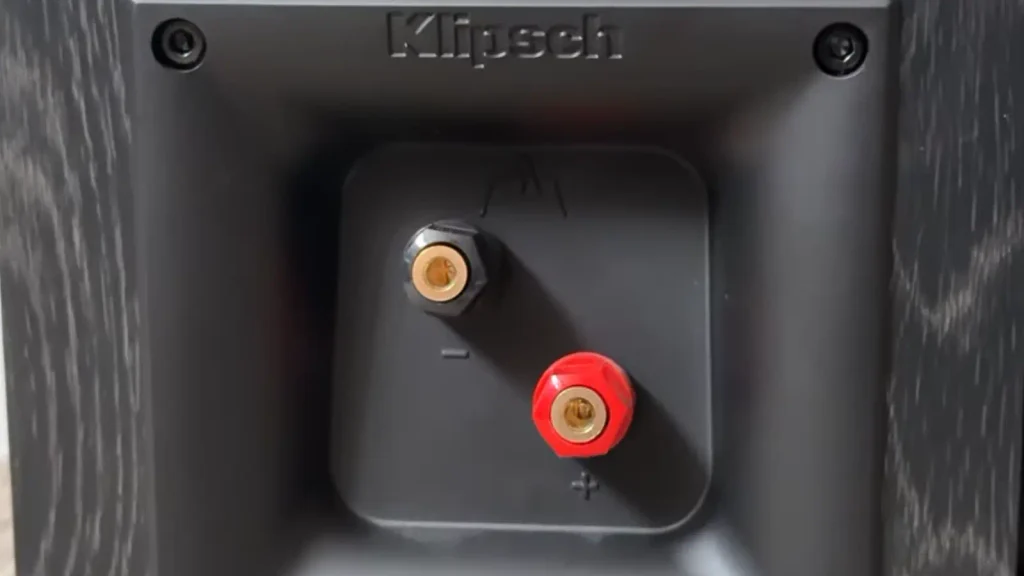
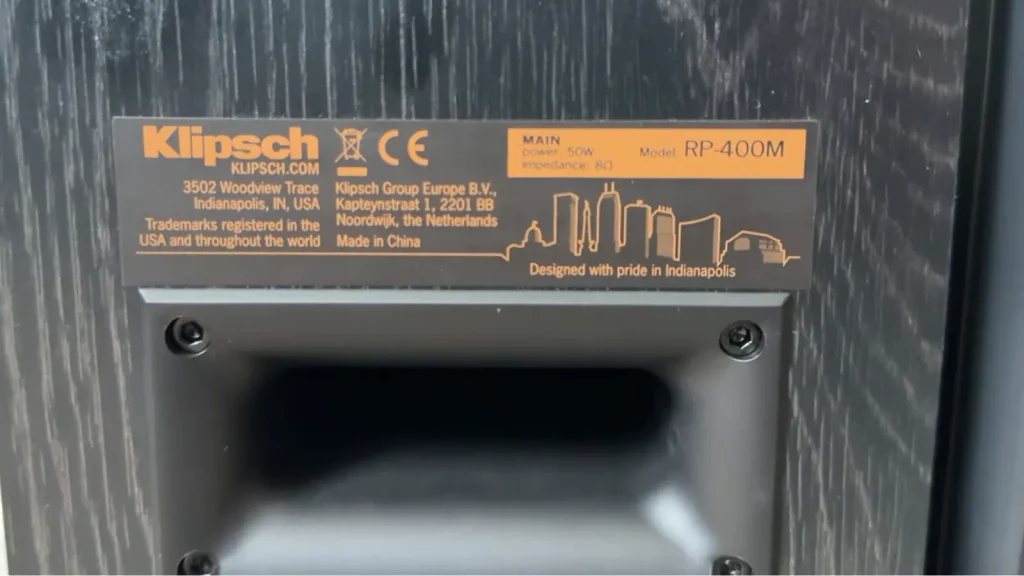
There is a practical side to the design, too. The RP-400M includes a rear-firing Tractrix port and conventional binding posts for connecting speaker cable. Its small dimensions make placement relatively straightforward, although the rear port means that positioning against a wall or deep inside a bookshelf deserves some attention. A little breathing room can help prevent the bass from becoming overly prominent or uneven in a particular room.
The overall impression is of a sensibly built compact loudspeaker with a recognisable design. The cabinet is not especially heavy, and its vinyl finish should not be confused with the more expensive materials found on high-end speakers, but the styling feels coherent. The RP-400M looks like a deliberate member of the Reference Premiere family rather than a budget model wearing an attractive badge.
The Horn-Loaded Tweeter Is the Main Attraction
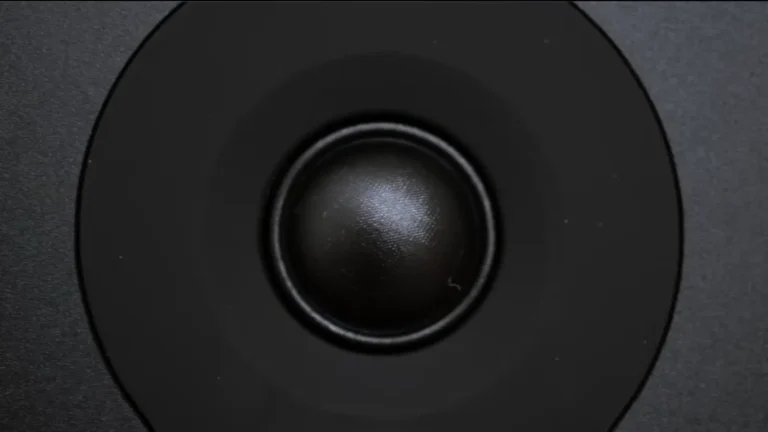
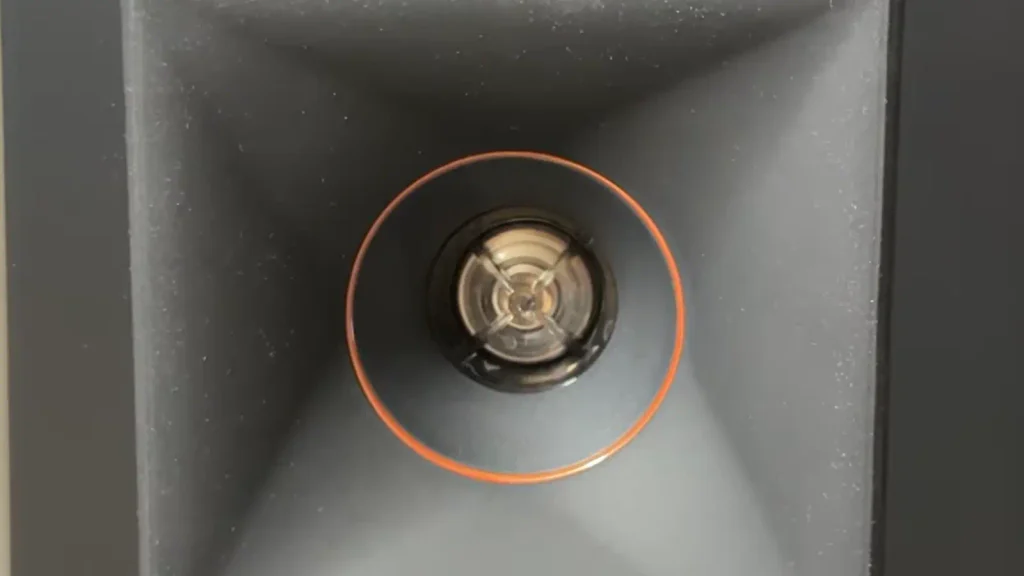
Klipsch has built much of its reputation around horn-loaded loudspeakers, and the RP-400M brings that approach to an unusually compact bookshelf design. Its high-frequency driver is a one-inch titanium Linear Travel Suspension, or LTS, tweeter mounted inside a 90-by-90-degree Hybrid Tractrix horn.
That combination is important because the horn helps control how high-frequency sound spreads into the room. Instead of relying entirely on a small dome radiating sound broadly, the design directs much of its energy toward the listening area. Klipsch also uses a vented tweeter arrangement intended to reduce unwanted resonances behind the diaphragm.
The aim is not simply to make the speaker sound louder. High efficiency allows the RP-400M to produce substantial output from relatively little amplifier power, while the horn design helps give the presentation its characteristic sense of immediacy. Voices, guitar attacks, percussion, and other musical details can sound direct and clearly defined rather than distant or subdued.
This is one reason the RP-400M is an interesting option for listeners who enjoy rock, acoustic music, and recordings with lively instrumental performances. The initial attack of a snare drum, the pick against an acoustic guitar string, or the edge of an electric guitar can be an important part of the musical experience. A speaker that presents those sounds clearly can make a recording feel more alive.
However, horn loading is not automatically a guarantee of perfect tonal balance. The result depends on the complete design, the recording, the room, and the listener’s position. People who enjoy a lively and forward presentation may find the Klipsch approach particularly appealing, while those who prefer a softer, more relaxed top end should pay close attention to how the RP-400M sounds with their favourite recordings.
The important point is that the tweeter is not an afterthought. It is central to the speaker’s design, and it explains much of the RP-400M’s appeal as a compact loudspeaker intended to deliver an energetic, high-efficiency presentation.
A Four-Inch Cerametallic Woofer Has Its Limits
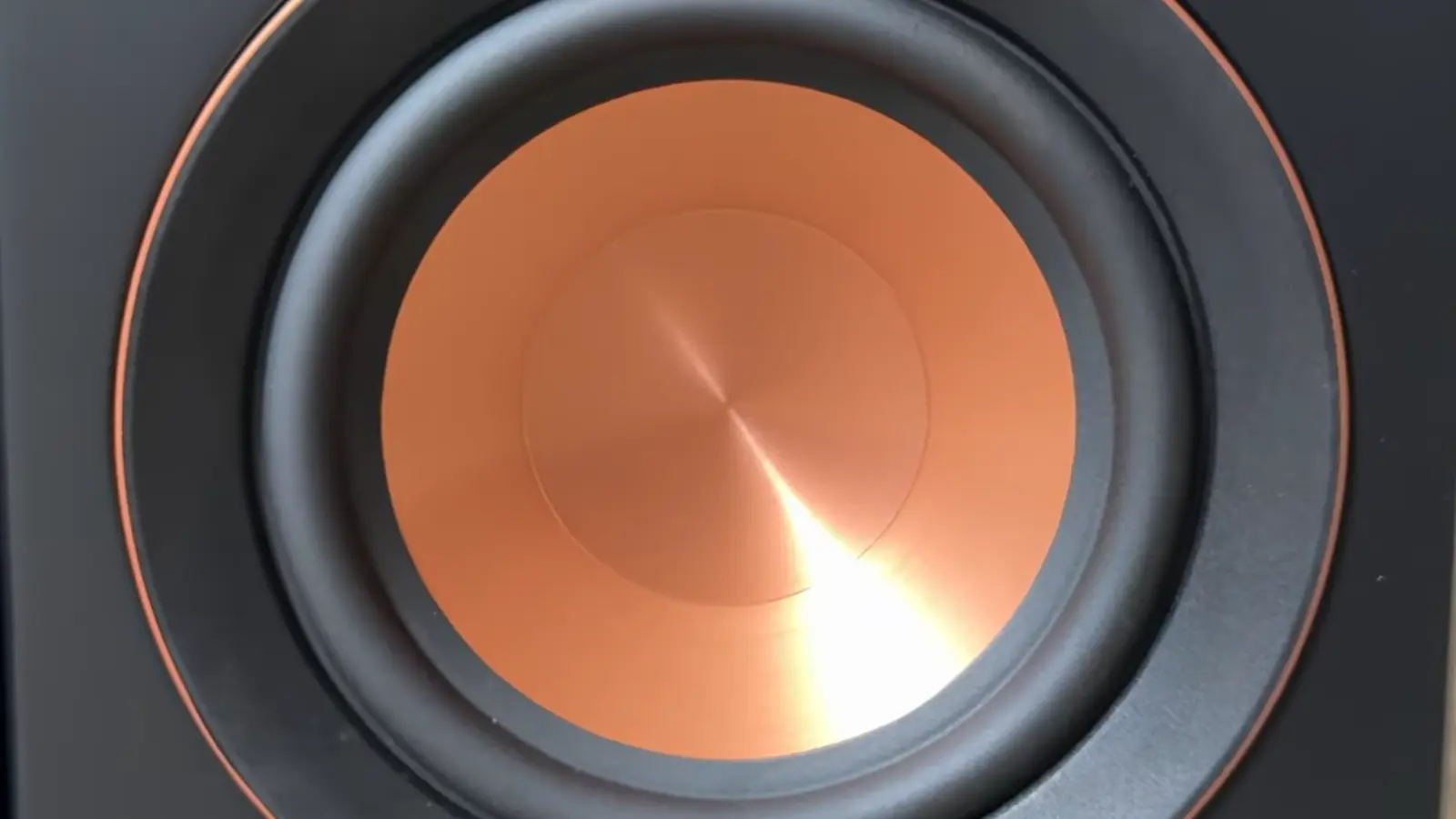
Below the horn sits a four-inch spun-copper Cerametallic woofer, another distinctive feature of the Reference Premiere range. The cone’s copper appearance gives the RP-400M much of its visual character, but its purpose is functional as well as cosmetic.
Klipsch uses a lightweight, rigid cone material designed to resist unwanted deformation while reproducing the midrange and bass. In a small speaker, this balance matters. The woofer needs to respond quickly to changes in the signal while moving enough air to provide convincing body to instruments and voices.
The four-inch driver also explains why expectations need to remain realistic. The RP-400M is a compact bookshelf speaker, not a substitute for a large floorstander or a dedicated subwoofer. It can reproduce the upper bass and much of the midrange without needing a large cabinet, but deep bass is a different challenge altogether.
The published frequency response extends down to 52Hz, although that figure should not be interpreted as a promise of equally strong output at every frequency. The amount of bass you actually hear will depend on the recording, listening level, room acoustics, and placement.
For everyday listening, that distinction is important. Bass guitar notes, the lower registers of male vocals, and the rhythmic body of a drum kit occupy a much wider range than the deepest effects in electronic music or film soundtracks. The RP-400M can cover a useful portion of the musical bass range, but listeners who want powerful sub-bass at high volume will probably want more substantial low-frequency support.
The rear-firing Tractrix port helps the woofer work more efficiently in the low frequencies. Its shaped opening is designed to encourage smoother airflow and reduce turbulence. In practical terms, the port gives the compact enclosure a better chance of delivering useful bass without requiring a larger cabinet.
Even so, a small woofer cannot escape the laws of physics. If your listening habits revolve around bass-heavy electronic music, hip-hop, modern pop, or films with substantial low-frequency effects, a well-integrated subwoofer is likely to make the system more satisfying. The advantage is that the RP-400M can then concentrate on the midrange and treble while the subwoofer handles the deepest notes.
What Should You Expect From the Sound?
The RP-400M is designed around efficiency, controlled high-frequency dispersion, and a compact bass-reflex enclosure. Those choices give us a good idea of its intended character, although they do not replace listening to the speakers in a real room.
Its high sensitivity rating of 93dB means that the RP-400M can produce useful listening levels without demanding a powerful amplifier. That makes it attractive for modest stereo systems, integrated amplifiers, and home theater receivers. It is also worth remembering that sensitivity figures do not tell the whole story about sound quality. They describe efficiency under specified conditions, not tonal accuracy, imaging, or how well a speaker handles difficult recordings.
Klipsch SPL-120 Subwoofer Review
With the right recording, a speaker of this type should be capable of presenting musical attacks clearly and maintaining a lively sense of rhythm. That can be especially enjoyable with acoustic guitars, drums, electric guitars, and recordings in which the singer’s voice sits prominently in the mix. The horn-loaded tweeter is intended to keep high-frequency information clear, while the Cerametallic woofer covers the lower midrange and upper bass.
The flip side is that clarity and energy are not the same as neutrality. Some listeners may prefer a more relaxed presentation, particularly with recordings that already have aggressive treble or a bright production style. The best way to judge the RP-400M is to use familiar music rather than a short demonstration designed to make every speaker sound impressive.
For a useful listening session, I would start with an acoustic recording featuring a clearly recorded voice and guitar. This reveals whether the vocal sounds natural, whether the guitar has convincing body, and whether the upper frequencies remain comfortable over a complete song. I would then move to a rock recording with a strong drum kit and electric guitars, listening for rhythmic definition and whether the sound becomes congested as the arrangement grows busier.
Finally, a bass-heavy track helps establish the limits of the small woofer. The question is not whether the RP-400M can reproduce every deep note with the authority of a much larger speaker. It is whether the bass remains tuneful and integrated with the rest of the music at the levels you normally use.
These checks matter more than simply turning the volume up. A compact speaker can sound exciting during a brief demonstration but become tiring after an hour if its tonal balance does not suit the listener. Equally, a speaker that seems modest at first can prove enjoyable over an entire album because it keeps the rhythm, vocals, and instruments intelligible.
Listening to Glen Hansard, The Church, and Neil Young
Three records make particularly useful starting points for evaluating a compact loudspeaker such as the RP-400M: Glen Hansard’s Rhythm and Repose, The Church’s richly layered recordings, and Neil Young’s Comes a Time. Each places different demands on a stereo system.
Hansard’s Rhythm and Repose is a useful choice because the voice and acoustic instrumentation invite close attention. Rather than relying on deep bass or spectacular treble, the recording gives you an opportunity to listen for vocal presence, the texture of strings, and the relationship between the singer and the accompanying instruments. With the RP-400M, pay attention to whether the voice remains convincing and whether the upper midrange sounds clear without becoming overly prominent.
The Church provide a different test. Their neo-psychedelic arrangements often rely on the interaction between guitars, atmosphere, and layers of sound. This is where stereo imaging and separation become important. Listen for whether individual guitar lines occupy distinct positions and whether the recording creates a sense of space beyond the physical location of the speakers. A compact pair can make music feel surprisingly expansive when the recording and room cooperate, although the exact depth and width of the image need to be judged in your own listening environment.
Neil Young’s Comes a Time offers a more direct way to examine vocal texture and acoustic instruments. The recording’s country-rock character makes it useful for assessing the body of the voice, the natural decay of strings, and the balance between the lead vocal and accompanying musicians. The goal is to hear the performance as a coherent musical whole rather than a collection of bright details.
These are also useful tests because they move beyond the assumption that a good bookshelf speaker must impress with bass or volume. A convincing midrange, a stable stereo image, and a comfortable tonal balance are just as important when listening to an album from beginning to end.
One important distinction is worth making here: these tracks are recommended listening tests, not a claim that the RP-400M was auditioned with them in the supplied reference system. The equipment list includes other loudspeakers, so those listening impressions cannot responsibly be attributed to the Klipsch without a confirmed RP-400M listening session.
Placement and Amplifier Matching
The RP-400M is a relatively easy speaker to accommodate, but it will still benefit from thoughtful placement. Ideally, use sturdy stands that put the tweeters close to ear height when seated. A stable platform also helps prevent the speakers from shifting and makes it easier to establish a consistent stereo image.
Start with the speakers separated enough to create a convincing left-to-right image, then adjust their distance and angle in small increments. A modest amount of toe-in may help focus vocals and central images, but the best setting depends on the room and listening position.
Because the bass port is on the rear, avoid pushing the cabinets tightly against a wall without checking the result. Moving them closer to a wall may increase perceived bass, but it can also make the low frequencies uneven or overly prominent. If the speakers sound thin, experiment with placement before assuming that a subwoofer or amplifier upgrade is necessary.
The RP-400M is rated at 93dB sensitivity and is compatible with an eight-ohm nominal load, with a published power-handling rating of 50 watts continuous and 200 watts peak. These figures make it a practical match for many modest amplifiers and receivers. You do not need an expensive high-powered amplifier simply to get useful volume from this speaker.
That said, a suitable amplifier still matters. Choose a model that can drive the speakers cleanly at your preferred listening level, and avoid assuming that high sensitivity makes them immune to distortion when pushed too hard. If you intend to use them for a home theater, a receiver with bass management and a suitable subwoofer output can make integration considerably easier.
For a two-channel system, the decision to add a subwoofer should depend on the room and the music you enjoy. If you mostly listen to vocals, acoustic music, jazz, and moderate-level rock, the RP-400M may provide enough bass for your needs. If you regularly play electronic music or want convincing low-frequency effects in films, a subwoofer is the more sensible route to a fuller-range system.
The RP-400M for Music and Home Theater
One of the RP-400M’s strengths is that its compact format does not restrict it to one role. It can serve as the main left and right speakers in a small stereo system, but it can also work as part of a surround setup built around other Reference Premiere models.
In a stereo system, its narrow cabinet makes it easier to fit into a smaller room than many conventional bookshelf speakers. Its high sensitivity can be useful when pairing it with a modest amplifier, while the horn-loaded tweeter gives the design a clear identity for listeners who enjoy an energetic presentation.
For home theater, the RP-400M’s compact size is equally appealing. It can be used as a pair of front speakers in a smaller room or as surround speakers in a compatible Klipsch system. Adding a subwoofer takes pressure off the little woofers when a film soundtrack demands deep bass, and using matching speakers from the same range can simplify tonal matching across the front soundstage.
The limitation is the same in either application: the four-inch woofer cannot move as much air as the larger drivers found in bigger bookshelf or floorstanding speakers. Listeners expecting room-filling bass from a pair of tiny cabinets may need to adjust their expectations. For a compact system, however, the combination of small dimensions and high sensitivity remains an attractive proposition.
Verdict:
The Klipsch RP-400M makes a strong case for the compact bookshelf speaker. Its copper-colored Cerametallic woofer, distinctive horn-loaded tweeter, and slim cabinet give it an identity that is immediately recognisable, while its high sensitivity makes it a practical choice for smaller stereo systems and home theater setups.
Its biggest attraction is the combination of compact dimensions and an efficient design. You do not need a large room or a powerful amplifier to consider the RP-400M, and its relatively small footprint makes it easier to incorporate into an everyday living space. For listeners who enjoy lively music and want a speaker that looks as distinctive as it sounds, the design has considerable appeal.
The four-inch woofer does impose a limit on deep bass, however. Although the rear-firing port helps the speaker produce useful low-frequency output, listeners who want substantial sub-bass for electronic music or films should consider adding a subwoofer. Placement also deserves attention, particularly if the speakers are going to sit close to a wall.
The other consideration is tonal preference. Klipsch’s horn-loaded approach is a defining feature of the RP-400M, but not every listener wants the same balance of clarity, presence, and treble energy. Familiar recordings are the best way to decide whether its presentation suits your tastes.
Ultimately, the RP-400M is most appealing to listeners who want a compact, efficient loudspeaker without giving up the distinctive styling and design philosophy of Klipsch’s Reference Premiere range. It is not a replacement for a large floorstanding speaker, nor does it promise effortless deep bass from a tiny enclosure. What it offers is a practical starting point for a small hi-fi system, with the option to build a more capable setup around it as your room and listening needs evolve.
Klipsch RP-400M specifications:
| Specification | Details |
|---|---|
| Speaker type | Passive two-way bookshelf speaker |
| Tweeter | 1-inch titanium LTS vented tweeter |
| Horn | 90° × 90° Hybrid Tractrix |
| Woofer | 4-inch spun-copper Cerametallic |
| Frequency response | 52Hz–25kHz |
| Sensitivity | 93dB at 2.83V/1m |
| Nominal impedance | 8 ohms compatible |
| Power handling | 50W continuous / 200W peak |
| Crossover frequency | 1,500Hz |
| Enclosure | MDF, bass-reflex |
| Bass port | Rear-firing Tractrix port |
| Dimensions (H × W × D) | 11.73 × 5.67 × 7.50 inches |
| Weight | 9lb per speaker |
| Finish | Ebony wood-grain vinyl |
| Grilles | Removable magnetic grilles |