I Stopped Chasing the Lowest Spec on the Sheet. Here’s What I Buy Instead
There are plenty of ways to choose speakers, but sometimes the music you listen to tells you almost everything you need to know.
If most of your listening is hip-hop, electronic music, rock, R&B, or recordings where bass is a major part of the experience, you probably won’t be satisfied with a speaker that sounds detailed or has a beautiful midrange. You want that low end to have weight. You want a kick drum to sound like a kick drum, and when the bass drops in an electronic track, you want to feel that something has actually happened.
And if you’re one of those people, I wouldn’t start by looking for the speaker with the biggest woofer.
Bass is about more than woofer size
It’s very easy to look at a large floorstanding speaker with two or three big bass drivers and assume it will automatically be the best choice for bass-heavy music. There’s a reason manufacturers use larger drivers and larger cabinets, but the amount of bass a speaker can produce isn’t the only thing that matters.
I’ve heard speakers that could produce plenty of low-end energy but didn’t necessarily make the music more enjoyable. Sometimes the bass becomes too loose or overwhelming, and once that happens, it starts to interfere with everything else the speaker is doing. Instead of hearing the bass guitar as part of the recording, you’re simply hearing a lot of low-frequency energy.
That’s not what I look for.
Good bass has to have some sense of control behind it. It needs weight, but it also needs to remain part of the music. A kick drum should have impact without turning the entire recording into a blur, while a deep electronic bass line should extend into the lowest octaves without making the vocals and other instruments feel pushed out of the way.
This is also why I wouldn’t make a buying decision based purely on the lowest frequency printed on a specification sheet. A very low claimed frequency response doesn’t tell you how that bass will actually sound in your room, particularly once volume, placement, and room acoustics enter the equation.
Why floorstanders still make sense
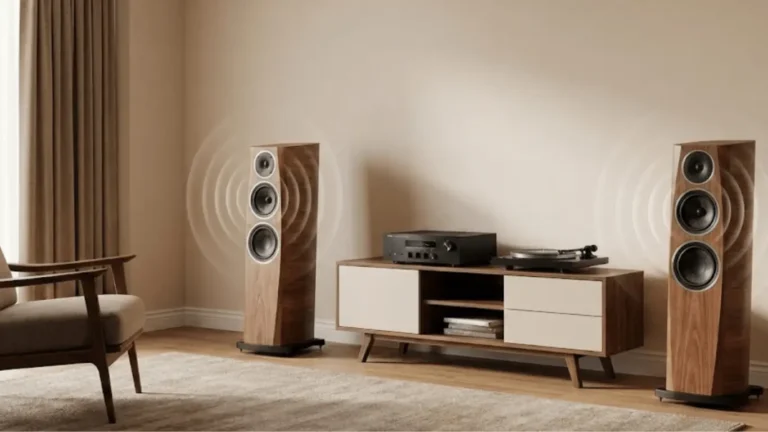
If your priority is serious bass from the speakers themselves, it’s difficult to ignore a good floorstander.
There’s simply more physical space for the designer to work with. A larger cabinet can accommodate larger or multiple bass drivers, and a well-designed floorstanding speaker can produce a much greater sense of scale than a small bookshelf speaker.
That doesn’t mean every floorstander is automatically better for bass-heavy music — I’ve heard plenty where the bass wasn’t the thing that impressed me most. But when the design is right, the additional cabinet volume and driver area make a noticeable difference when the music becomes demanding.
This is one of the reasons I’ve always found Klipsch interesting.
Klipsch would be one of my first recommendations
If somebody told me they mainly listen to rock, hip-hop or energetic music and wanted a speaker that could play with plenty of impact, Klipsch would be one of the first brands I’d tell them to hear.
Their appeal isn’t simply about bass. There’s a particular combination of dynamics, efficiency and immediacy that makes their larger speakers extremely entertaining with music that needs to move some air.
The older Klipsch RF-5 is a good example. These aren’t new speakers, but they demonstrate what can happen when you combine a high-sensitivity design with large bass drivers and a horn-loaded high-frequency section. I found them particularly enjoyable with rock and music that benefits from dynamics, and good used examples can still be worth considering.
That kind of presentation isn’t for everyone. Someone looking for a very relaxed, neutral presentation may prefer something else. But if you want the music to feel energetic and physical, Klipsch makes a lot of sense.
And that’s an important distinction: bass-heavy music doesn’t necessarily mean you want exaggerated bass. You may simply want a speaker that doesn’t lose its composure when the recording gets aggressive.
The KEF LS60 Wireless proves size isn’t everything
The KEF LS60 Wireless takes a completely different approach, and that’s one of the things I find so interesting about it.
At first glance, the LS60 doesn’t look like the kind of speaker you’d associate with serious bass. It’s remarkably slim compared with many traditional floorstanders, yet KEF has built a full-range active system around that narrow cabinet.
The amplification is built into the speakers, and the system is designed around modern network and streaming functionality — so it also removes the need for a large stack of electronics.
For somebody who wants a clean-looking system without giving up the scale and low-frequency capability of a proper floorstanding speaker, the LS60 Wireless is a very interesting proposition.
It reinforces something important: there isn’t one physical shape that automatically makes a speaker good for bass-heavy music. A huge traditional floorstander can do it. A sophisticated active speaker can do it. And a relatively compact speaker paired with the right subwoofer can arguably do it even better.
Sometimes the right answer is speakers + a subwoofer
If someone tells me they want extremely deep bass, I don’t necessarily tell them to spend their entire budget on larger and larger main speakers. There comes a point where adding a properly designed subwoofer makes more sense.
My experience with the SVS PB-1000 is a good example. It has a very different job from the main speakers: get down into the lower frequencies and bring serious weight to the music. In my experience, it has a wild side that makes it particularly entertaining when you want to hear and feel what’s happening at the bottom of the recording.
I’ve written more about that in The SVS PB-1000 Has a Wild Side You Need to Hear, and it’s particularly relevant to anyone who wants more physical bass from their system.
Rather than asking your main speakers to reproduce everything, you let the subwoofer concentrate on the frequencies it was designed for.
But more bass isn’t always better
There’s a point where bass stops being impressive and starts becoming distracting. I’ve heard systems where the subwoofer was clearly doing too much, and the first thing I noticed wasn’t how deep the bass went — it was that the subwoofer itself had become part of the presentation.
A properly integrated subwoofer should make the system sound more complete, not make you constantly aware that another box is producing the bass.
That’s one reason I appreciate what a sealed design such as the SVS SB-4000 brings to the conversation. In my experience, the character is different from the more aggressive presentation of a large ported design: the bass can feel deeper and more controlled, and for some systems that’s exactly what you want. I’ve covered that approach in my SVS SB-4000 review, and it’s worth considering if your idea of great bass is control and authority rather than simply getting the room shaking.
Your room matters more than you think
A speaker doesn’t exist in isolation. The room becomes part of the system the moment you put the speakers in it — and that’s particularly true with bass, because low frequencies interact strongly with the room.
Move a speaker closer to a wall and the balance changes. Move it into a corner and the effect is even more obvious. In a small room, a speaker capable of producing enormous amounts of low-frequency energy may actually create more problems than it solves.
That’s why I wouldn’t tell someone with a small room to automatically buy the biggest floorstander they can afford. A good bookshelf speaker combined with a properly positioned subwoofer can make much more sense: you gain flexibility in where the main speakers go, and you can experiment with the subwoofer’s position to get a better balance.
It isn’t as simple as buying the largest speaker in the store and expecting the room to cooperate.
Different music wants different bass
The phrase “bass-heavy music” covers a lot more ground than people realize:
- Hip-hop: serious low-frequency extension and impact that makes the bass line feel physical. Electronic music can demand the same, particularly when a recording reaches into the sub-bass region.
- Rock: I care more about dynamics and punch — the bass guitar and kick drum need energy without becoming disconnected from the guitars, vocals, and drums.
- R&B: depth and presence, while still leaving room for the vocals.
That’s why I don’t think there’s one speaker that deserves to be called the best speaker for bass-heavy music for everyone. The better question is: what kind of bass do you want?
The explosive dynamics of a large Klipsch? The modern simplicity of the KEF LS60 Wireless? A more traditional audiophile floorstander such as the Monitor Audio Silver range? Or smaller main speakers combined with a serious subwoofer? Those are very different systems, even though they all answer the same question.
So what would I buy?
I wouldn’t start by chasing the lowest number on a specification sheet. I’d start with the music.
- Rock and energetic recordings (dynamics + impact): a good pair of Klipsch floorstanders. The RF-5 remains an interesting used buy — just judge the condition of the particular pair you find.
- A modern, clean, integrated system: the KEF LS60 Wireless — a completely different approach to serious performance from a slim active speaker.
- A traditional hi-fi floorstander with substantial low end: the Monitor Audio Silver range.
- The deepest, most physical bass possible: stop trying to make the main speakers do everything and add a good subwoofer — SVS PB-1000 for the wild, entertaining side, SB-4000 for control and authority.
The bottom line
People who love this kind of music want it to be exciting. They want to feel the kick drum, hear the bass guitar properly, and experience the lowest parts of electronic music rather than simply knowing they’re somewhere down there.
But I wouldn’t chase bass for the sake of bass. After years of listening to different speakers and subwoofers, I think the best systems are the ones where the low end feels like a natural part of the music. You notice the weight and impact, but you don’t spend the whole session thinking about the speaker producing it.
That’s ultimately what I’d look for: not the speaker with the biggest woofer, the lowest specification, or the most impressive bass claim — but the one that makes bass-heavy music sound powerful, controlled and enjoyable without sacrificing everything else that makes the music worth listening to.