No Built-In DAC, No Extra Gain: Meet the $1,545 Ladder Chopin II
Ladder has introduced the Chopin II, a compact analog preamplifier designed for listeners who want precise volume control and source switching without additional signal amplification. Priced at $1,545, it combines a fully balanced, discrete circuit with Class A output stages, a linear power supply, and a relay-controlled volume attenuator.
Its most unusual feature is its unity-gain design. Rather than increasing the input signal level, the Chopin II operates at 0 dB gain, focusing on source selection and volume control. For a high-end stereo system that already has the necessary amplification, this approach makes the Chopin II a dedicated control center rather than another gain stage.
A Fully Balanced Circuit With Class A Output Stages
The Chopin II uses a fully differential amplifier circuit built from discrete components, with field-effect transistors in the output stages. The ladder specifies a frequency response of 10 Hz to 80 kHz within -0.3 dB, a signal-to-noise ratio of 120 dB, and a dynamic range exceeding 121 dB.
The manufacturer also lists channel separation of 110 dB. The manufacturer specifies total harmonic distortion plus noise at 0.00%, but provides no measurement conditions or precision beyond that figure.
Output levels reach 2 V RMS through the RCA connections and 4 V RMS through balanced XLR. The preamplifier supports both connection types, making it suitable for integration into conventional stereo systems as well as fully balanced setups.
60 Steps of Relay-Controlled Volume
Instead of a traditional variable resistor, Ladder uses a 60-step, microprocessor-controlled relay attenuator. According to the manufacturer, precision-matched components help maintain accurate volume settings and minimize level differences between the left and right channels.
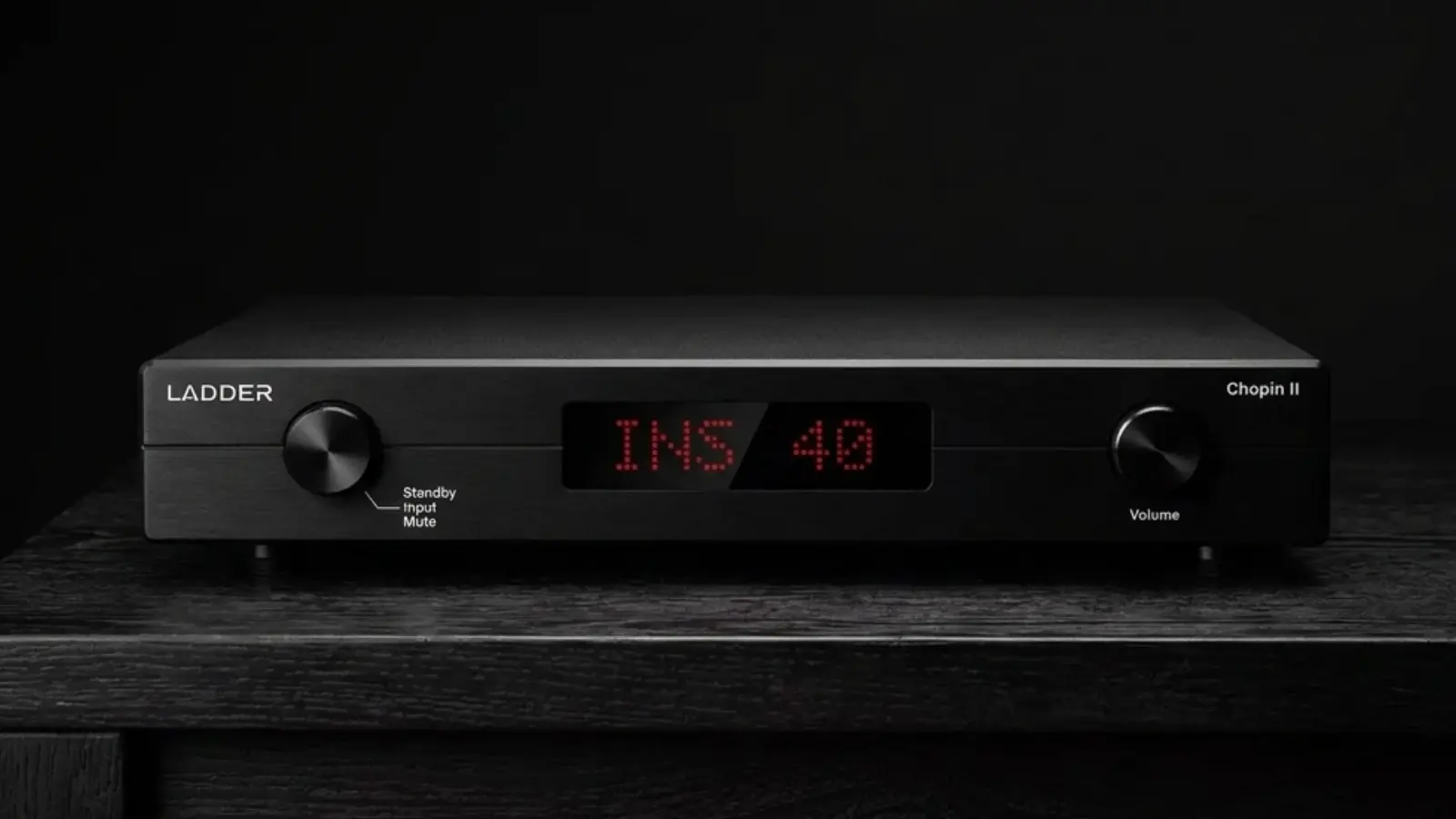
The front panel keeps operation straightforward. A central display shows the selected input and volume level, while two multifunction knobs handle the main controls. The left knob manages power, source selection, standby and mute; the right adjusts volume. An included remote control provides access to the main functions from the listening position.
The arrangement gives the Chopin II a clean, minimalist appearance while placing its most important functions within easy reach.
A Linear Power Supply With Eight Stabilized Circuits
Ladder has also paid particular attention to the power supply. The Chopin II uses a 65-watt toroidal transformer with copper windings, supported by a bank of ERSE capacitors. Eight independent stabilized power-supply circuits serve different functional sections of the preamplifier.
This design is intended to electrically isolate the various stages, limit mutual interference, and reduce noise. The power supply and discrete circuitry are housed inside an aluminum-alloy enclosure measuring approximately 320 × 61 × 330 mm and weighing 6.5 kg.
Despite its relatively low profile, the unit accommodates the transformer and multiple dedicated power-supply circuits alongside its analog electronics. It will be available in black or silver.
Analog Connections Without a Built-In DAC
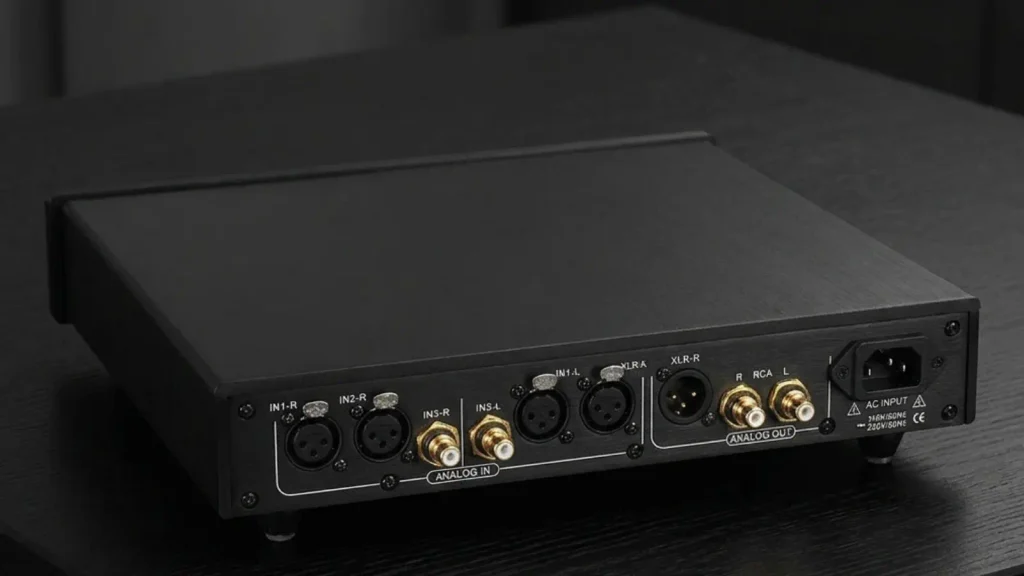
The Chopin II offers three stereo analog inputs: two balanced XLR pairs and one unbalanced RCA pair. For connecting a power amplifier or active speakers, it provides both balanced XLR and unbalanced RCA outputs.
Gold-plated, single-crystal copper contacts are used for the connections. There is no built-in digital-to-analog converter, so digital sources must be connected through an external DAC or another component that supplies an analog output.
That keeps the Chopin II focused on its intended role: switching and controlling analog signals between source components and the amplification stage.
Ladder Chopin II Price and Availability
The Ladder Chopin II has a suggested retail price of $1,545, regardless of whether buyers choose the black or silver finish.
Its combination of balanced and unbalanced connectivity, relay-based volume control, discrete Class A output stages and a dedicated linear power supply positions it as an option for stereo enthusiasts seeking a purpose-built analog preamplifier. Its appeal will depend on how well its implementation performs in a complete system, but its 0 dB gain architecture gives it a distinct place among conventional preamplifiers.