I Thought I Knew These Wharfedale Speakers. Then I Test Them Again
Wharfedale updated its EVO range in 2019, introducing a series of loudspeakers that borrowed some interesting engineering ideas from the company’s much more expensive Elysian models. We have already spent time with the larger floorstanding models, including the Wharfedale EVO 4.4 and the newer-generation Wharfedale EVO 5.4. However, there is another model in the original EVO family that deserves just as much attention: the EVO 4.2.
At first glance, the EVO 4.2 might look like a conventional pair of large bookshelf speakers. Look a little closer, though, and you will discover something rather unusual for this category. These are genuine three-way loudspeakers, complete with a dedicated dome midrange driver, a ribbon tweeter and a Kevlar bass driver. That is a considerably more ambitious arrangement than the two-way configuration found in many competing standmount speakers.
Wharfedale has also developed dedicated stands for the EVO 4.2, designed to complement the distinctive curves of the cabinets. They are substantial, beautifully finished and make the speakers look like a carefully considered part of a complete hi-fi system.
But the real question is whether the EVO 4.2 sounds as interesting as its engineering suggests. After spending time listening to them with different amplification, the answer is quite revealing.
A Cabinet That Deserves a Closer Look
I have been familiar with the Wharfedale EVO 4.2 for quite some time. A pair in the white finish previously accompanied me during a listening experiment exploring how speaker height influences our perception of music. This time, however, I had the walnut-finished version in the showroom.
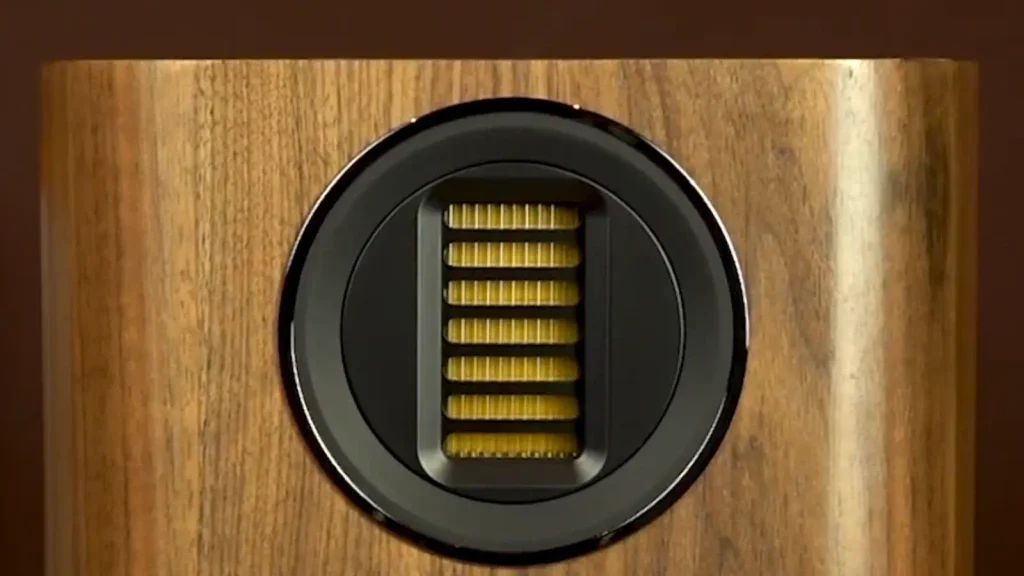
And I must admit, the walnut finish gives these speakers a particularly attractive appearance. It is warm, understated, and fits naturally into a traditional listening room. The white version has a more contemporary, almost futuristic character, particularly when the golden ribbon tweeter and woven Kevlar driver are exposed.
Whichever finish you prefer, the cabinet construction is one of the EVO 4.2’s most appealing features.
The enclosure has an unusual shape when viewed from above. Rather than using conventional flat, parallel sidewalls, Wharfedale has given the cabinet a curved profile that gradually narrows towards the rear. This is not simply a styling exercise. The geometry helps reduce internal standing waves and unwanted reflections that can otherwise colour the sound.
The front and rear panels transition smoothly into the rounded sidewalls, while the top panel has a more defined appearance with clean, sharp edges. The walnut veneer is particularly well executed, with carefully finished surfaces and no obvious imperfections to distract from the overall presentation.
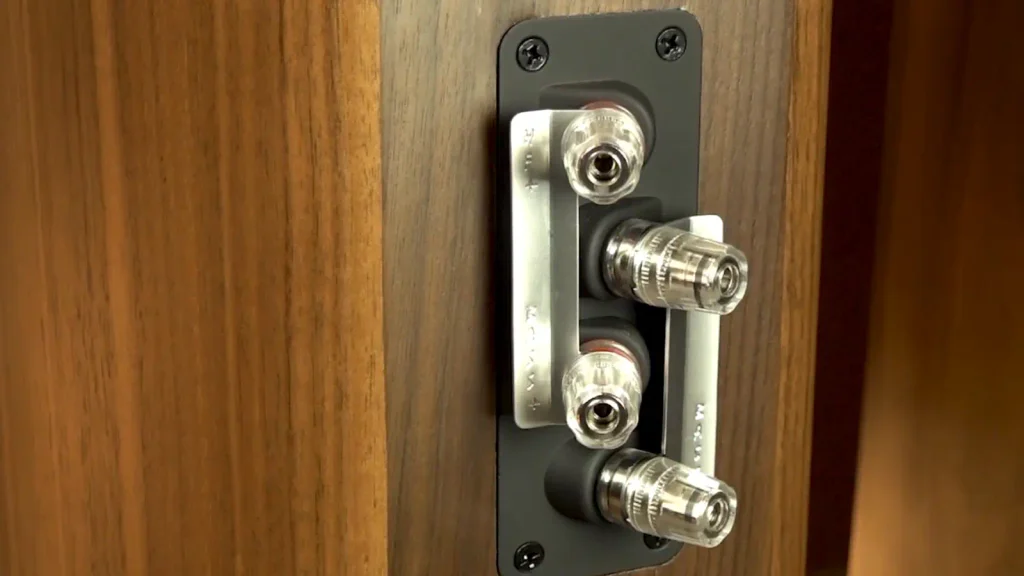
The rear panel houses two pairs of speaker terminals connected by removable jumpers. This gives owners the option of conventional wiring, bi-wiring or bi-amping, depending on their system and preferences. The terminals are also slightly angled, making cable connections more convenient.
One of the more interesting engineering decisions is found underneath the cabinet.
Instead of placing a conventional bass-reflex port on the rear panel, Wharfedale uses its Slot-Loaded Profiled Port (SLPP) arrangement. The port opening is directed towards the substantial base of the speaker, with a small gap between the cabinet and the base allowing the airflow to escape.
Originally developed for the company’s high-end Elysian loudspeakers, this arrangement was subsequently introduced into the EVO range.
Its practical advantage is that it gives owners more flexibility when positioning the speakers. Moving a conventional rear-ported speaker too close to a wall can result in excessive bass reinforcement and a muddy presentation. The SLPP arrangement does not eliminate room interaction, of course, but it makes the EVO 4.2 somewhat less demanding when it comes to placement.
Three Drivers, Three Different Responsibilities
The EVO 4.2 is particularly interesting because Wharfedale has resisted the temptation to use a conventional two-way configuration.
Instead, the company has equipped it with three dedicated drivers, each responsible for a different portion of the frequency range.
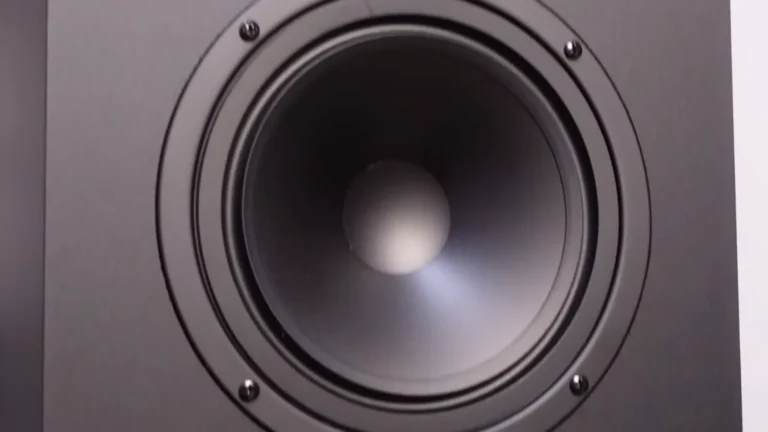
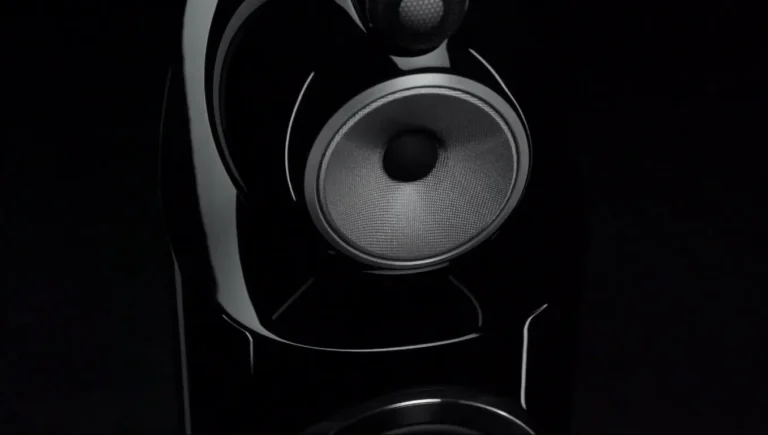
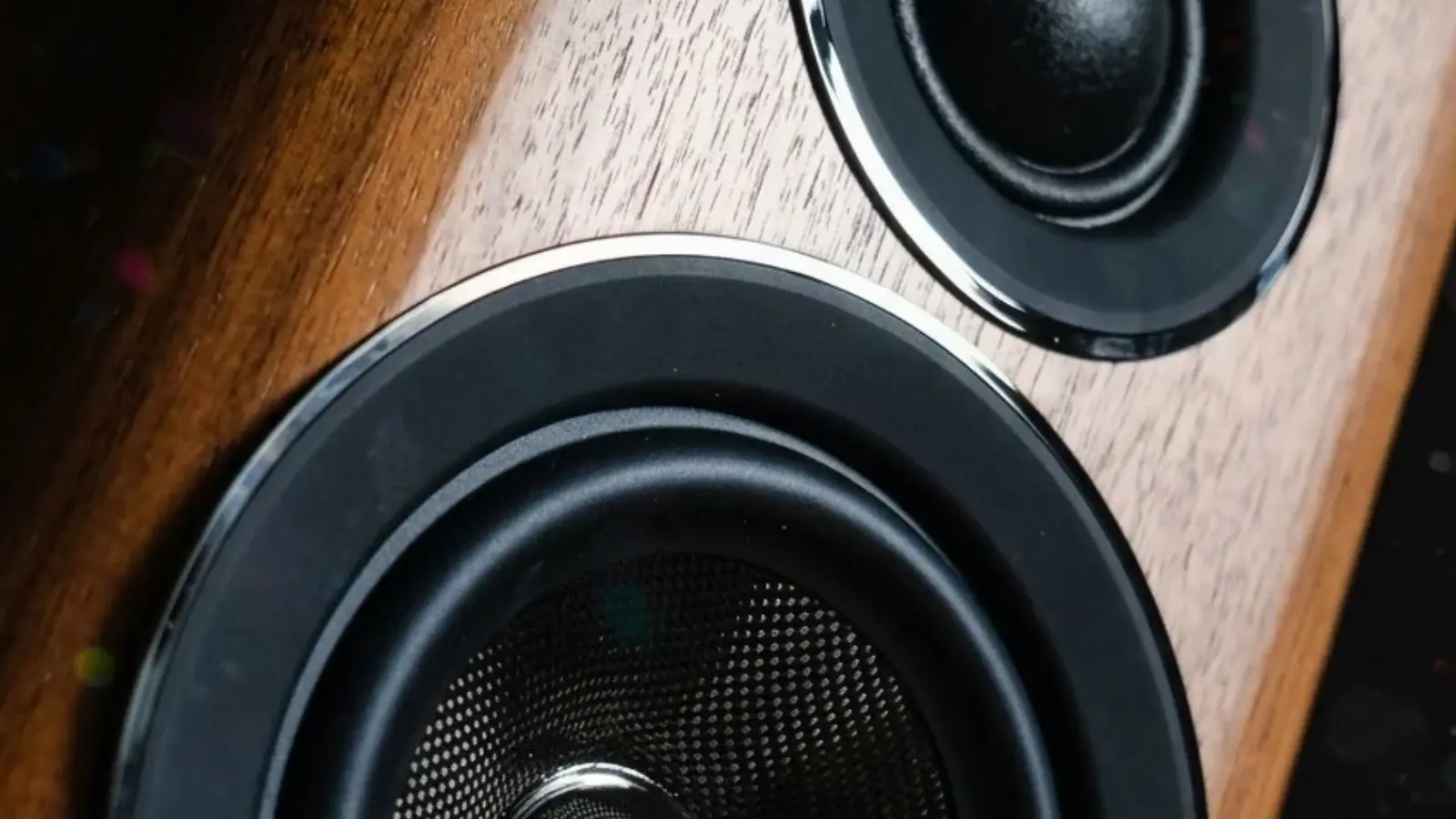
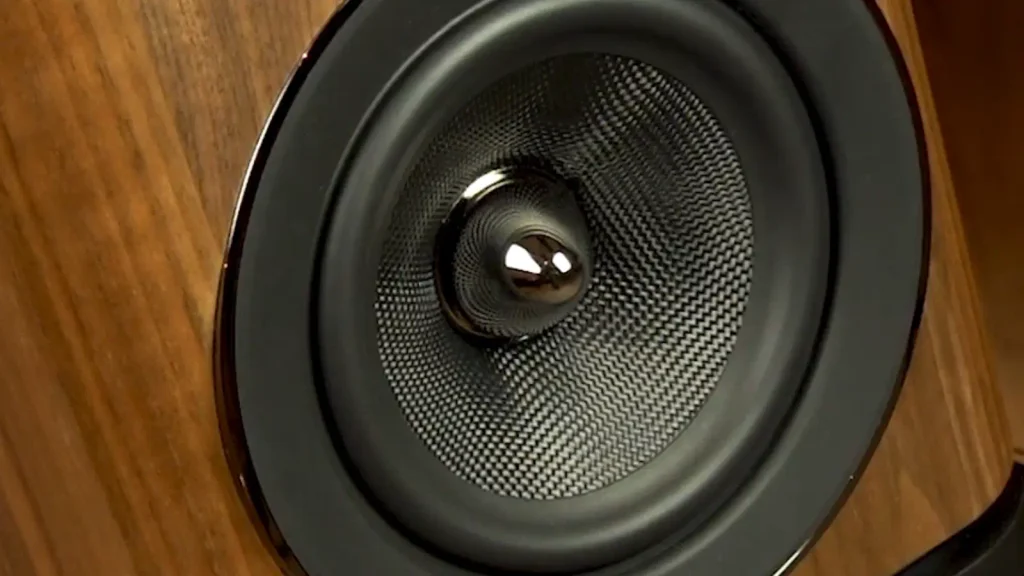
The bass driver uses woven Kevlar, a material that has become closely associated with Wharfedale’s more ambitious loudspeaker designs. It features a distinctive phase-equalising plug in the centre and a substantial rubber surround designed to accommodate considerable cone movement.
Although it is sometimes described as a woofer, its actual responsibilities extend into the lower midrange. It operates up to approximately 1.3 kHz, where the dedicated midrange driver takes over.
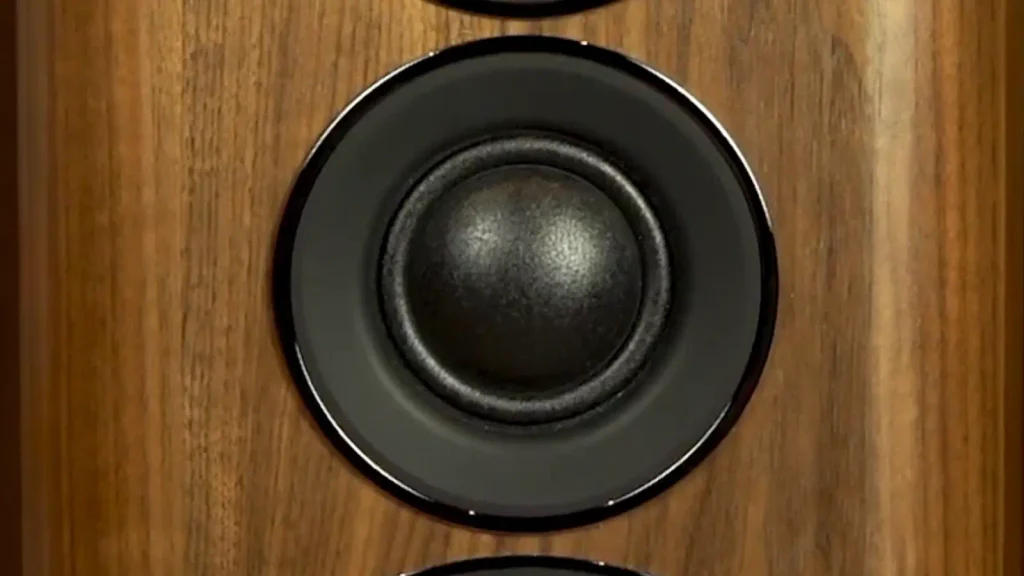
That midrange unit is a 50mm soft-dome design developed specifically to work alongside the ribbon tweeter. Its rear acoustic chamber is carefully shaped to control unwanted energy behind the dome, while its design aims to maintain a smooth response throughout its operating range.
The dome is also slightly recessed into a small waveguide, helping it distribute sound over a relatively wide listening area.
At the top of the cabinet sits the ribbon tweeter. This is a simplified version of the technology used in the more expensive Elysian range, with differences in its dimensions, diaphragm material and surrounding structure.
Nevertheless, it remains one of the EVO 4.2’s most interesting components.
Ribbon-based high-frequency drivers are often associated with exceptional speed and detail, although some implementations can sound overly analytical or aggressive. Wharfedale has taken a different approach here, aiming for a combination of clarity, speed and natural tonal balance rather than simply emphasising every little detail in a recording.
The tweeter operates from approximately 3.9 kHz up to 22 kHz, while the dedicated midrange handles the frequencies between the bass driver and tweeter.
The crossover is a carefully developed three-way design using polypropylene capacitors and inductors with air and silicon-iron cores. Its purpose is not simply to divide the frequency range between the drivers, but to make their individual contributions blend into a coherent musical presentation.
That distinction becomes particularly important when listening to the EVO 4.2. A speaker can have impressive individual drivers, but if their transitions are not handled properly, the result can sound disjointed. Wharfedale’s objective was to avoid that problem and create a more unified presentation.
Listening Impressions: A Surprisingly Refined Presentation
For my initial listening sessions, I paired the walnut-finished EVO 4.2 with the Leak Stereo 130 amplifier and CDT transport.
Visually, it is an interesting combination. The Leak components bring a certain old-school character to the system, while the EVO 4.2’s rounded cabinet design looks almost retro-futuristic. Somehow, the two complement each other rather nicely.
However, I also tried the speakers with different amplification because I wanted to understand how much of their character remained consistent across different systems.
One thing worth mentioning is the height of the dedicated Wharfedale stands. At approximately 60cm, they position the speakers relatively high. If you are sitting on a particularly low sofa, the ribbon tweeter can end up slightly above ear level. However, the dedicated midrange driver sits lower, and it is this driver that plays a particularly important role in the presentation of vocals and instruments.
Listening to Type O Negative, Depeche Mode and Pet Shop Boys, I immediately noticed the way the EVO 4.2 handles male vocals.
There is a subtle sense of added body and presence, almost as if the voices have been given a little extra volume. It is not an exaggerated effect, but it makes the performances feel intimate and engaging. The electronic arrangements surrounding the vocals also come across with impressive clarity, retaining their individual textures without becoming overly sharp.
This is where the ribbon tweeter deserves particular praise.
Having encountered Wharfedale’s ribbon technology in both the EVO and Elysian families, I have come to appreciate its relatively restrained character. It does not push high-frequency details aggressively towards the listener, nor does it introduce the kind of artificial brightness that can make some speakers tiring over longer listening sessions.
There is detail, certainly, but it feels integrated into the music rather than presented as a collection of isolated sounds.
Cymbals, electronic effects and the finer textures of instruments remain clearly audible without dominating everything else. The result is a presentation that feels neutral, composed and surprisingly natural.
Bass Performance: Good Control, But There Are Limits
The single Kevlar bass driver is quick and articulate, provided you partner the speakers with suitable amplification.
With the Leak Stereo 130, the low frequencies were relatively soft and gentle, creating a relaxed presentation that suited the overall character of the system. With other amplifiers, however, the EVO 4.2 demonstrated that it could deliver considerably more energy.
Electronic music from Infected Mushroom and energetic American rock recordings had enough weight and impact to remain enjoyable. The bass was not sluggish, and the speakers avoided turning complex passages into an indistinct collection of low-frequency sounds.
Nevertheless, there are physical limitations.
For most musical genres, the EVO 4.2 delivers sufficient bass presence, but listeners who regularly enjoy particularly aggressive electronic music or heavy guitar-driven recordings may want something more substantial.
Trip-hop, for example, benefits from the speaker’s ability to reproduce soft, rolling bass lines with convincing texture. Move towards djent or particularly aggressive electronic material, and the lack of physical impact becomes more noticeable.
This is also where the difference between the EVO 4.2 and the larger Wharfedale EVO 4.4 floorstanding speakers becomes apparent.
The EVO 4.4 has a clear advantage in the lower frequencies, thanks to its larger cabinet and additional bass-driver area. It delivers more weight and authority, particularly when the music demands a powerful low-frequency foundation.
The EVO 4.2, on the other hand, manages to preserve much of the larger model’s overall tonal character in a considerably more compact enclosure. It is not trying to imitate a floorstander, and it is better understood as a standmount speaker with its own particular strengths.
Soundstage: Big, Wide and Sometimes a Little Diffuse
Speaker positioning has a noticeable influence on the EVO 4.2’s presentation.
With the cabinets positioned relatively parallel to one another, they create a wide and deep soundstage. The music seems to detach itself from the speakers, spreading across the room rather than remaining confined to the cabinet positions.
Tracks from Orbital, Morcheeba and Massive Attack were particularly enjoyable in this arrangement. Rather than hearing individual sounds competing for attention, I found myself following complete musical arrangements. Different elements seemed to blend naturally, creating an engaging and continuous presentation.
There is, however, a small compromise.
With the speakers positioned straight ahead, some stereo images lose a little of their precision. A saxophone might appear somewhere towards the right side of the room rather than occupying a clearly defined position. Electronic effects moving between channels can also become somewhat diffuse.
Angling the speakers towards the listening position helps improve image focus and makes individual instruments easier to locate.
Even without careful toe-in, though, the EVO 4.2 does a surprisingly good job of keeping complex arrangements organised.
Listening to 1/2 Orchestra, the saxophones, trumpets and trombones remained recognisable as separate instruments. They did not collapse into one another, even when the stereo image became less precisely defined.
This is an important distinction. The EVO 4.2 may favour a broad presentation over pinpoint imaging in certain configurations, but it does not sacrifice the ability to separate individual musical elements.
What Kind of Music Suits the Wharfedale EVO 4.2?
After spending time with different recordings, I began to understand the personality of these loudspeakers.
They are particularly comfortable with melodic music, atmospheric electronic compositions, vocals, and recordings where tonal balance matters more than sheer aggression.
The EVO 4.2 can reproduce DragonForce and Haggard without difficulty, and the sound remains clear even when the arrangements become complicated. However, the speakers do not always deliver the physical punch and aggression that these genres demand.
The same applies to certain drum and bass and psy-trance recordings.
Take Infected Mushroom as an example. Tracks such as “Heavyweight” and “Dancing with Kaddafi” suit the EVO 4.2’s presentation reasonably well, allowing the speakers to demonstrate their control and clarity. More aggressive, fast-moving material, however, can leave you wanting additional bass weight and impact.
This is not necessarily a problem with amplification. Even moving to a more powerful amplifier does not completely change the fundamental character of the speakers.
In other words, the EVO 4.2 is not designed to impress by exaggerating the extremes of the frequency spectrum. Its strength lies in producing music with a sense of balance, refinement and continuity.
A Different Kind of Wharfedale EVO
There is something quite distinctive about the EVO 4.2.
In a market where many loudspeakers try to attract attention with bright treble, powerful bass or an aggressively forward presentation, these Wharfedales take a more restrained approach.
They can initially seem a little soft compared with more energetic alternatives, but that should not be confused with a lack of detail. Their presentation is deliberate, balanced and relatively neutral.
This approach works particularly well with melodic recordings, vocals and electronic music that benefits from a spacious, layered soundstage. The speakers allow the music to develop naturally without constantly drawing attention to individual frequencies.
At the same time, listeners who want maximum impact from heavy metal, aggressive electronic music or bass-heavy recordings may find the presentation a little too polite.
The larger EVO 4.4 offers a more convincing solution when additional bass authority is a priority. And if you are interested in how Wharfedale has developed the series in its latest generation, our Wharfedale EVO 5.4 review explores what changed with the newer floorstanding model.
The EVO 4.2, however, remains an interesting proposition in its own right.
It combines a genuine three-way architecture, a dedicated midrange driver, ribbon tweeter technology and a carefully designed cabinet into a standmount speaker that sounds considerably more sophisticated than its appearance might suggest.
Ultimately, these are loudspeakers for people who appreciate musical balance, natural reproduction and a wide, enveloping presentation rather than exaggerated excitement. They are not trying to make every recording sound bigger, louder or more aggressive.
Sometimes, that restraint is precisely what makes them enjoyable.
Wharfedale Evo 4.2 Specifications:
- Type: shelf, three-way
- Acoustic design: SLPP bass reflex
- Frequency response: 48 – 22,000 Hz (+/- 6 dB)
- Maximum sound pressure: 105 dB
- Crossover frequency: 1400 Hz, 3900 Hz
- Speakers: HF – ribbon 30 x 60 mm, MF – 50 mm fabric dome with damping coating, woofer – 165 mm with a Kevlar cone on a rubber suspension
- Sensitivity: 87 dB
- Resistance: 8 ohms nominal, 4 ohms minimum
- Dimensions (HxWxD): 455 x 250 x 350 m
- Weight: 13.4 kg (each)