A 1970s Studio Legend Reborn for Modern Audiophiles
Some loudspeakers don’t merely reproduce music — they define entire eras.
Among all models in JBL’s Studio Monitor lineup, the 4312E stands closest to the speaker that conquered recording studios and later became a staple in audiophile homes in the 1970s: the legendary JBL 4310.
The JBL Studio Monitor 4312E is not a nostalgic reissue designed to cash in on heritage. It is a direct evolutionary successor to JBL’s original studio monitors, preserving their core philosophy while refining the engineering for modern listening environments. In many ways, it represents one of the purest expressions of JBL’s professional DNA still available today.
Check Out: KEF Q150 Review: A Budget Speaker That Quietly Redefined “Real Hi-Fi
A Speaker That Shaped Studio History
To understand the 4312E, we must briefly return to the late 1960s. As recording studios rapidly evolved, traditional floor-standing monitors became impractical. Engineers needed compact, accurate speakers that could sit on mixing consoles, be wall-mounted, or even suspended from ceilings.
JBL’s answer was the 4310 reference monitor, released in 1968. It quickly became one of the most widely used studio speakers of its time. It’s sound defined countless rock, jazz, and pop recordings — not as a playback device, but as a professional tool.
By the mid-1970s, demand grew for a home version of this studio icon. JBL responded with the L100, featuring upgraded finishes, colored grilles, and a vertically aligned driver layout. The L100 became one of the most commercially successful loudspeakers in the history of audio.
In today’s JBL lineup, the 4312E is the most faithful continuation of the original studio concept. Unlike the more domesticated 4319, the 4312E retains the true studio monitor layout, voicing, and intent.
Built Like a Tool, Not a Luxury Object
The JBL Studio Monitor 4312E does not attempt to appear luxurious — and that is precisely the point.
The cabinet is finished in a practical black wood-grain laminate. It is constructed from 19 mm thick particleboard, reinforced internally with bracing and ribs to minimize resonance. The overall impression is rugged, purposeful, and unapologetically professional.
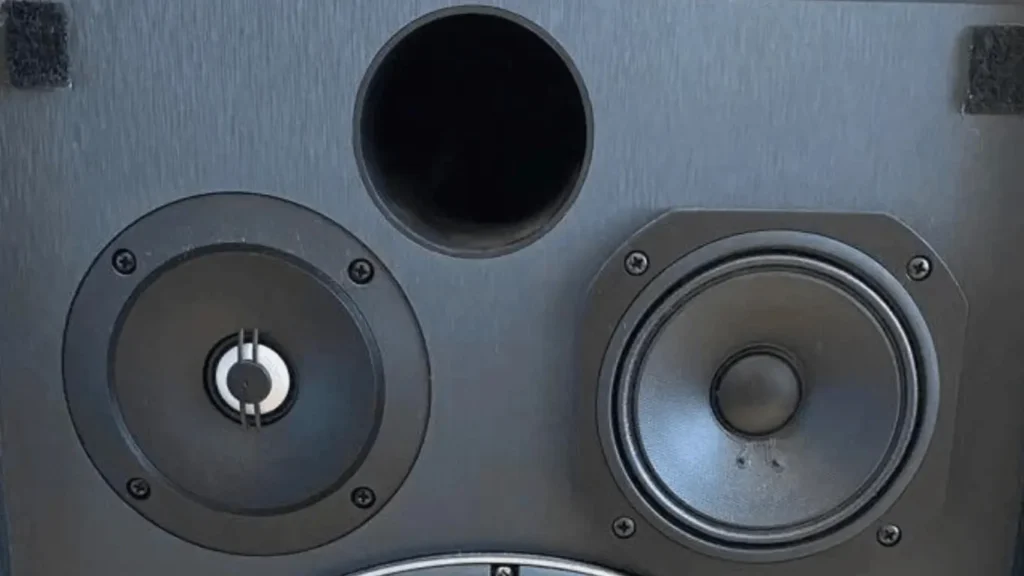
Driver placement immediately signals its studio heritage. Rather than a vertical, symmetrical arrangement typical of home speakers, the drivers are clustered, allowing the speaker to be used vertically or horizontally — a common practice in professional control rooms.
Visible on the front panel are:
- The midrange and high-frequency drivers
- The large white woofer with a fabric surround
- The front-firing bass reflex port
- Velcro fasteners for the grille — a direct nod to classic JBL monitors
Nothing here is decorative. Everything serves a function.
Classic Drivers, Modern Engineering
Visually, the driver complement will feel instantly familiar to anyone who has seen JBL monitors from the 1970s: a large white woofer, a paper-cone midrange, and a dome tweeter. Technologically, however, these are thoroughly modern designs.
Woofer
The woofer features a cellulose cone with annular stiffening ribs, treated with JBL’s Aquaplus coating to suppress unwanted resonances. Its corrugated fabric surround allows exceptionally free movement, contributing to the speaker’s outstanding microdynamics.
A large dual 75 mm voice coil operates within a dual ferrite magnet system, delivering high precision and excellent control even at elevated listening levels. The cast aluminum basket is fully open, ensuring unrestricted airflow during cone movement.
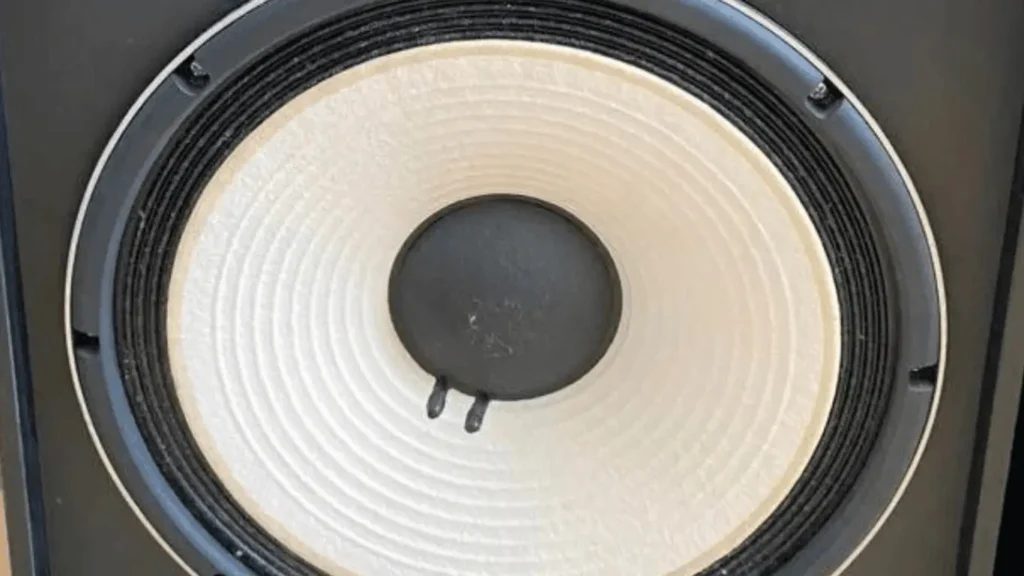
Bass loading is bass-reflex, with a front-firing port, making placement easier in real-world rooms.
Midrange
The 125 mm midrange driver uses a paper cone with polymer coating and a 25 mm voice coil wound on a lightweight Kapton former. Its open basket design minimizes reflections and coloration — critical for vocal clarity and instrumental realism.
Tweeter
High frequencies are handled by a 25 mm magnesium-aluminum dome tweeter, mounted in a shallow horn with a phase-equalizing diffuser. The circular horn geometry allows flexible orientation, enabling both vertical and horizontal placement without compromising dispersion.
A Crossover That Breaks Convention
The crossover design of the JBL Studio Monitor 4312E is unconventional — and intentional.
The woofer operates without a filter, connected directly to the amplifier. This design choice preserves dynamic integrity in the low and lower-mid frequencies, contributing to the speaker’s explosive macrodynamics and natural timing.
The midrange crosses over at a relatively high 2 kHz, with the tweeter taking over above 5 kHz. As a result, the midrange operates within a focused bandwidth, reducing distortion and improving clarity.
The remaining crossover sections employ first- and second-order filters, helping maintain transparency while achieving a high sensitivity rating of 93 dB.
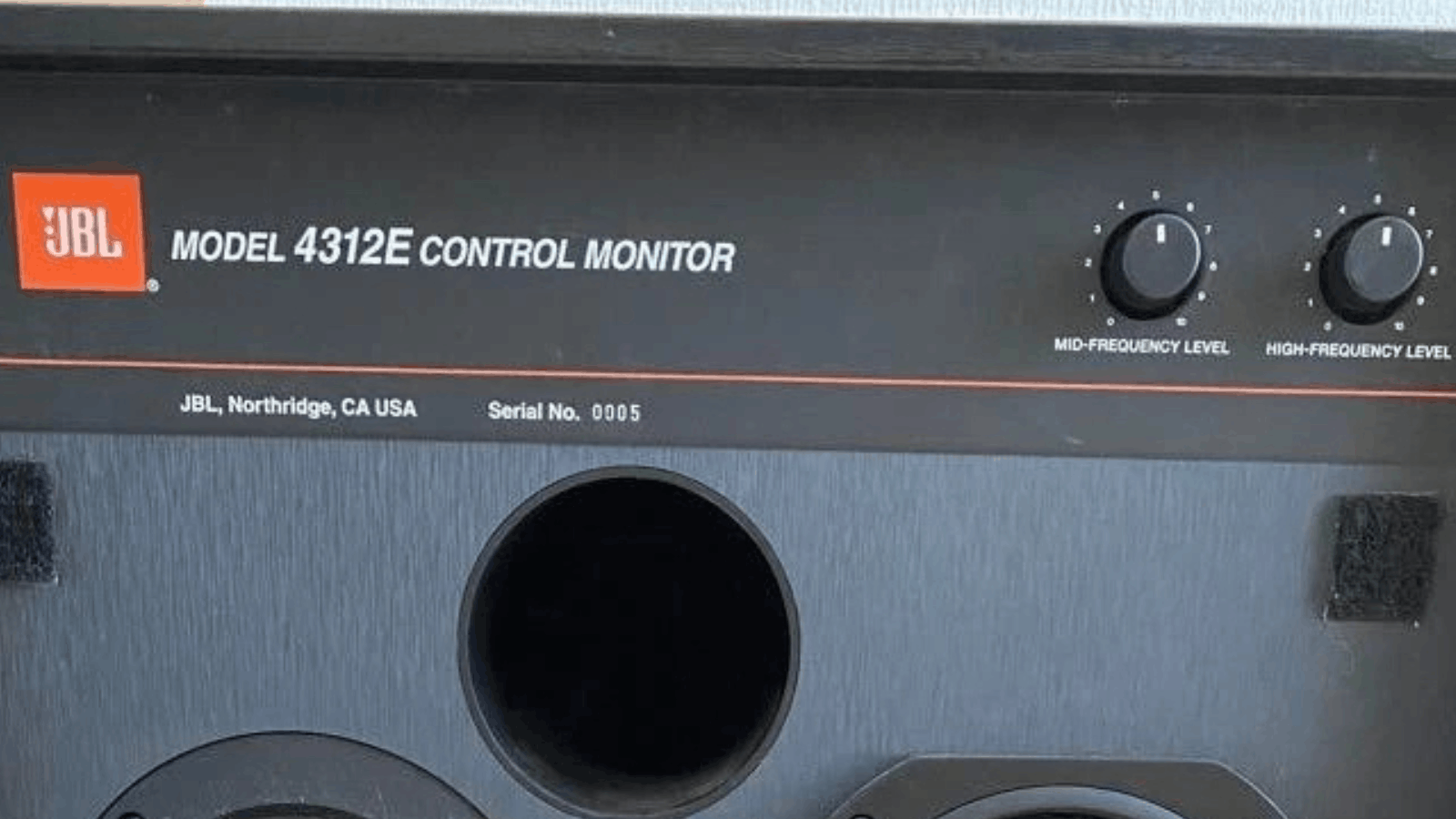
Level controls allow fine adjustment of midrange and high-frequency output. Unlike JBL’s home-oriented models, the neutral reference position is set at 12 o’clock, reinforcing the speaker’s studio intent.
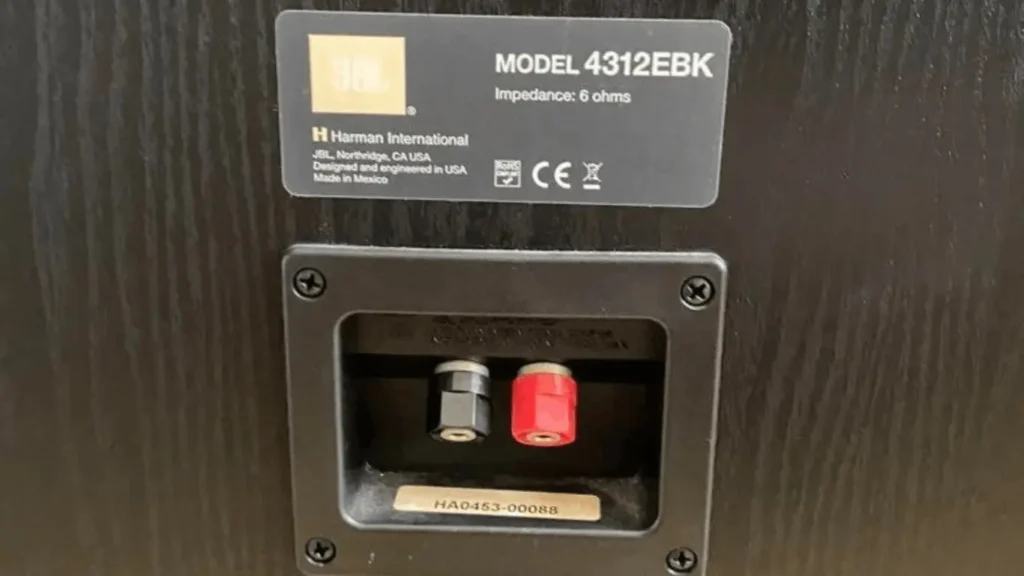
Connection is via a single pair of binding posts, ruling out bi-wiring or bi-amping unless modified by the user.
Placement, Orientation, and Real-World Use
Thanks to its close-packed driver arrangement, the 4312E works well on standard-height speaker stands — provided the stands are wide and stable enough to support the cabinet’s footprint.
The mirror-symmetrical driver layout allows precise control over soundstage presentation. In our setup, placing the midrange drivers closer to the center and the tweeters toward the outside produced the most balanced and immersive image.
Listeners can fine-tune the soundstage by swapping speaker orientation, making the 4312E equally comfortable in nearfield studio setups and traditional home listening rooms.
Sound Impressions: Where the 4312E Truly Excels
The first impression is scale. The soundstage extends confidently beyond the speakers, with convincing depth and rock-solid image placement. Instruments occupy clearly defined positions, remaining stable even during complex passages.
Dynamics are outstanding. Both micro- and macrodynamics are delivered with ease, giving music a sense of effortlessness rarely found at this price point. The frequency response feels unrestricted, with no obvious roll-off at either end of the spectrum.
You May Like: I Finally Experienced a True Concert in My Living Room, Thanks to Klipsch
Tonal balance is remarkably even. Nothing is exaggerated, yet nothing feels restrained. If a recording sounds bright, warm, or aggressive, it is because the recording itself demands it.
Resolution Test: Hotel California
A reliable test of resolution is the Eagles’ 1994 live recording of Hotel California. Many speakers blur this performance, masking the number and placement of acoustic guitars.
The JBL Studio Monitor 4312E resolves the recording effortlessly. Each guitar is clearly identifiable, each musician precisely located. Subtle phrasing, timbral variations, and dynamic shifts are rendered with exceptional clarity.
The performance is captivating, and the lengthy track passes in what feels like moments.
Classical, Rock, and Electronic Music
Classical and organ recordings benefit immensely from the speaker’s dynamic range and tonal stability. Orchestral crescendos build naturally, without compression or glare, while quiet passages retain fine detail and atmosphere.
Rock performance is almost a given. After all, many of the genre’s foundational recordings were mixed on early JBL monitors. Electric guitars have bite, drums hit with authority, and bass lines remain tightly controlled.
Electronic music presents a more surprising result. Playing Daft Punk’s debut album reveals bass that is tight, articulate, and impeccably controlled — despite the woofer handling a significant portion of the midrange. Synthesized sounds feel expressive and engaging, bordering on “live” in presentation.
No genre exposed a weakness. The 4312E simply adapts.
A Practical Limitation
With high sensitivity comes one practical consideration: room size. Even small turns of the volume knob result in substantial sound pressure. The JBL Studio Monitor 4312E thrives in medium to large rooms.
For smaller spaces, JBL offers the 4312MII, a compact alternative better suited to nearfield or limited-space environments.
Measurements: Do the Numbers Match the Sound?
Laboratory measurements fully support the listening impressions.
- On-axis frequency response is flat
- Distortion remains extremely low across the main frequency range
- A single impedance peak occurs in the low frequencies
This impedance behavior favors high-power amplifiers with strong damping factors.
Key Measurement Data (Stereo & Video Lab, March 2013):
- Sensitivity (1 kHz): 95.5 dB
- Lower cutoff (–10 dB): 42 Hz
- Average impedance: 7.17 ohms
- Minimum impedance: 4.62 ohms
- Average THD (100–20,000 Hz): 0.10–0.24%
Who Should Buy the JBL Studio Monitor 4312E?
Ideal For:
- Audiophiles who value natural dynamics and tonal honesty
- Listeners with medium to large rooms
- Fans of classic JBL studio sound
- Professionals seeking a speaker that works for both studio and home use
Not Ideal For:
- Small rooms or very nearfield listening
- Buyers seeking luxury furniture-grade finishes
- Low-power tube amplifiers with limited damping factor
Final Verdict
The JBL Studio Monitor 4312E proves that true studio heritage never goes out of style. It delivers sound quality that rivals — and often surpasses — home speakers costing many times more, without chasing modern tuning trends or aesthetic excess.
This is not a speaker for everyone. But for those who understand its lineage and purpose, the 4312E offers something increasingly rare: honest, dynamic, emotionally engaging sound built on decades of professional experience.
In today’s hi-fi landscape, that makes it something special.
JBL Studio Monitor 4312E Specifications
- Frequency range: 40–40,000 Hz (–6 dB)
- Configuration: 3-way
- Crossover frequency: 2 kHz, 5 kHz
- HF driver: 25 mm, magnesium-aluminum dome
- Midrange driver: 125 mm, polymer-coated paper cone
- Woofer: 320 mm, paper with Aquaplas coating
- Acoustic design: LF-Phase inverter
- Sensitivity: 93 dB
- Impedance: 6 Ohms
- Rated power: 200 W
- Dimensions: 597x362x298 mm
- Weight: 18.1 kg