Can Pivoting Ceiling Speakers Finally Satisfy Demanding Designers and Serious Home Theater Enthusiasts?
Everyone loves the sound of a great home theater system. Unfortunately, not everyone loves the look of one. Even a relatively small, discreet speaker can become a point of disagreement when an interior designer wants a clean, uncluttered living room.
For homeowners who want immersive surround sound without filling their rooms with visible equipment, in-ceiling speakers seem like an obvious solution. They disappear into the architecture, leaving the walls and furniture untouched. But there is a catch: conventional ceiling speakers fire directly downwards, which is rarely the ideal direction for delivering sound to a listening position.
Speaker manufacturers have been addressing this problem by introducing pivoting drivers and adjustable tweeters. These mechanisms allow installers to direct sound towards the listening area, potentially improving imaging, detail and dialogue intelligibility without sacrificing the discreet appearance that makes architectural speakers so appealing.
My earlier experiences with pivoting designs left me impressed by the concept but less certain about their actual acoustic benefits. So I decided to take a closer look at several models from Definitive Technology, Russound, Sonance, and SpeakerCraft to find out whether these clever designs can genuinely satisfy both interior designers and demanding listeners.
The question is simple: can you really enjoy serious home theater sound without having to look at your speakers?
Why Pivoting Ceiling Speakers Can Make a Difference
Most conventional in-ceiling speakers position their woofers and tweeters behind a relatively shallow baffle, leaving the drivers firing straight down into the room. Some manufacturers take a different approach, introducing a recessed assembly that allows the drivers to tilt towards the listening position.
There is a good reason for this. When a speaker directs its sound away from the listener, high-frequency detail and imaging can suffer. Aiming the tweeter towards the seating area helps deliver more direct sound, potentially making dialogue clearer and stereo images more focused.
Think of speaking with your hands cupped around your mouth. The sound changes because its direction and dispersion have changed. A pivoting speaker works on a similar principle, although the actual acoustic results depend on the driver design, crossover, and listening position.
Not every manufacturer takes the same approach. Some allow the entire driver assembly to pivot, while others concentrate on making the tweeter adjustable. More ambitious designs even allow both the woofer and tweeter to move, giving installers greater freedom when positioning speakers in rooms where conventional placement is difficult.
Definitive Technology DC-80 MAX: A More Ambitious Pivoting Design
Definitive Technology takes an interesting approach with its Dymension DC-80 MAX. Rather than limiting adjustment to the tweeter, the company allows both the woofer and tweeter to pivot, giving installers greater control over the direction of sound.
The DC-80 MAX features an 8-inch mineral-filled polypropylene BDSS woofer incorporating Definitive Technology’s Linear Response Waveguide, alongside a 1-inch pivoting aluminum oxide dome tweeter. This arrangement is designed to deliver a more controlled presentation while allowing the installer to direct sound towards the listening position.
The technical specifications are impressive for an architectural speaker. Definitive Technology rates the DC-80 MAX at 43 Hz to 25 kHz at -3 dB, with sensitivity of 88 dB and a nominal impedance of 6 ohms. Recommended amplifier power ranges from 20 to 150 watts.
The speaker also features a tweeter attenuation switch, an IP55 rating, and a paintable micro-perforated magnetic grille. Its installation requires a cutout measuring approximately 10.57 inches, with a mounting depth of 5.34 inches.
When Jacob and I connect the DC-80 MAX, we immediately notice a lively presentation that exceeds our expectations for an architectural speaker. Percussion instruments seem to dance across the ceiling, while singers appear to float in space behind the speakers.
The pivoting arrangement helps create more focused imaging than we would expect from a conventional fixed-down design. The aluminum oxide dome tweeter delivers crisp detail, while the larger BDSS woofer provides a satisfying and precise foundation for music and movie soundtracks.
The crossover maintains a smooth transition between the drivers, and the overall tonal balance leans towards neutral. Bass reproduction is particularly satisfying for an in-ceiling speaker, although a dedicated subwoofer remains the better choice when serious low-frequency impact is required.
f you’re interested in how Definitive Technology approaches low-frequency reproduction, our Definitive Technology SuperCube Trinity Signature review offers a closer look at one of the company’s more ambitious subwoofer designs.
This is an important distinction: the DC-80 MAX is not simply another ceiling speaker with an adjustable tweeter. Its pivoting woofer and tweeter give installers considerably more flexibility when directing sound towards the listening area.
The practical details are equally appealing. Its magnetic paintable grille helps the speaker disappear into the ceiling, while the installation system makes it suitable for discreet architectural installations.
Definitive Technology has produced an interesting combination of installation flexibility and serious audio engineering, making the DC-80 MAX one of the more compelling designs in this group.
Russound IC-830: Sometimes Simplicity Is the Better Solution
Turn over most pivoting ceiling speakers and you will often discover a surprisingly complicated collection of plastic mouldings and mechanical components. Russound has traditionally favoured a simpler approach, and its IC-830 continues that philosophy with a practical combination of adjustable high frequencies and straightforward installation.
The IC-830 is an 8-inch, two-way in-ceiling speaker featuring a 1-inch pivoting titanium tweeter and an 8-inch injection-moulded polypropylene woofer with a vapour-deposited titanium finish.
Unlike more elaborate designs that allow the entire driver assembly to move, Russound concentrates on the tweeter. The result is a relatively uncomplicated construction that keeps installation manageable.
Its SwiftLock by Swarm mounting system is particularly convenient. Installers can secure the speaker without conventional tools by pressing a button on each of its three mounting dogs.
Russound also includes a front-mounted tweeter adjustment switch offering +/-3 dB of adjustment. This allows users to compensate for different room acoustics, reducing high frequencies in bright, reflective rooms or increasing them in heavily furnished spaces.
The manufacturer specifies a frequency response of 38 Hz to 25 kHz and sensitivity of 93 dB, making the IC-830 an interesting proposition for both distributed music systems and home theater installations.
Once we start listening, the IC-830 produces a spacious presentation that immediately reminds us of earlier Russound models. Sound spreads generously across the room, making the speaker suitable for stereo music as well as surround applications.
The pivoting titanium tweeter provides more focus than older fixed-driver designs, while the relatively deep bass gives movie soundtracks a welcome sense of weight.
Its overall presentation is softer rather than analytical, but that does not prevent it from being enjoyable. The tweeter adjustment is also useful: in our carpeted listening room, the +3 dB setting brings vocals forward without making the presentation unpleasantly harsh.
The IC-830 may not deliver the same midrange neutrality as the Definitive Technology, but its expansive sound, straightforward installation and useful tonal adjustment make it an appealing choice for multi-room audio or a secondary home theater.
Sometimes a straightforward solution is exactly what an architectural speaker needs.
Sonance Ellipse LCR 2.0: When Home Theater Comes First
Sonance attracted considerable attention with its Ellipse LCR 1.0, a ceiling speaker developed specifically with home theater applications in mind. The Ellipse LCR 2.0 takes the concept further with upgraded components and an internal foam lining designed to reduce unwanted reflections within the speaker.
One of the limitations of conventional pivoting ceiling speakers is their relatively modest adjustment range. Many offer approximately 15 degrees of movement, which may not be enough to direct sound towards the main listening position.
Sonance takes a more ambitious approach. Its Ellipse LCR 2.0 uses a pivoting midrange and tweeter assembly positioned inside a substantial recessed section. The assembly can tilt by approximately 30 degrees, with the pivoting mechanism providing a combined adjustment of around 40 degrees.
A separate woofer positioned at the opposite end of the recess handles low-frequency reproduction. Sonance also offers an optional acoustic enclosure or back box, which can help control the speaker’s acoustic environment.
Listening to the Ellipse LCR 2.0, we get the impression that Sonance has prioritised movie sound over musical refinement.
Its bass is particularly impressive for this category, delivering a fuller and more satisfying presentation than we have experienced from several competing architectural speakers. Depending on the room and listening preferences, some owners may even find its low-frequency output sufficient for certain applications without immediately adding a subwoofer.
The upper midrange, however, sounds slightly emphasised. This gives movie dialogue additional presence, although it does not always produce the most natural tonal balance. The treble could also benefit from refinement, as sibilance occasionally becomes noticeable in voices.
For dedicated music listening, the Ellipse LCR 2.0 is not our favourite. But that is not necessarily its intended purpose.
Three speakers positioned across the front of a home theater, accompanied by matching Ellipse surround speakers at the rear, could create a remarkably discreet multichannel installation. For homeowners who want their cinema equipment to disappear into the architecture, that is an attractive proposition.
SpeakerCraft AIM Series 2: A More Ambitious Approach to Ceiling Sound
Few architectural speakers resemble the high-end freestanding designs that serious audiophiles traditionally prefer. SpeakerCraft’s AIM Series 2 is an interesting exception, combining an elaborate driver arrangement with adjustable components and several acoustic technologies.
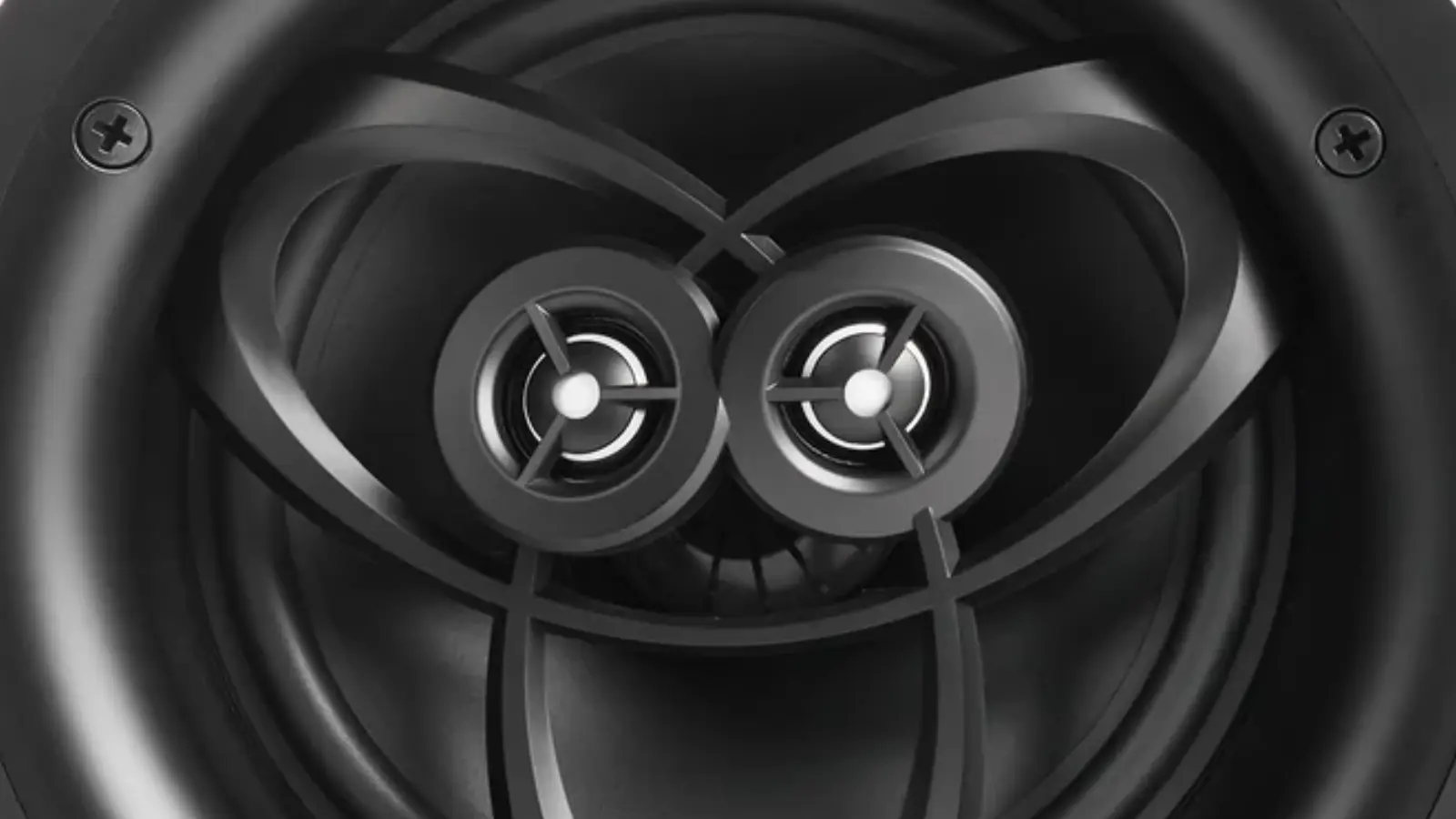
The AIM5 TWO features SpeakerCraft’s ARC Tweeter Array, consisting of three 5/8-inch aluminum dome tweeters arranged in a line array. The assembly can pivot by approximately 15 degrees and rotate through 359 degrees, providing considerable flexibility when positioning the high-frequency drivers.
The arrangement is more sophisticated than a conventional single-tweeter design. By using multiple tweeters, SpeakerCraft aims to improve dispersion and create a more generous listening area while maintaining greater control over high-frequency energy.
The AIM5 TWO also incorporates WavePlane technology, which acts as an acoustic lens to shape high-frequency dispersion. Acoustic Isolation Technology is intended to reduce the transfer of unwanted vibration into the surrounding drywall.
The woofer is a 5 1/4-inch glass-fibre cone design that can pivot by up to 15 degrees. A front-mounted switch provides +/-3 dB of treble adjustment, while the flangeless grille helps the speaker blend into its surroundings.
The AIM5 TWO is rated at 87 dB sensitivity, with an 8-ohm nominal impedance, 100-watt power handling and a specified frequency response of 42 Hz to 20 kHz.
The attention to detail is evident, particularly when compared with simpler architectural designs.
During our listening sessions, Alex’s favourite Steely Dan track comes up in the CD changer. I make a note that I could listen to these speakers for a long time, and we both find their presentation refined and well balanced.
The ARC Tweeter Array appears to deliver on its promise. The centre image is more convincing and stable than with several single-tweeter competitors, while the sound seems to occupy a wider area rather than emerging from a single point.
For an in-ceiling speaker, the AIM Series 2 comes surprisingly close to the presentation we associate with a respectable freestanding design. Its combination of driver adjustment, controlled dispersion and tonal balance makes it particularly interesting for listeners who want more than background music from their architectural speakers.
SpeakerCraft has clearly invested considerable engineering effort in this series. If advanced pivoting technology and discreet installation are your priorities, the AIM5 TWO deserves a place on your audition list.
Can You Have Great Home Theater Sound Without Seeing the Speakers?
Pivoting ceiling speakers address one of the biggest compromises in architectural home theater installations: the conflict between attractive interiors and convincing sound.
The models examined here demonstrate that manufacturers have several ways of approaching the problem. Some concentrate on adjustable tweeters, others allow larger driver assemblies to move, while more ambitious designs use multiple tweeters and acoustic technologies to improve dispersion.
However, there is no universal solution. A pivoting tweeter cannot compensate for every limitation of an incorrectly positioned speaker, and a discreet ceiling installation will not automatically outperform a properly positioned conventional speaker system.
Room acoustics, ceiling height, seating position, speaker placement and the quality of the drivers all remain important considerations.
For homeowners who want their living rooms to look like living rooms rather than equipment showrooms, these designs offer a compelling compromise. And for serious listeners, they demonstrate that hiding the speakers does not necessarily mean hiding their potential.