This Discontinued 175-Pound Subwoofer Packed 2,000 Watts and Serious Bass
Some subwoofers are designed to disappear into a living room. The Definitive Technology SuperCube Trinity Signature took the opposite approach. Weighing 175 pounds, standing nearly 32 inches tall, and powered by a 2,000-watt amplifier, it was built for listeners who wanted deep, physical bass without sacrificing the precision of a high-end loudspeaker system.
Originally priced at $3,000, the SuperCube Trinity was an ambitious design from Definitive Technology. Its combination of two 14-inch long-throw drivers, four passive radiators, and a claimed frequency response extending down to 10Hz put serious low-frequency performance at the center of its design.
The Trinity is now a discontinued model, so this is a look back at what made it stand out. Its original review is particularly interesting because the listening tests focused on something more demanding than simply shaking a room: integrating powerful bass with high-performance loudspeakers for both movies and music.
That distinction is what made the Trinity memorable. It wasn’t just about how much bass it could produce, but how well it could control it.
Why Definitive Technology Built Such a Massive Subwoofer
The SuperCube Trinity was developed around the challenge of reproducing the enormous pipe organs at Trinity Church in New York. Reproducing the lowest notes of a large pipe organ requires substantial low-frequency capability, and the Trinity’s design reflected that ambition.
At a time when many manufacturers were concentrating on making subwoofers smaller and easier to hide, Definitive Technology pursued a very different approach. The Trinity was intended to deliver deep bass with the physical authority that smaller enclosures can struggle to match.
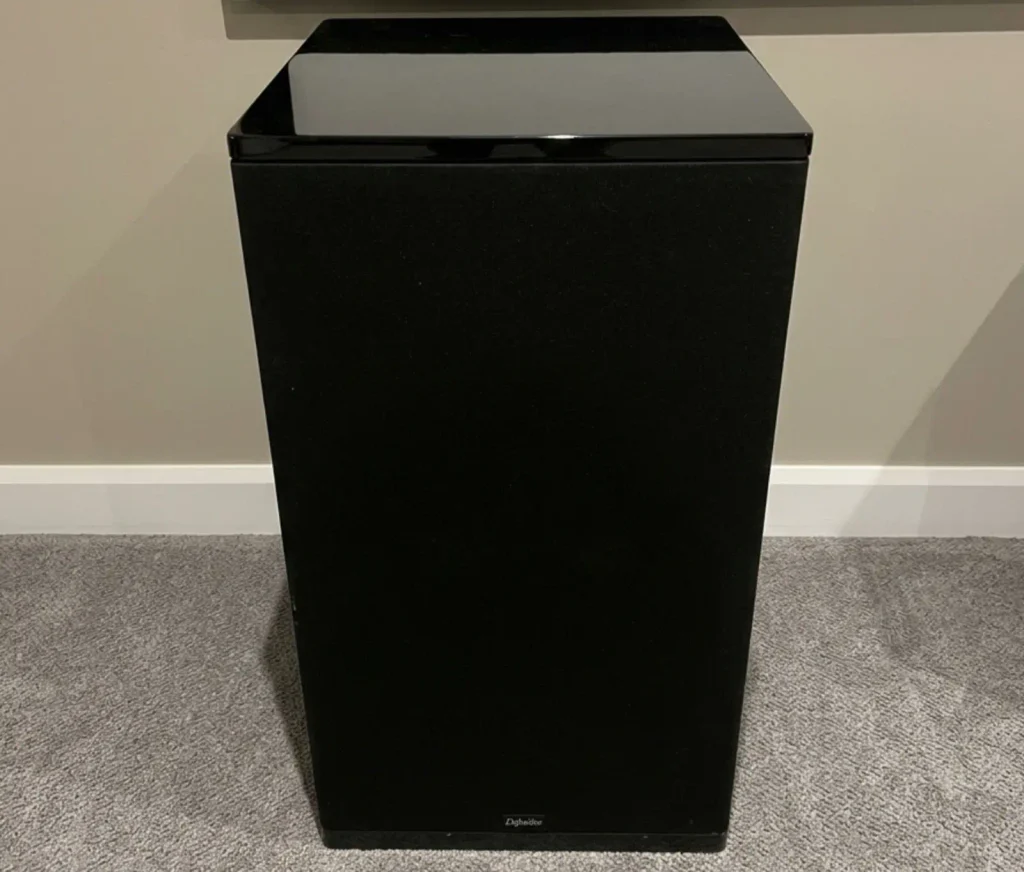
Its proportions leave little doubt about its priorities. Measuring 18 inches wide, 18 inches deep, and 31.75 inches tall, it was never going to blend discreetly into every living room.
The cabinet features a black fabric covering with a piano-black or cherry-finished top. The appearance is relatively restrained, but the sheer size makes the subwoofer a substantial part of any room.
At approximately 175 pounds, it is also a product owners would want to position carefully before beginning the calibration process. Moving it repeatedly to experiment with placement is considerably more demanding than it would be with a compact subwoofer.
Yet the physical scale was part of the appeal. The Trinity was built for enthusiasts who prioritized low-frequency performance over the ability to hide their equipment.
Two 14-Inch Drivers and a 2,000-Watt Amplifier
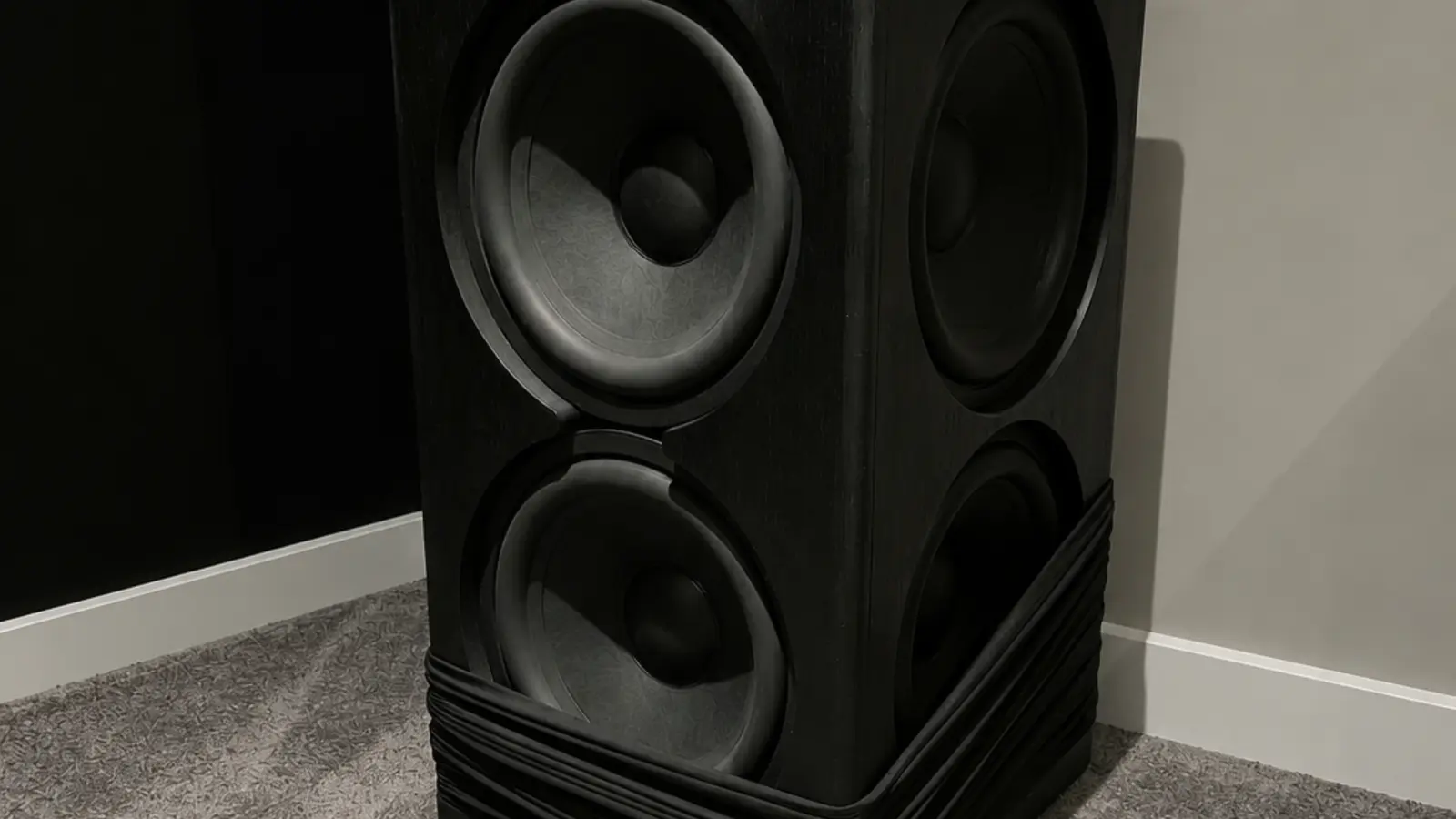
The SuperCube Trinity Signature combines two 14-inch long-throw SuperCube drivers with four 14-inch infrasonic passive radiators. A 2,000-watt digitally coupled Class D amplifier powers the system.
Its rated frequency response extends from 10Hz to 200Hz, although a published response range alone does not tell the whole story. Maximum output, distortion, and performance in the listening room also determine how effectively a subwoofer reproduces extremely low frequencies.
Nevertheless, the Trinity’s driver complement and amplification make its intentions clear. It was designed to deliver substantial low-frequency energy while retaining the control needed for demanding recordings.
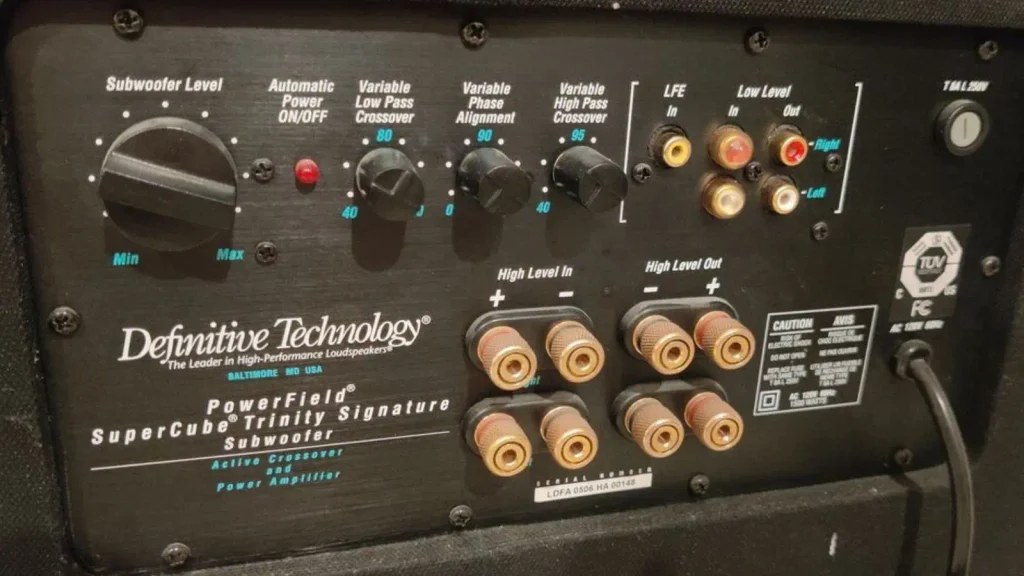
The adjustable low-pass crossover covers 40Hz to 150Hz, and a direct-coupled LFE input allows an AV receiver or processor to handle bass management. Variable phase adjustment from 0 to 180 degrees provides additional flexibility when integrating the subwoofer with the main speakers.
The Trinity also includes high-pass filtering options for different system configurations.
These controls are important because adding a powerful subwoofer does not automatically improve a system. The transition between the subwoofer and the main loudspeakers must be handled properly, or the additional output can make the bass sound thick, disconnected, or uneven.
The Trinity’s design offered the adjustment range needed to address those challenges.
Setting Up the Trinity: Power Is Only Half the Story
The original reviewer connected the Trinity through its LFE input and initially matched its placement and settings to a reference Linn Sizmik subwoofer. That reference system had been professionally set up by acoustician Bob Hodas.
The starting settings were an 80Hz low-pass crossover, a phase adjustment of 100 degrees, and a volume level matched to the front loudspeakers using an analog sound-pressure-level meter. Spikes were then installed to help stabilize the cabinet.
Those settings were specific to the reviewer’s room and equipment, rather than a universal recipe for every installation.
The real challenge was integrating the Trinity with Revel Salon loudspeakers that already delivered substantial bass. Simply increasing the amount of low-frequency energy would not have been enough. The subwoofer needed to extend the system’s capabilities without drawing attention to itself.
After further calibration, the Trinity blended seamlessly with the Revels. This was an important early indication that its performance involved more than brute force.
Why Is Everyone Suddenly Buying the Klipsch SPL-120 Subwoofer?
A subwoofer can generate enormous output and still sound slow or bloated. Getting one to complement high-performance loudspeakers requires the right balance of level, phase, crossover, and placement.
The Trinity’s reported ability to disappear into the system became one of the defining themes of the review.
Movie Performance: Explosions With Real Weight
16 Blocks
The first major movie test was 16 Blocks, the 2006 Bruce Willis action thriller. Its gunfire, car crashes, and other effects provided plenty of opportunities to test the Trinity’s low-frequency capabilities.
The reviewer immediately noticed a substantial increase in bass energy compared with the existing system. But the more interesting result came after the subwoofer had been properly integrated with the Revel Salon loudspeakers.
Gunshots carried convincing percussive weight, and the bass remained distinct rather than turning into a continuous rumble. Despite its enormous cabinet and powerful amplifier, the Trinity did not overwhelm the rest of the soundtrack.
This mattered because the main loudspeakers already reached deep into the bass region. The Trinity was not simply filling an obvious gap. It was adding energy and physical impact while retaining the speed and character of the existing system.
That combination made the subwoofer’s contribution more convincing than raw output alone could have done.
We Were Soldiers
The next test involved We Were Soldiers, with its gunfire, mortar attacks, and explosions.
The reviewer first played the footage without the Trinity and then repeated the experience with the subwoofer operating. The difference was dramatic, making the action feel considerably more physical.
What stood out was the ability to produce earthquake-like thunder without overwhelming the room. Large subwoofers can easily excite room resonances and create excessive bass, particularly when their output is not properly calibrated.
The Trinity still required careful adjustment, but once integrated, it delivered the desired impact without the saturation that can make explosions sound indistinct.
For a dedicated home theater, this is an important distinction. The objective is not simply to make every explosion louder, but to reproduce the scale and force of the soundtrack while preserving its detail.
Terminator 2: Judgment Day
Terminator 2: Judgment Day provided another useful demonstration of the Trinity’s abilities, particularly during the bar scene in which the Terminator acquires a motorcycle.
The engine’s low-frequency energy gave the subwoofer an opportunity to demonstrate both extension and impact. According to the original review, the motorcycle sounded exceptionally physical, with enough weight to make its presence almost tangible.
Yet the Trinity did not sacrifice definition to achieve that effect. The bass remained forceful without becoming loose or bloated.
This is where a capable subwoofer can transform a home theater experience. Rather than merely hearing the lowest frequencies, the listener gains a stronger physical impression of what is happening on screen.
The Trinity’s performance suggested that its appeal extended beyond sheer power to the way it controlled that power.
Music Performance: Could It Keep Up With High-End Speakers?
Movie soundtracks make it easy to appreciate a powerful subwoofer. Music is often a more demanding test because bass lines, kick drums, and synthesized notes must retain their timing, texture, and definition.
The Trinity’s original review placed considerable emphasis on this challenge. Its performance with the Revel Salon loudspeakers was especially important because those speakers already produced deep, well-defined bass.
Metallica’s Black Album
Metallica’s Black Album, played from DVD-Audio, was the first serious music test. The recording’s powerful bass passages offered an opportunity to determine whether the Trinity could add weight without making the music sound heavy-handed.
Without the subwoofer, the Revels already delivered tight and deep bass in the reviewer’s room. Adding the Trinity brought substantially more energy while preserving the original presentation’s speed and attack.
On “Sad But True,” the kick drum gained considerable physical weight without losing its punch. The reviewer also found the Trinity’s output between 20Hz and 40Hz clean and nimble.
“The Unforgiven” posed a different challenge. Its prominent bass notes could excite standing waves in the reviewer’s relatively small 12-by-20-foot room.
Some room resonance remained, but the overall presentation stayed controlled at high playback levels. The additional bass did not overwhelm the recording’s richer midrange and treble information.
That result was significant. The Trinity was adding low-frequency energy without making the rest of the recording sound less detailed.
Foreigner 4
Foreigner’s 4, also played from DVD-Audio, provided another demanding test.
“Jukebox Hero” contains powerful bass that can become congested when a system is pushed hard. The Trinity delivered the required impact while maintaining a tight, percussive presentation.
The reviewer reported listening at levels exceeding 100dB, with the bass remaining controlled. Such levels can be hazardous to hearing, so they should not be treated as a recommended listening target.
“Urgent” was equally impressive. The combination of snare strikes and bass guitar retained its impact, and the Trinity continued to blend with the Revel Salon loudspeakers rather than appearing as a separate source in the soundstage.
This was perhaps the strongest demonstration of the subwoofer’s dual-purpose character. It could deliver powerful bass without making music sound as though a separate, oversized subwoofer was doing all the work.
Yello’s Flag
The final music test involved Yello’s 1989 album Flag. Its electronic production, synthesized bass, and energetic rhythms offered a different way to assess the Trinity’s control.
The reviewer found the bass tight and articulate, with enough energy to make the recording feel engaging again. It was an older favorite that had fallen out of regular rotation, but the listening session renewed the reviewer’s interest in it.
That reaction illustrates an important aspect of subwoofer performance. The goal is not to make every recording artificially bass-heavy. A good subwoofer should reproduce the low-frequency information already present in the recording and integrate it with the main loudspeakers.
The Trinity’s performance with Yello reinforced the central finding of the original review: it could produce substantial bass while retaining the definition necessary for music.
The Downsides: Size, Placement, and Room Acoustics
The SuperCube Trinity’s most obvious disadvantage is its size. At 18 inches wide, 18 inches deep, and nearly 32 inches tall, it is difficult to conceal in a typical living room.
The original reviewer appreciated its substantial cabinet and even treated it as an end table. However, anyone looking for an unobtrusive subwoofer would likely find the Trinity impractical.
Its 175-pound weight also makes repositioning difficult. Placement matters with any subwoofer, and finding the best position can require experimentation. With the Trinity, that process is considerably less convenient.
Floor construction is another consideration. Powerful low-frequency output can excite structural resonances, particularly in suspended timber floors. A solid, stable floor is preferable, although the actual result depends on the building and room construction. Spikes may help stabilize the cabinet, but they should not be assumed to eliminate structure-borne vibration.
Room acoustics remain important, too. The Trinity’s impressive specifications cannot prevent standing waves or guarantee even bass response at every listening position. Appropriate placement, calibration, and level adjustment are still necessary.
Finally, the original $3,000 price placed the Trinity firmly in the high-end market. Its appeal depended on the buyer’s need for substantial low-frequency output, deep extension, and the ability to complement demanding loudspeakers.
Is the Definitive Technology SuperCube Trinity Worth Buying Used?
Because the SuperCube Trinity is discontinued, the question today is different from the one facing buyers when it was originally reviewed.
The historical review praised the subwoofer’s ability to combine powerful output with musical control. Those qualities remain relevant when evaluating a used example, but the original $3,000 price should not be mistaken for its current market value.
I could not establish a reliable current asking price for a working SuperCube Trinity Signature from the available listings. Historical asking prices alone are insufficient to establish what buyers are paying today.
Anyone considering a used example should pay particular attention to the condition of the amplifier, the operation of both active drivers, the passive radiators, and the controls and connections. Given the subwoofer’s age and complexity, confirming that it operates properly is more important than buying solely on the strength of its original specifications.
The cabinet’s size and weight also make shipping and installation worth considering. A seemingly attractive price can become less appealing if the unit needs specialist servicing or expensive transportation.
For prospective buyers, the most sensible approach is to assess the condition of the individual unit, confirm that it can be demonstrated working, and compare its asking price with other available subwoofers.
Verdict: A Discontinued Subwoofer That Put Control Before Brute Force
The Definitive Technology SuperCube Trinity Signature was an ambitious product. Its dual 14-inch drivers, four passive radiators, and 2,000-watt amplifier gave it the hardware to deliver substantial low-frequency output, but the original listening tests suggested that its greatest strength was how well it combined that output with control.
Action films gained physical impact, while music benefited from additional weight without losing its rhythm and definition. Its reported ability to integrate with the Revel Salon loudspeakers was especially impressive, demonstrating that powerful bass does not have to come at the expense of a system’s overall balance.
The drawbacks are clear. The Trinity demands space, careful placement, and proper calibration. It is not a practical choice for someone seeking a compact subwoofer that can disappear into a living room.
As a discontinued product, it also presents the additional considerations associated with buying older powered audio equipment. Condition, serviceability, and the asking price all matter.
The original reviewer considered the Trinity exceptional value at its $3,000 launch-era price. Today, its significance is better understood through its design and performance than through that historical price tag.
The SuperCube Trinity remains an interesting example of a high-end subwoofer built around an enduring principle: deep bass is impressive, but deep bass that remains controlled, articulate, and seamlessly integrated is what makes a system satisfying.
Definitive Technology SuperCube Trinity Specifications
| Specification | Details |
|---|---|
| Product type | Powered subwoofer |
| Active drivers | Two 14-inch long-throw drivers |
| Passive radiators | Four 14-inch infrasonic radiators |
| Amplifier | 2,000-watt Class D |
| Rated frequency response | 10Hz–200Hz |
| Low-pass crossover | 40Hz–150Hz, adjustable |
| Phase control | Continuously variable, 0–180 degrees |
| LFE connection | Direct-coupled, unfiltered |
| Dimensions | 18 × 18 × 31.75 inches |
| Weight | Approximately 175 pounds |
| Finishes | Black fabric covering with piano-black or cherry top |
| Original review-era price | $3,000 |
| Current status | Discontinued |
Specifications are drawn from the SuperCube Trinity Signature documentation. The $3,000 figure is its historical review-era price, not a current selling price.