Who Needs a Huge Subwoofer When Magnat Can Deliver Bass Like This?
A subwoofer doesn’t have to be enormous to make a strong impression. Magnat’s Omega CS-12 makes that point with a relatively compact cabinet, a 12-inch long-throw driver, and a powerful Class D amplifier rated at 525 watts RMS and 1,100 watts peak. More interestingly, this sealed subwoofer is specified to reach down to 18Hz, putting it firmly in the territory of serious low-frequency reproduction.
Originally introduced as a powerful addition to Magnat’s subwoofer range, the Omega CS-12 was designed for listeners who want deep bass without sacrificing control or taking up the space required by some larger subwoofers. Its combination of a closed enclosure, sophisticated DSP processing and substantial amplification makes it an interesting proposition for both stereo hi-fi systems and home cinema installations.
But specifications only tell part of the story. In this review, we look at the Omega CS-12’s construction, technical features, and real-world performance, including how it behaves with different loudspeaker combinations and demanding music and movie soundtracks.
Magnat Omega CS-12: A Different Approach to Deep Bass
Magnat has spent decades experimenting with loudspeaker technologies and unconventional designs. Its history includes developments such as ion tweeters in the 1980s, tube amplifiers, and the Omega 530, once promoted as one of the most powerful hi-fi subwoofers available.
That engineering experience has also influenced the company’s more conventional products. Magnat places considerable emphasis on measurement and driver development, using equipment from manufacturers such as Klippel, Audio Precision, Brüel & Kjær and Rohde & Schwarz. Its engineers use laser-assisted Klippel measurement systems to optimise loudspeaker drivers and their diaphragms, examining both small-signal and large-signal behaviour.
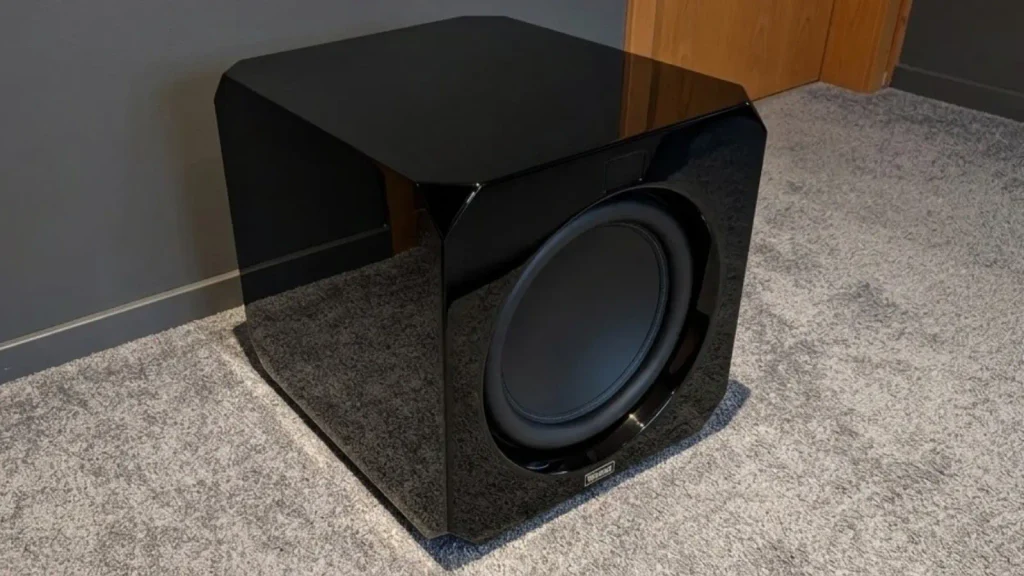
The Omega CS-12 is a good example of this engineering approach. Rather than relying on a large bass-reflex enclosure to produce substantial low-frequency output, Magnat opted for a sealed design measuring approximately 38.5 × 40 × 46.5cm, including the amplifier.
The cabinet has a distinctive appearance, with bevelled corners that give it a more compact and less conventional look. Its design also helps the subwoofer fit more naturally into a living room or dedicated listening space.
At its original launch, the Omega CS-12 carried a recommended price of €999, making its combination of power and sealed-box construction particularly interesting in its price category.
A 12-Inch Driver Backed by 1,100 Watts
The technical specifications are where the Magnat Omega CS-12 starts to become particularly interesting.
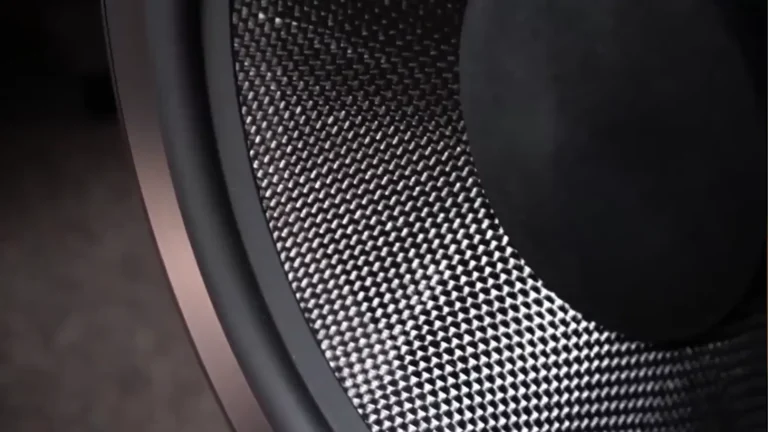
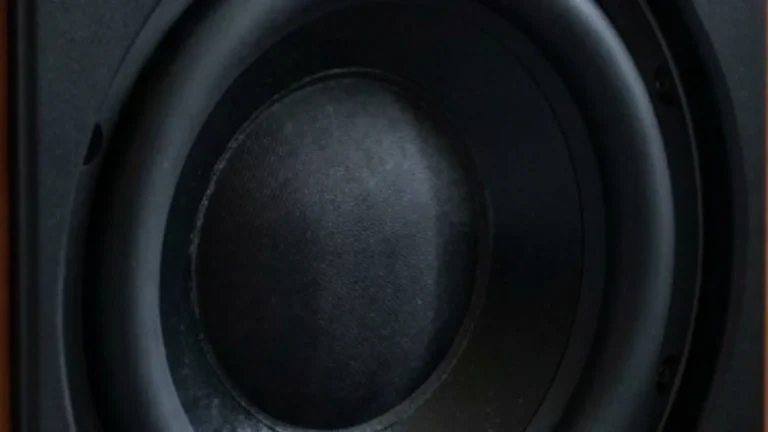
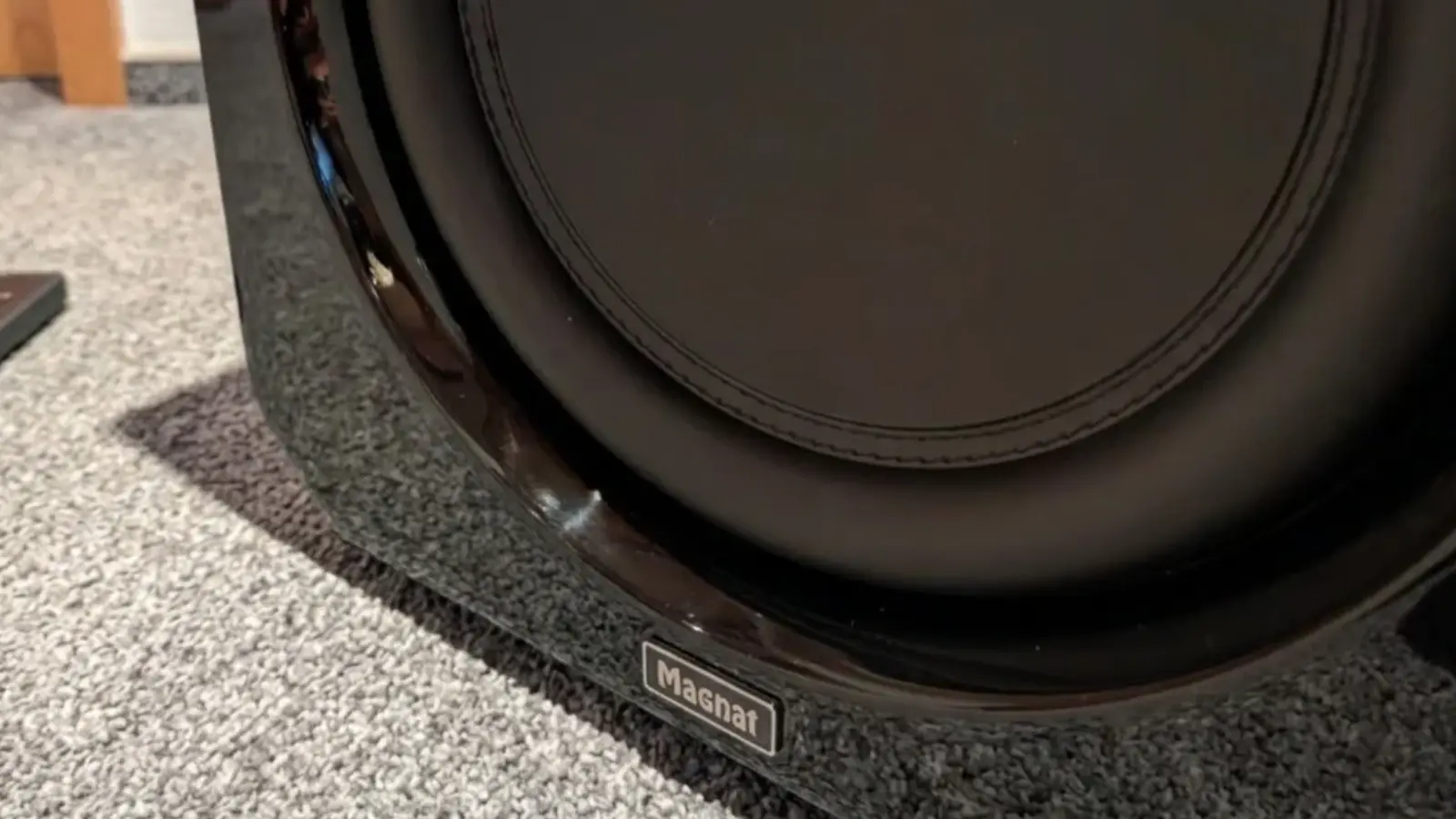
At its heart is a 30cm (12-inch) long-throw bass driver with a specially reinforced, coated sandwich diaphragm. A large spider and wide surround allow the cone to move through substantial excursions, helping it reproduce the lowest frequencies without immediately reaching its mechanical limits.
Power comes from an integrated Class D amplifier rated at 525 watts RMS, with peak output reaching 1,100 watts. This is an important part of the design because a sealed enclosure does not benefit from the additional acoustic output provided by a bass-reflex port. The amplifier and driver therefore have to work harder to maintain useful output at very low frequencies.
Magnat also incorporates DSP processing to help linearise the frequency response and manage the driver’s behaviour at high listening levels. A limiter circuit helps keep the subwoofer under control when the system approaches its operating limits.
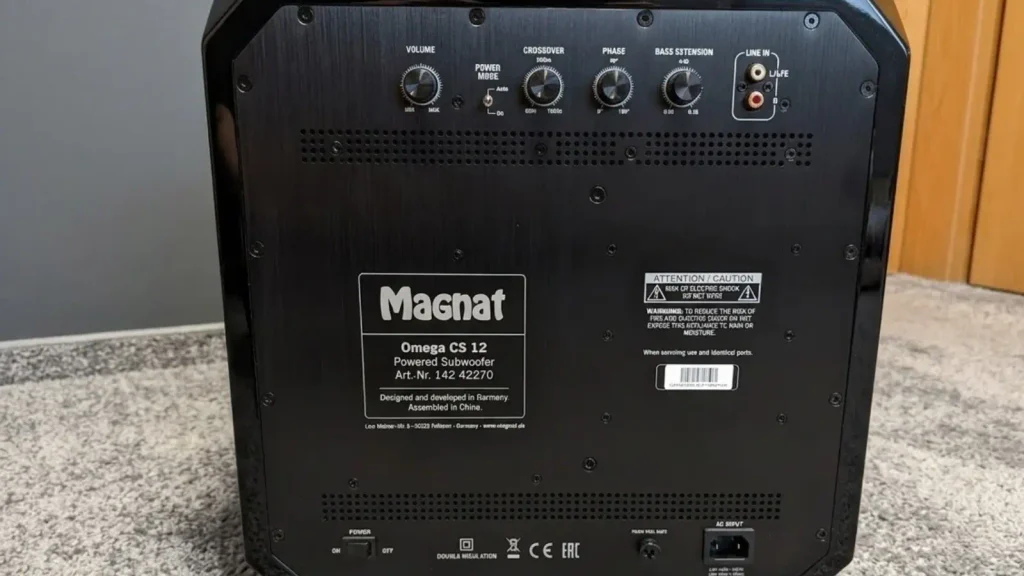
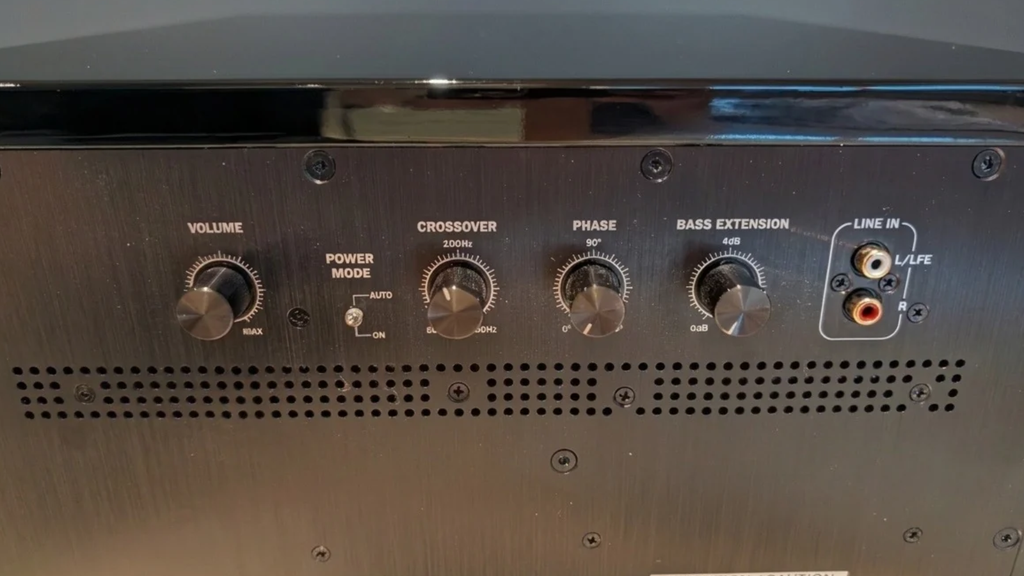
The bass-extension adjustment around 35Hz is another useful feature. Depending on the room and the rest of the speaker system, listeners can adjust the low-frequency response to suit their preferences. This is particularly valuable when integrating the Omega CS-12 into different listening environments.
The subwoofer provides adjustable level, phase and crossover settings, allowing it to work with a wide range of main speakers. Its line-level connection can be used with a subwoofer or LFE output from an AV receiver or compatible amplifier.
Why Did Magnat Choose a Sealed Enclosure?
One of the most important decisions in the Omega CS-12’s design is its sealed cabinet.
Bass-reflex subwoofers use a tuned port to increase output around a particular low-frequency region. This can provide greater acoustic efficiency, but the port can also introduce unwanted noise when pushed hard. A sealed enclosure avoids this problem because there is no port through which air can escape.
The sealed configuration also offers a gradual low-frequency roll-off and can provide more predictable integration with the main speakers. Its behaviour can be particularly appealing when reproducing music, where controlled bass and accurate timing are just as important as sheer output.
Of course, a sealed design brings its own challenges. Producing very deep bass from a relatively compact enclosure requires substantial cone movement and amplifier power. This is precisely why Magnat equipped the Omega CS-12 with a long-throw driver and a powerful amplification stage.
The cabinet itself is made from reinforced MDF to minimise unwanted vibrations caused by the substantial internal air pressure generated during operation.
The result is a design intended to combine deep bass extension with the controlled presentation expected from a well-engineered sealed subwoofer.
Setting Up the Magnat Omega CS-12: Placement Matters
Even an excellent subwoofer can disappoint when positioned incorrectly. Low frequencies interact strongly with the dimensions and boundaries of a listening room, creating standing waves and room resonances that can make certain bass notes sound excessively loud while others almost disappear.
This means the sound you hear depends not only on the subwoofer itself but also on where it is placed and where you sit.
A subwoofer positioned in an unfortunate location may produce boomy or uneven bass, even if its frequency response is exceptionally smooth under measurement conditions. Moving it just a short distance can sometimes make a surprisingly large difference.
One useful approach is the subwoofer crawl. Place the subwoofer temporarily at the main listening position, ideally around ear height if practical. Play bass-heavy music or low-frequency test material, then move around the room near the floor to find a position where the bass sounds most balanced. Place the subwoofer in that location and listen again from your normal seat.
Once the position is established, the remaining adjustments involve level, phase, crossover frequency and distance.
In a home cinema system, the AV receiver will generally handle bass management and apply the appropriate crossover. An 80Hz crossover is a common starting point, although the ideal setting depends on the main speakers and room. When the receiver controls the crossover, the subwoofer’s own low-pass filter should be set appropriately to avoid unwanted double filtering.
The Omega CS-12 does not include automatic room correction, so careful placement and calibration remain important parts of getting the best performance from it.
Magnat Omega CS-12 Listening Test: Music Gets a New Foundation
For the listening tests, the Magnat Omega CS-12 was connected to several different loudspeaker systems, including the Elac Debut Reference B6, ATC SCM 19 and Piega Ace 50 floorstanding speakers.
In each combination, the subwoofer proved to be a convincing addition. It extended the frequency range, added weight to the presentation and gave the soundstage a greater sense of depth.
Still buying CDs, Audiolab had a new reason to keep your disc collection
One particularly interesting observation was how naturally the Omega CS-12 integrated with the main speakers. A good subwoofer should not sound like a separate box producing bass in the corner of the room. Instead, its contribution should blend into the overall presentation, creating the impression of a larger and more complete loudspeaker system.
The Magnat managed this convincingly. Rather than drawing attention to itself with excessive bass, it added the lowest octaves while allowing the main speakers to retain their character.
Music streamed through Tidal and managed with Roon provided plenty of opportunities to explore its capabilities. The reviewer noted how much modern recordings can reveal in the lowest octaves, particularly when a capable subwoofer is added to an otherwise full-range system.
Magnat MA 900 hybrid Amplifier Review
Musica Nuda’s “Come Together” provided an excellent example, with its acoustic bass reproduced with clean contours and convincing definition. “Ain’t No Sunshine” by Buddy Guy and Tracy Chapman also demonstrated the Magnat’s ability to handle a powerful electric bass line and crisp drum work without making the presentation excessively heavy.
What stood out was the balance between the subwoofer and the other loudspeakers. The sound remained coherent rather than becoming a collection of separate sources, with the Omega CS-12 adding depth without overwhelming the music.
That is an important distinction. Some subwoofers can sound impressive initially because they emphasise certain bass frequencies, but this can quickly become tiring. The Magnat’s more controlled approach made it easier to appreciate the additional low-frequency information without constantly noticing the subwoofer itself.
Can the Omega CS-12 Handle Demanding Bass?
The listening tests also included more challenging material.
Peter Less’s “Half-Life” proved particularly demanding, with its powerful electronic bass placing considerable demands on the subwoofer. Some bass-reflex designs can struggle under this kind of pressure, sometimes producing audible port noise as air moves rapidly through the enclosure.
The sealed Magnat avoided that particular problem. Although its driver was moving through substantial excursions, the bass remained controlled even when the material became demanding.
The reviewer also compared it with the AperionAudio Bravus II 12D, finding the Omega CS-12 superior in both level stability and precision. Its overall character was also reminiscent of the Miller & Kreisel V12, another sealed subwoofer equipped with a 30cm driver.
This comparison is particularly interesting because it highlights what Magnat was trying to achieve. The Omega CS-12 is not simply designed to produce as much bass as possible. Its purpose is to combine substantial output with the kind of precision that makes a subwoofer useful for serious music listening.
What Happens When You Use It for Home Cinema?
The Magnat Omega CS-12 was equally convincing in a multichannel system.
With the levels properly calibrated, the subwoofer remained unobtrusive until the soundtrack demanded its contribution. Rather than constantly drawing attention to the effects channel, it added impact when the sound engineer had mixed deep bass into the soundtrack.
The animated film Antz provided an entertaining demonstration. During the picnic scene, when enormous shoes stomp around the tiny characters, the initial impact was followed by a substantial low-frequency resonance.
The Magnat reproduced both elements convincingly, demonstrating that its abilities extend beyond brute-force bass. It also managed softer low-frequency details with sufficient differentiation, giving the soundtrack a more complete sense of scale.
Its dynamic capabilities make it a strong candidate for small and medium-sized home cinema systems. However, the original listening tests also demonstrated that room size and listening levels matter. The subwoofer was used in a room approaching 50 square metres, larger than Magnat’s suggested ideal listening area of approximately 30 square metres.
It performed well, although the maximum output naturally became more limited during particularly demanding action sequences.
Who Should Buy the Magnat Omega CS-12?
The Magnat Omega CS-12 makes the most sense for listeners who already own capable bookshelf or floorstanding speakers but want to extend their system’s low-frequency response.
For stereo enthusiasts, its sealed construction and controlled bass presentation make it an appealing way to add the lowest octaves without compromising the character of the main speakers.
Home cinema owners can also benefit from its combination of deep extension and substantial amplification. It can reproduce the impact of movie soundtracks while retaining the ability to handle more subtle low-frequency information.
Room size should be considered before buying. Magnat’s recommended application is around 30 square metres, and although the original tests showed that the subwoofer could work in a considerably larger space, very large home cinemas may require multiple units to achieve higher bass levels.
Verdict: A Sealed Subwoofer That Takes Bass Seriously
The Magnat Omega CS-12 demonstrates how much performance can be extracted from a relatively compact sealed enclosure when the driver, amplifier and DSP are properly matched.
Its 12-inch long-throw driver and 525-watt RMS amplifier provide the foundation for impressive low-frequency performance, while the sealed cabinet helps maintain a controlled and precise presentation. More importantly, the listening tests showed that it could integrate naturally with different loudspeaker systems rather than simply adding excessive bass.
Its limitations become more apparent in very large rooms and demanding home cinema installations, where additional subwoofers may be necessary. It also lacks built-in room correction, making careful positioning and calibration essential.
Nevertheless, the Omega CS-12 offers a compelling combination of deep bass, musical precision and home cinema impact. At its original €999 launch price, it was particularly attractive for anyone looking for a serious sealed subwoofer without moving into considerably more expensive territory.
For listeners who value both music and movies, the Magnat Omega CS-12 is a subwoofer that deserves serious consideration.
Magnat Omega CS-12 Specifications:
| Specification | Details |
|---|---|
| Type | Active sealed subwoofer |
| Driver | 30cm (12-inch) long-throw woofer |
| Amplifier | Class D |
| Continuous power | 525 watts RMS |
| Peak power | 1,100 watts |
| Frequency response | 18Hz–200Hz |
| Crossover frequency | 50Hz–150Hz, adjustable |
| Phase adjustment | 0°–180° |
| Bass extension | Adjustable around 35Hz |
| Cabinet | Reinforced MDF |
| Dimensions (H × W × D) | 38.5 × 40 × 46.5cm |
| Weight | 24kg |
| Finish | Black / White |
| Original launch price | €999 |