Revel Concerta B12 Review: The 650-Watt Subwoofer That Tamed My Room’s Bass Problems
Revel has spent years building a reputation among home theater and hi-fi enthusiasts who want serious loudspeaker performance. Its Ultima and Performa ranges have attracted listeners looking for high-end sound, but those products have traditionally occupied a different price category from the speakers most people buy for their first serious home theater.
If you’re interested in the wider Concerta family, our Revel Concerta2 MI6 review looks at how the bookshelf speakers perform in a stereo or home theater system
The Concerta series brought some of Revel’s engineering approach to a more accessible part of the market. For enthusiasts looking to move beyond mass-market speakers, it offered a way to experience the brand without paying flagship prices.
The Revel Concerta B12 was an interesting part of that lineup. Originally priced at $999, this powered subwoofer combined a 10-inch driver, a 650-watt amplifier and something that still deserves attention: a built-in parametric room equalizer.
That last feature turned out to be particularly useful in my listening room. I discovered a troublesome resonance around 60Hz that made the glass in my flush-mounted gas fireplace rattle during playback. Rather than simply turning down the bass and sacrificing the experience, I used the B12’s adjustable EQ to reduce the offending frequency.
It was a practical demonstration of what a well-equipped subwoofer can do. The B12 had to deliver convincing bass for music and movies, but it also had to work in a real room with its own acoustic problems.
Design and Build Quality
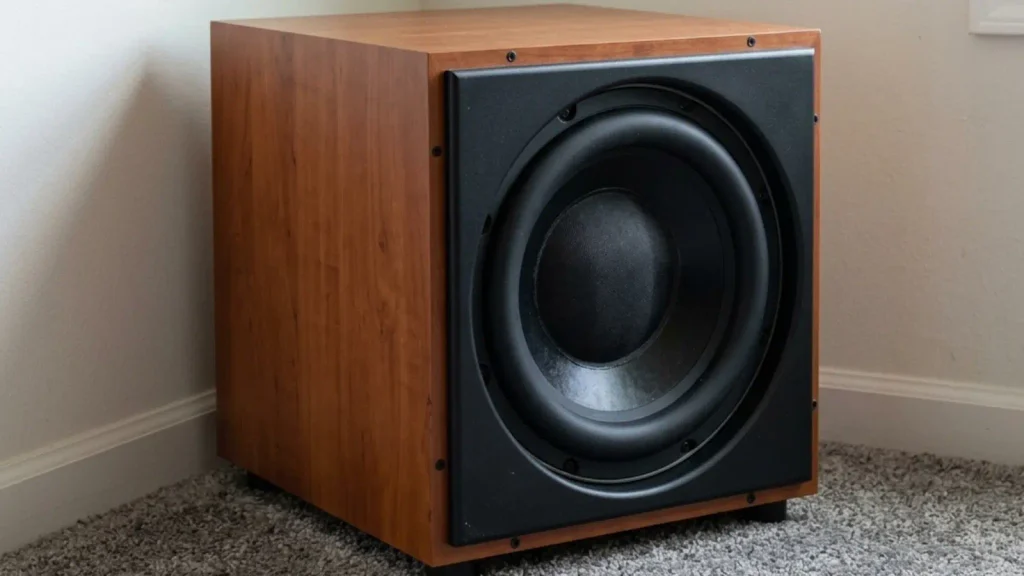
The Revel Concerta B12 is not a tiny subwoofer, but its proportions are relatively manageable for a product weighing approximately 64 pounds. Measuring 14.10 inches high, 13.12 inches wide and 15.96 inches deep with the grille fitted, it should fit into many home theater rooms without dominating the space.
Metal spikes are included for carpeted floors, while rubber feet are provided for hard surfaces. My theater room had a tile floor, so I used the rubber feet supplied with the subwoofer.
The cabinet is constructed from thick MDF with internal bracing to help maintain rigidity. The B12 was available in black ash, maple and natural cherry finishes. My review sample came in natural cherry, which almost matched my kitchen cabinets.
Revel’s design priorities here were clear. The B12 was built around its driver, amplifier and acoustic controls rather than an elaborate exterior. Its square cabinet is understated, although listeners who prefer rounded edges or more distinctive styling may find it rather ordinary.
I have always liked the compact appearance of some Sunfire subwoofers, so the B12 did not win me over on looks alone. The natural cherry finish was also somewhat orange, and its faux-wood appearance did not quite reproduce the character of real wood.
Fortunately, there is an easy solution if you prefer not to make the subwoofer a visual centerpiece: keep the grille fitted and place it where it integrates naturally with the room. That is what I did, tucking the cabinet into a corner.
The styling is average, but the build and engineering matter considerably more in a product designed to reproduce demanding low-frequency effects.
A 10-Inch Driver With a 650-Watt Amplifier
The B12 uses a proprietary 10-inch woofer with an anodized aluminum diaphragm, a three-inch copper voice coil and Revel’s Symmetrical Field Gap motor design.
According to Revel, the driver can achieve two inches of peak-to-peak excursion. That movement, combined with the amplifier’s substantial output capability, is intended to deliver strong bass without excessive distortion.
The manufacturer’s specifications list a maximum amplifier output of 650 watts over the 20Hz to 150Hz range at no more than 0.1 percent total harmonic distortion. That is a specified maximum output condition, not a claim that the subwoofer produces its maximum power continuously at every frequency.
The published anechoic low-frequency extension is more informative when considering how deeply the B12 can reproduce bass. Revel specifies 28Hz at -3dB, 25Hz at -6dB and 23Hz at -10dB.
Those figures indicate that the B12 was designed to reach well into the low bass, although actual performance depends on room acoustics, placement, playback level and the rest of the system.
The cabinet’s internal bracing, driver motor and substantial voice coil all contribute to the design. Rather than relying on amplifier power alone, Revel combined several elements intended to maintain control when the subwoofer is asked to produce demanding passages.
For another perspective on compact, performance-focused bass, our JL Audio Dominion d108 review explores how a smaller subwoofer can complement full-range speakers.
Rear-Panel Controls and Room EQ
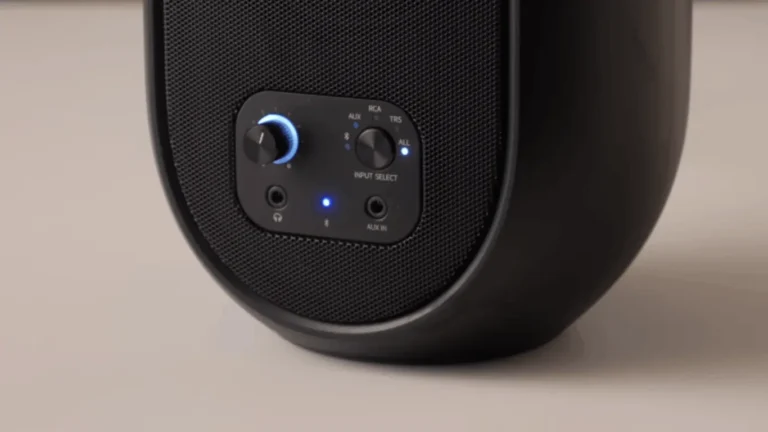
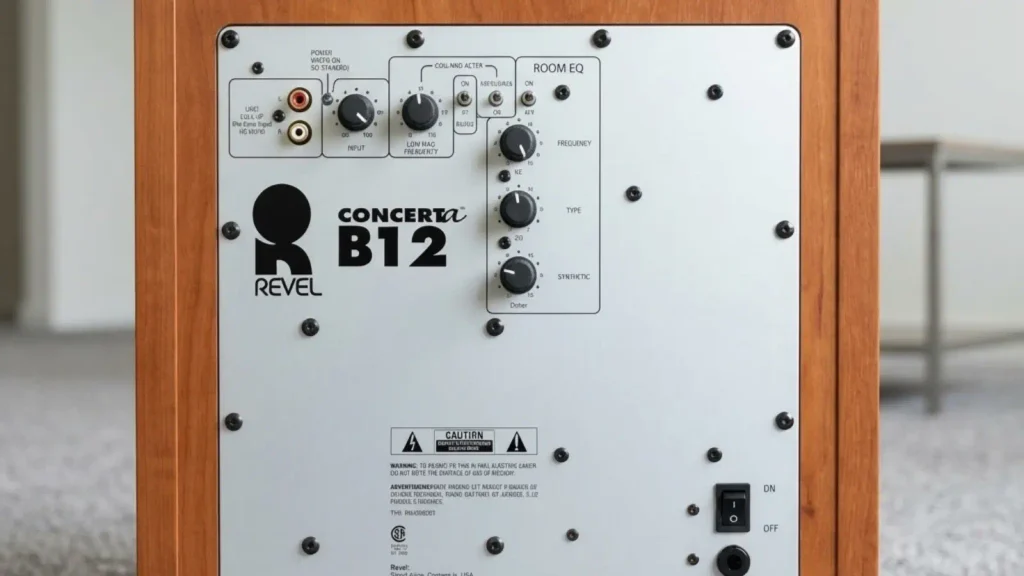
The rear panel is one of the most interesting parts of the Revel Concerta B12. It houses the stereo RCA inputs, status indicator, level control, variable low-pass filter, phase switch, parametric equalizer and power switch.
The status light turns green during normal operation and red in standby. When the subwoofer receives no signal for approximately ten minutes, it automatically enters standby and wakes when a signal returns.
I appreciated this feature because subwoofers are often positioned in corners or behind furniture, where reaching the power switch is inconvenient. I generally left the B12 switched on and allowed its standby function to handle periods of inactivity.
Level control
The volume knob has minimum and maximum markings, along with a nominal reference position. It is not a precision numerical adjustment, but it offers a useful range for balancing the subwoofer against the main speakers.
Getting this balance right is important. Too much output can make the bass overpower the rest of the system, while too little leaves the subwoofer contributing less than it should.
Low-pass crossover
The variable low-pass filter covers 50Hz to 175Hz, with a 24dB-per-octave slope. It determines the highest frequencies reproduced by the subwoofer when this filter is active.
For a system connected to an AV receiver or processor with bass management, the usual approach is to leave the B12’s own low-pass filter switched off and let the receiver handle crossover duties.
For a two-channel system without a dedicated bass-management crossover, the B12’s filter can help integrate the subwoofer with the main speakers. Its setting depends on the speakers’ low-frequency capabilities and the characteristics of the room.
My RBH WM-24 speakers could reproduce bass down to approximately 50Hz, which gave me a useful starting point for configuring the B12 for two-channel music.
Phase switch
A 0°/180° phase switch provides another adjustment for integration with the main speakers. The correct position depends on the relative placement of the speakers, the subwoofer and the listening seat.
Although it is tempting to select a setting based only on the movement of the driver, the more useful test is how the bass combines at the listening position. Compare both settings with familiar material and choose the one that produces the more even, convincing result around the crossover region.
Parametric room equalization
The built-in parametric EQ is the B12’s standout feature.
It provides three adjustable parameters:
- Frequency: Selects the center frequency of a room-related problem between 20Hz and 80Hz.
- Bandwidth: Adjusts the range of frequencies affected, from 0.05 to 0.53 octaves.
- Level: Applies a cut from 0dB to -14dB.
This is not a complete automatic room-correction system. It is a manual tool for reducing a troublesome low-frequency peak, and it requires some experimentation to use effectively.
In my room, it proved far more useful than an extra styling detail or another control that I would rarely touch. The fireplace rattle gave me a specific problem to solve, and the B12 provided the adjustment needed to address it.
Setting Up the Revel Concerta B12
My theater system used RBH on-wall and in-wall speakers, so I could not evaluate the B12 as part of a complete Revel Concerta system. That was useful in another way: it allowed me to assess how the subwoofer worked with speakers from a different manufacturer.
Subwoofers can often be integrated into mixed-brand systems more easily than the front three speakers of a home theater. The latter need to maintain consistent tonal characteristics, while a subwoofer’s main task is to reproduce the low frequencies assigned to it.
Placement was somewhat restricted in my room, but I managed to put the B12 in the front-left corner. Revel’s guidance also discusses using two subwoofers where practical, with placement chosen to improve bass coverage and reduce the severity of room-related peaks and nulls.
Two subwoofers are not automatically better in every room, and placement still matters. However, using more than one can provide more even bass across multiple seats when the system and room are configured properly.
The most memorable part of my setup was discovering a frequency that caused the glass in my flush-mounted gas fireplace to rattle. The problem was particularly noticeable during music with substantial low-frequency content.
I used the supplied test disc to identify the troublesome area at approximately 60Hz. I then adjusted the parametric EQ frequency, narrowed the bandwidth to target the problem, and reduced the level until the rattle disappeared.
The result was immediate. With the EQ switched off, the fireplace rattled during the relevant passages. With the EQ enabled, the disturbance disappeared without dramatically changing the overall tonal balance of the music.
The sensible long-term solution would have been to open the fireplace and secure the offending component. Nevertheless, the B12 allowed me to address the problem in the meantime without giving up the bass that made the system enjoyable.
There is an important distinction here: room EQ can reduce a bass peak, but it cannot repair a loose object or correct every acoustic problem. Placement, crossover settings and the physical room remain important parts of subwoofer setup.
Listening Impressions: Music and Movies
Rush and Neil Peart: Keeping up with fast drums
I am a bit of a hack drummer myself, and I enjoy playing along to Rush and Led Zeppelin on my iPod through the auxiliary input of my Yamaha digital drums.
A particularly useful test came from Neil Peart’s Anatomy of a Drum Solo, a two-disc instructional DVD that breaks down his solo, “Der Trommler.” The controlled studio recording provided an opportunity to listen closely to the individual drum sounds.
I cued up the rapid double-bass pedal section, where Peart’s feet move at remarkable speed. A good kick drum sound needs more than sheer weight. There is a defined attack, a body to the note and a low-frequency foundation that should not obscure the rhythm.
The Revel B12 provided a solid bottom end that blended well with the RBH speakers. The relationship between the visible pedal strikes and the resulting sound also gave me a useful impression of the subwoofer’s responsiveness.
I have heard faster-sounding subwoofers, including some of Sunfire’s smaller models. Even so, the B12 handled the demanding passages impressively for a subwoofer with a 10-inch driver.
As Peart moved around the drum kit, using the lower floor toms to create a sustained, droning effect, the B12 maintained enough definition to keep individual strikes distinguishable. On a less controlled system, those sounds can merge into an indistinct low-frequency rumble.
The B12 gave the drums a convincing foundation without making the performance sound unnecessarily thick.
Kung Fu Hustle: Bringing movie effects to life
Kung Fu Hustle is an unusual film, mixing martial arts, comedy, musical elements and exaggerated action. Its sound design makes it a particularly entertaining test for a home theater system.
One sequence features two assassins attacking three martial arts masters with an instrument that produces an extraordinary, escalating sound effect. The resulting blasts and impacts are exaggerated, almost surreal, and the soundtrack depends heavily on sound to convey the action.
The B12 reproduced these effects with impressive detail and precision in my system. The low-frequency energy added weight to the impacts without making the sequence sound like a succession of indistinguishable explosions.
It was a good demonstration of why bass quality matters in a home theater. A subwoofer should deliver impact, but it should also preserve the shape and timing of the sound rather than simply making everything louder.
The Revel provided the physical weight these scenes needed while retaining a sense of control.
Jamiroquai: Bass that stays composed
Dance music presents a different challenge. A subwoofer needs to reproduce the weight of the kick drum while keeping pace with the bass line, especially when the two overlap rhythmically.
I turned to Jamiroquai’s Dynamite, specifically “Black Devil Car,” using the enhanced stereo mix.
The track puts the relationship between the drums and bass guitar front and center. The kick drum delivers its low-frequency punch while the slap bass adds a different texture and rhythmic accent.
The B12 handled these competing demands well. Compared with a Polk LSi subwoofer I had heard in another system, the Revel seemed smoother through the upper portion of the bass range, producing a cleaner overall presentation.
The important point was not that the Revel made more bass, but that it made the different elements easier to follow. The bass line retained its character instead of becoming a continuous low-frequency wash.
That balance is particularly important with music, where a subwoofer can easily become distracting if it adds too much weight or obscures the timing of the performance.
Pink Floyd: Finding the limits of the room
I returned to an old favorite, the 30th-anniversary SACD release of Pink Floyd’s The Dark Side of the Moon.
The opening heartbeat and the building effects of “Speak to Me/Breathe” are an excellent way to assess the way a system handles low-frequency texture, dynamic changes, and sustained bass.
This was also where the fireplace problem became impossible to ignore. Without the parametric EQ engaged, the rattling made the system unpleasant to listen to at higher levels.
Once I had adjusted the EQ, I could turn the music up considerably without the same distraction. The B12 delivered a tight, fast, and remarkably smooth bass presentation for a product that originally sold for under $1,000.
The rubber feet on my tile floor and the cabinet construction also helped keep the subwoofer itself from becoming an obvious source of unwanted noise.
The following day, I asked my neighbors whether my Pink Floyd demonstration had disturbed them. I had been playing it at a level that made me wonder whether the entire neighborhood had heard the performance. They had not even realized I was listening to music.
That does not mean every apartment or building will behave the same way. Low-frequency sound can travel through structures, and room construction makes a substantial difference. But in my particular setup, the B12 delivered the scale and weight I wanted without creating the nuisance I had feared.
The Downsides of the Revel Concerta B12
The B12 is not without shortcomings.
Its appearance is fairly ordinary. The square cabinet does little to distinguish it from other conventional subwoofers, and the natural cherry finish on my sample looked more orange than authentic wood. The muted silver rear panel was attractive, but it is hardly a feature anyone would want to display.
I would have preferred the softer edges and more compact styling of some competing designs. Nevertheless, the straightforward cabinet is consistent with a product that places more emphasis on performance and useful engineering than visual extravagance.
The setup process also had its frustrations. As a primarily Mac user, I had to find a PC to run the setup software. I was unable to locate the B12’s software on Revel’s website at the time, so I used a version intended for the larger B15. I managed to get it working, but this was hardly an ideal experience.
The B12 also did not include a sound-pressure meter. Anyone attempting the more involved calibration procedure would need to obtain a suitable meter separately.
These are historical observations from my original review, rather than a statement about the availability of software, accessories or support today.
Finally, the parametric EQ is useful, but it is not a substitute for understanding the room. You need to identify a problem frequency, make careful adjustments and listen again. Listeners who want an entirely automatic setup process may prefer a system with integrated room correction.
None of these shortcomings undermined the B12’s core performance in my room, but they are worth considering if you are shopping for an older subwoofer.
Verdict:
The Revel Concerta B12 made a strong case for itself when it launched at $999. It combined a powerful amplifier, a capable 10-inch driver and a parametric room equalizer in a cabinet that could fit into many home theater rooms.
Its greatest strength was not simply the amount of bass it could produce. It was the way the subwoofer combined weight and impact with enough control to make music enjoyable, from Neil Peart’s rapid kick-drum passages to the bass line on Jamiroquai’s “Black Devil Car.”
Movie soundtracks benefited too. The B12 gave the exaggerated effects in Kung Fu Hustle the weight they needed without reducing everything to an undifferentiated rumble.
But the built-in EQ was the feature that left the strongest practical impression on me. Being able to reduce the resonance that made my fireplace rattle meant I could enjoy the system at higher levels without that irritating distraction.
The original $999 price should be treated as historical. The B12 is an older model, so anyone considering one today should check its condition, service history, amplifier operation and the availability of parts before buying. Its value will depend on the asking price and the condition of the individual unit.
If you already own a capable pair of speakers and want to add more depth to your system, the Revel Concerta B12 deserves consideration as a used-market option. It is also worth remembering that subwoofer integration involves more than buying a powerful model: placement, room acoustics and proper calibration can make a substantial difference.
The B12 was not the most stylish subwoofer I had tested, and its setup software presented some frustrations. But it delivered convincing musical bass, brought movie effects to life and gave me a practical way to address a real problem in my listening room.
For me, that combination made it a particularly satisfying subwoofer to live with.