Forget Hi-Res Audio: “Biological Tuning” Is the Future of Sound
Imagine headphones that don’t just tune to your room—they tune to you.
Your ears. Your hearing curve. Your personal sonic fingerprint.
This isn’t science fiction anymore. It is the beginning of a revolution in high-fidelity listening: AI-assisted sound personalization, led by technologies like Masimo AAT (Adaptive Acoustic Technology), which was recently adopted by Denon.
The impact here is much bigger than a fancy EQ preset. This is audio that adapts to your biology. Let’s go deep into what this technology does, why it matters, and how it’s already reshaping the future of Hi-Fi.
What Makes This So Special?
Most speakers and headphones are designed around one stubborn idea: “If it measures flat in a lab, it will sound great for everyone.”
But real listeners aren’t lab mannequins. We have different ear shapes, different sensitivities, and varying levels of high-frequency roll-off as we age. Two people listening to the same pair of expensive headphones often aren’t hearing the same thing at all.
Enter the next frontier: AI that measures your hearing… automatically.
Meet Masimo AAT: The AI Engine That Learns Your Ears
Masimo—a medical-technology giant—created AAT to bridge the gap between hardware and biology. This technology is the spiritual successor to Nura (the Australian pioneer acquired by Masimo in 2023), and it has now found a mainstream home in the Denon PerL and PerL Pro earbuds.
The process is stunningly simple:
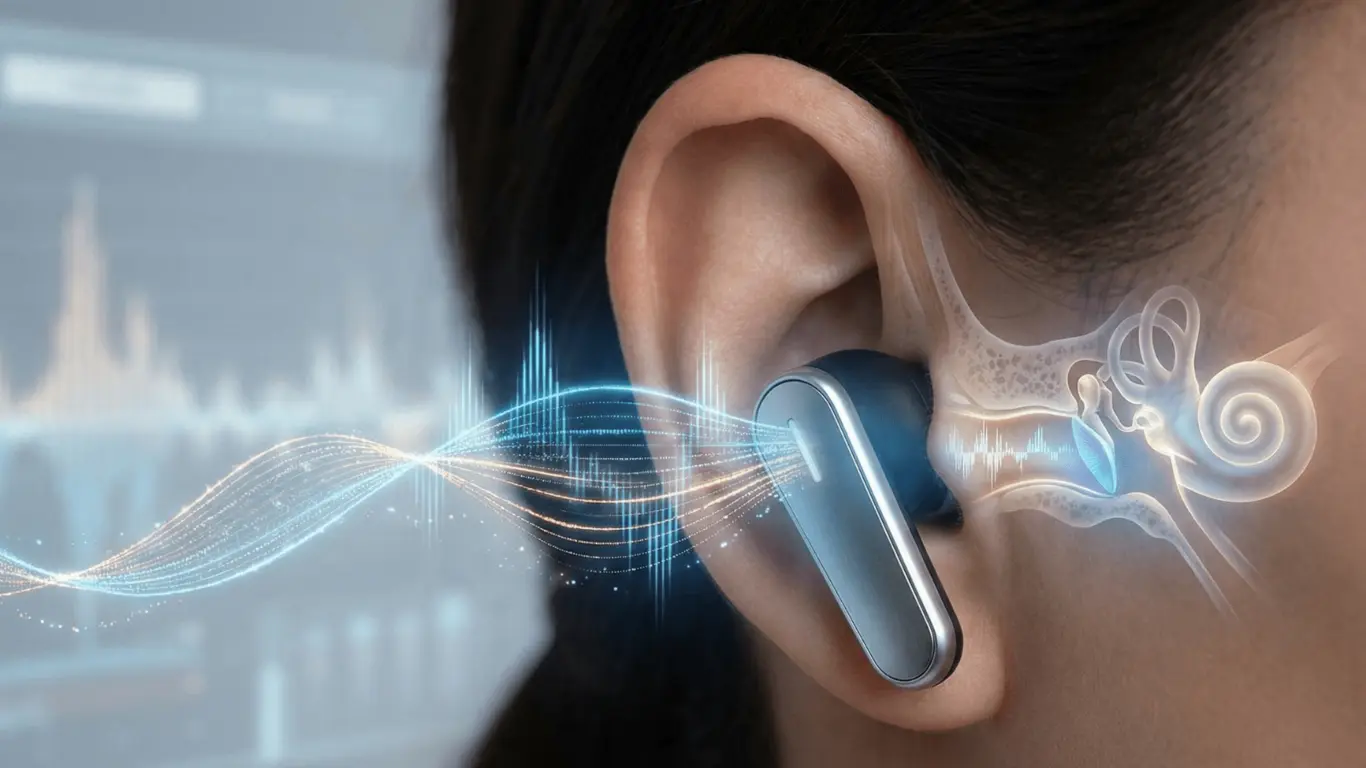
- Tiny microphones inside the earbuds listen to your cochlear.
- The system plays test tones into your ear.
- Your inner ear sends back tiny “echoes” called Otoacoustic Emissions (OAEs).
- The AI analyzes these signals to build a hearing profile unique to you—like a fingerprint.
Music is then digitally sculpted so your ears hear every detail they naturally miss. This takes about 60 seconds. No hearing test, no audiologist, no guessing.
Why OAEs Are a Game-Changer for Audiophiles
OAEs are microscopic sounds produced by your inner ear in response to incoming sound. Doctors have used them for years to test newborns’ hearing, but applying them to consumer audio is a massive leap forward.
In my experience testing this technology, the difference isn’t subtle. It reveals exactly which frequencies your ears struggle with and detects asymmetry between your left and right ears. It essentially performs room correction—but for your cochlea.
The Audible Benefits: What You Actually Hear
When you toggle that “Personalized” switch on, three things happen immediately:
- Clarity Returns: Vocals sharpen, and micro-details appear. The high-frequency shimmer that often fades with age is restored, effectively lifting a veil from the music.
- True Balance: Most of us have uneven hearing between our left and right ears. Traditional headphones can’t fix that, but AAT balances the stereo image perfectly to your specific sensitivity.
- Objectivity: This isn’t subjective like “listen to this tone and tell me when you hear it.” OAEs don’t lie. It is data-driven tuning.
Is It Perfect? The Real-World Limits
While the tech is impressive, it is important to be realistic. Here is what I found in real-world use:
- The “Seal” is Critical: Because OAEs are tiny signals, the earbuds need a perfect acoustic seal to measure them. If you use the wrong ear tip size, the calibration will be off.
- Silence is required: You cannot do this on a bus. You need a quiet room for the one-minute test to work accurately.
- It won’t Fix Bad Sources: It optimizes the frequency balance, but it can’t turn a low-bitrate MP3 into a lossless FLAC file.
The Big Picture: This Is the Next Era of Hi-Fi
Audiophiles have spent decades arguing about DAC chips, bitrates, and cable purity. But the reality is, improving the listener’s hearing response produces a bigger audible difference than almost any hardware upgrade.
For many people, personalized audio unlocks a version of their music they’ve never heard before. Not louder. Not boosted. Just correct for their ears.
The future of Hi-Fi isn’t just about better gear. It’s about better listening.