How Much Serious Sound Can You Really Fit Into a Pair of Budget Bookshelves?
Most small speakers are honest about their size. They sound fine on a desk, fill a bedroom with background music, and quietly convince you that you do not need anything bigger. The Klipsch R-40PM plays a different game.
These are small speakers on paper, featuring a single 4-inch woofer per side and no separate receiver or amplifier in sight. Behind that copper-and-black Klipsch face sits a genuinely complete Hi-Fi system: its own amplification, Bluetooth, USB, optical, analog, and a dedicated phono input for a turntable. That combination alone puts them in a different category from the average pair of compact powered speakers.
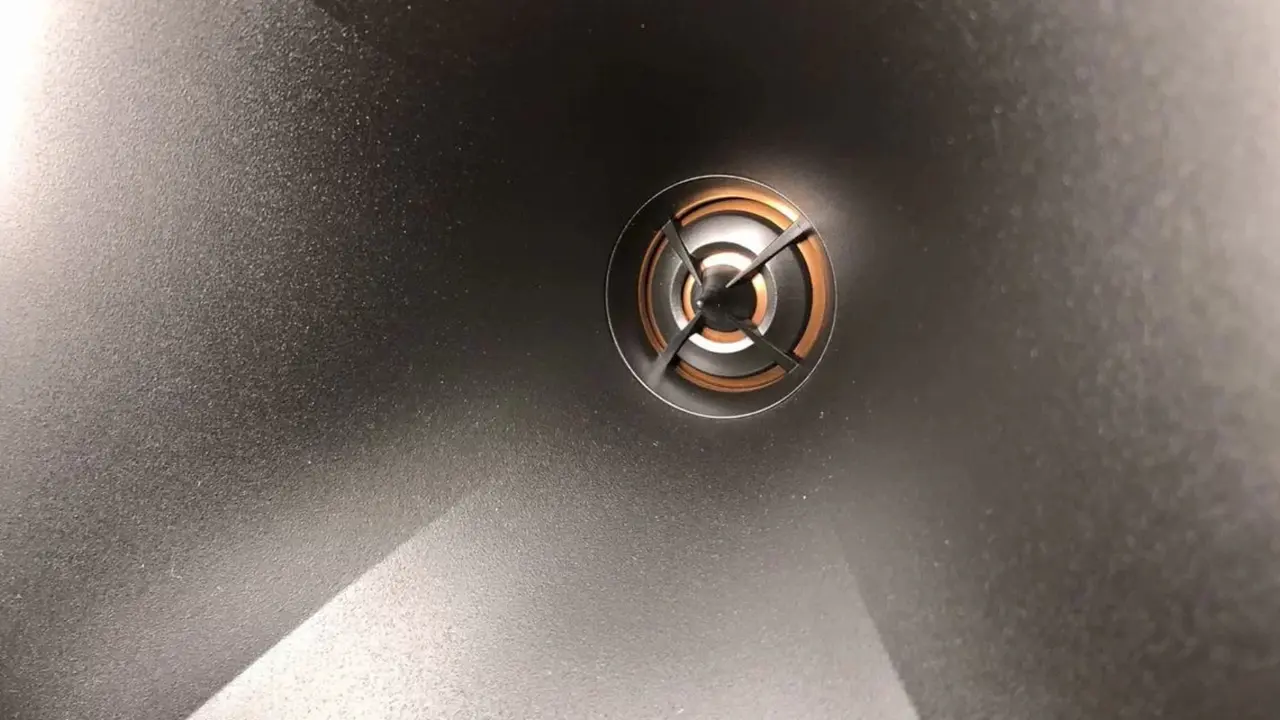
I have always liked that Klipsch does not try to make its speakers disappear into the background. The horn-loaded tweeter, the copper driver, and the bold styling give even its smaller models personality. The R-40PM takes that same identity and fits it into a compact, powered package, making me reconsider how complicated affordable Hi-Fi actually needs to be.
I Didn’t Expect This Much Bass From the Klipsch R-12SW
An All-in-One Stereo System, Not Just a Pair of Speakers
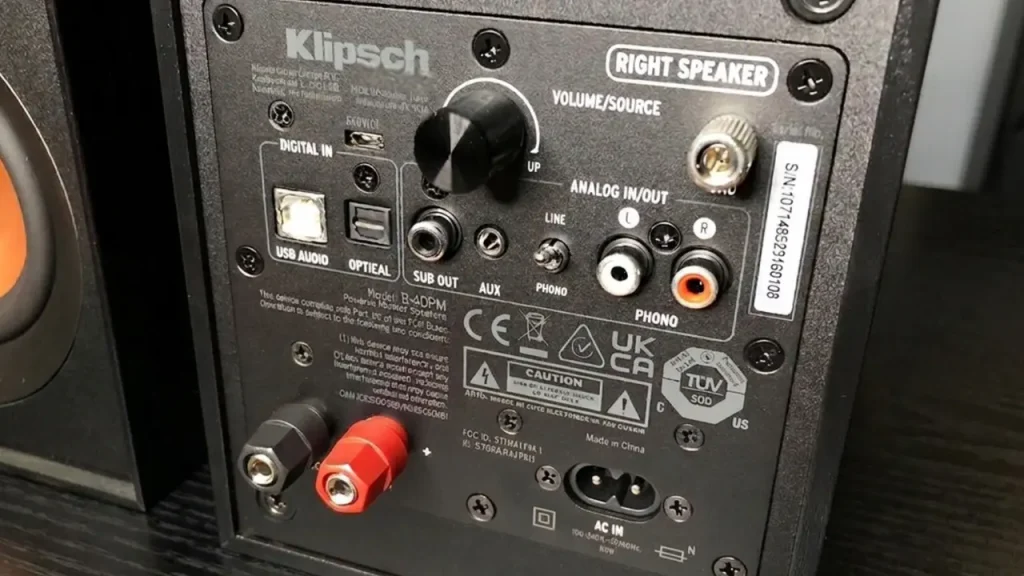
One speaker houses all the electronics, while the second connects to it with the supplied cable. From there, you can plug in a computer over USB, a TV over optical, a turntable straight into the phono stage, or stream over Bluetooth. There is also a subwoofer output if you want more low end later. This single setup handles what a separate amp, DAC, phono preamp, and receiver normally do, all in a footprint small enough to skip the equipment rack entirely.
Design and Build:
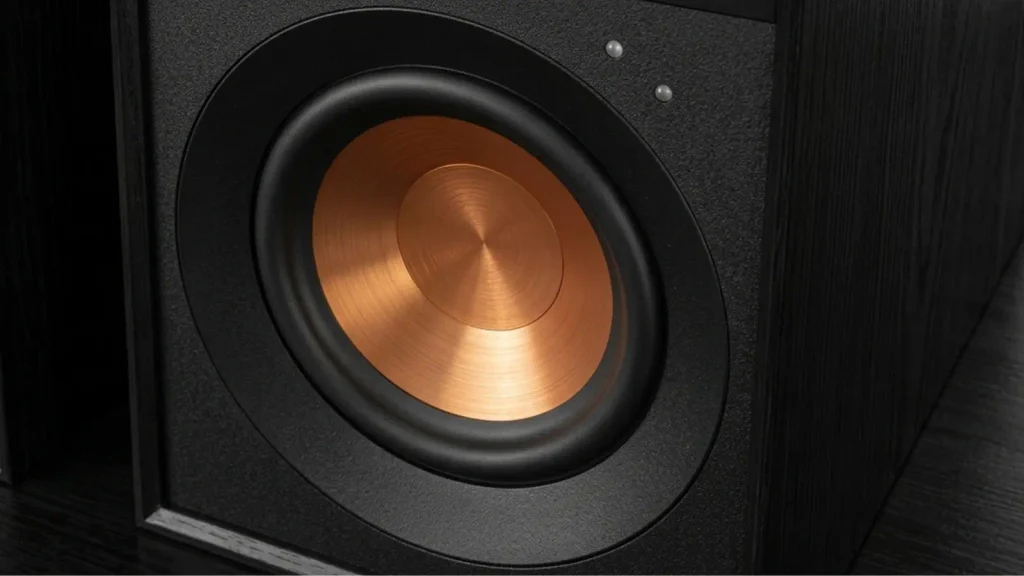
There is no mistaking these for anything else on a shelf. Black cabinet, copper woofer, and the Tractrix horn front and center; pull the magnetic grilles off, and it is pure Reference-series Klipsch. The cabinets are MDF wrapped in black wood-grain vinyl. While unglamorous, they are tidy and offer enough depth to give the 4-inch driver room to work, which matters more than the spec sheet suggests.
The 1-inch aluminum tweeter sits inside Klipsch’s 90° x 90° Tractrix horn, built to widen the sweet spot without smearing detail. The highs feel present rather than layered on top, which is a big part of why these speakers sound larger than their size implies. The copper woofer is not just cosmetic either, as the cone geometry adds rigidity and helps it hand off cleanly to the tweeter.
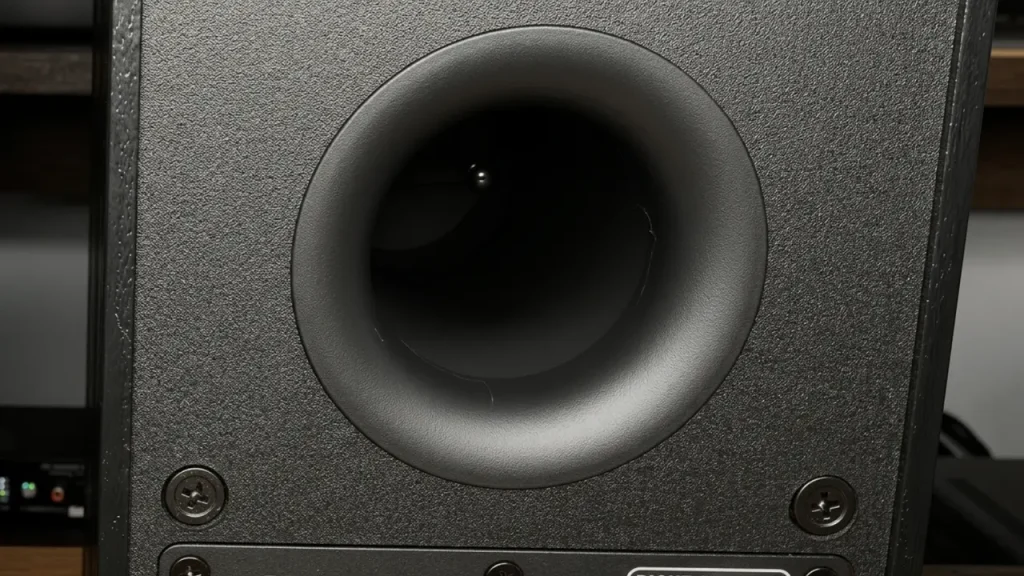
Around back, the primary speaker holds every connection: Bluetooth, USB, optical, analog, a phono/line input with a ground terminal, and an RCA sub-out. That sub-out matters because while the R-40PM’s bass is convincing for its size, a 4-inch woofer still has limits. Klipsch gives you an upgrade path rather than pretending otherwise. Finally, the rear-firing bass ports mean the speakers need breathing room rather than a spot flush against a wall.
Setup:
Setup takes only a few minutes: connect the two speakers, plug the powered unit into the wall, choose a source, and start listening. The remote covers everyday use, and Klipsch includes all necessary cables, so there is no extra shopping required. It is a system built for anyone who wants real stereo sound without becoming an equipment collector. Traditional setups require a source, DAC, amp, interconnects, speaker cable, and sometimes a phono stage, but the R-40PM condenses most of that into two boxes.
How I Tested Them:
I set the pair up in a small room, about 12 square meters, furnished with thick curtains, a rug, bookshelves, and upholstered furniture. This environment naturally absorbs reflections rather than bouncing them, which suits compact speakers well. I placed the speakers a bit over a meter apart and spent time fine-tuning their positions. Most listening was done through a Samsung Galaxy S21 Ultra over USB with an OTG adapter, using Bluetooth for direct comparison. USB delivered a cleaner, more transparent connection, whereas Bluetooth softened detail noticeably. Bluetooth works fine for casual listening, but a wired connection lets these speakers show what they can really do.
I Put This Klipsch Sub Through a James Bond Chase. Big Mistake for a Budget Subwoofer
Sound Quality:
The overall sound profile is warm and energetic, representing classic Klipsch tuning. These are not tuned for clinical neutrality. Vocals sit forward, guitars have bite, drums have attack, and the horn adds an immediacy that keeps you engaged.
- Bass: For a 4-inch woofer, the low end holds up well. There is no floor-shaking sub-bass, but the cabinet depth and rear port carry the low mids further than expected. Rock takes full advantage of the energetic tuning, while electronic music and hip-hop reveal limitations sooner, as the lowest octave sits just past what a 4-inch driver can reach. That is when the subwoofer output becomes genuinely useful.
- Midrange: This is where the R-40PM is most impressive: full and warm without turning muddy. Vocals have body, guitars keep their texture, and there is no obvious gap between the woofer and tweeter where many small powered speakers thin out. Even dense rock mixes hold together instead of collapsing into noise.
- Treble: Highs are direct and energetic, especially on percussion and vocals, yet they avoid harshness at sensible volumes. Detail remains open without introducing uncomfortable sibilance, making long listening sessions effortless.
While rock feels like the most natural fit for this tuning, classical, jazz, and blues lean into the warmth and imaging just as easily.
Placement Tips
The horn makes positioning important. Give the speakers room to breathe, set them up symmetrically, and take a moment to dial in the stereo image. The 90° x 90° dispersion helps widen the sweet spot, but only once positioning is correct. When set up well, they project a wider soundstage than their cabinet size suggests, though they will not match a floorstander’s scale.
What Could Be Better:
A couple of features would make this an even easier recommendation: AirPlay 2 for Apple users, and a companion app with EQ or basic room correction, as these speakers will often end up in acoustically imperfect rooms. Neither limitation is a dealbreaker, as deep bass has a physical ceiling and Bluetooth naturally trades some detail for convenience, but both are worth considering.
Verdict:
The R-40PM was never built to replace a floorstander and a rack of separate equipment. What it does is remove the friction from getting real stereo sound by packing a built-in amp, Bluetooth, USB, optical, analog, and a phono stage into the signature copper-and-horn design Klipsch is known for. The bass punches above its weight, the midrange has real body, and the horn delivers trademark energy.
If you want a single pair of speakers that can handle a turntable, computer, TV, and Bluetooth streaming while delivering authentic Klipsch sound, the R-40PM easily earns a recommendation.
Klipsch R-40PM: Specs
- Type: 2-way active/powered bookshelf speakers (pair)
- Woofer: 4-inch spun-copper cone
- Tweeter: 1-inch aluminum LTS tweeter with 90° x 90° Tractrix horn
- Frequency response: 60Hz to 20kHz (Dynamic Bass EQ extends to 52Hz)
- Power: 70W total system power, 35W per channel continuous (240W peak)
- Inputs: Bluetooth, USB, optical (TOSLINK), 3.5mm analog, phono/line (switchable, with ground terminal)
- Output: RCA subwoofer out
- Cabinet: MDF with black wood-grain vinyl finish
- In the box: Speaker cable, USB cable, power cable, remote