Is the Marantz Receiver the Ultimate Bridge Between Audiophile Stereo and 8K Home Theater?
Recently, there has been a significant trend toward simplifying home audio systems. Modern consumers are moving away from “stack” complexity, seeking to increase versatility without sacrificing high-fidelity performance. A prime example is replacing a rack of separate stereo components with a high-end AV receiver (AVR). Beyond traditional stereo playback, this shift opens the door to immersive multichannel audio, including formats like Dolby Atmos and DTS: X.
However, this move toward universality raises a common audiophile concern: can a multi-channel receiver deliver that elusive “sonic magic”? To find out, we put a serious contender to the test, the Marantz SR7015 9.2 channel 8K AV receiver.
Why the Marantz SR7015?
The value proposition is clear: the Marantz SR7015 price is roughly equivalent to a mid-range integrated stereo amplifier. However, when you calculate the cost of a standalone Hi-Res DAC, a network streamer, and a 9-channel power stage, the SR7015 offers a massive financial and spatial advantage.
A Legacy of “The Most Musical Sound”
Marantz has been a cornerstone of the audio world since Sol B. Marantz founded the company in 1953. Known for innovative engineering and a distinct aesthetic, the brand has survived multiple ownership changes, each adding technological depth while preserving the signature Marantz “Musical Sound.”
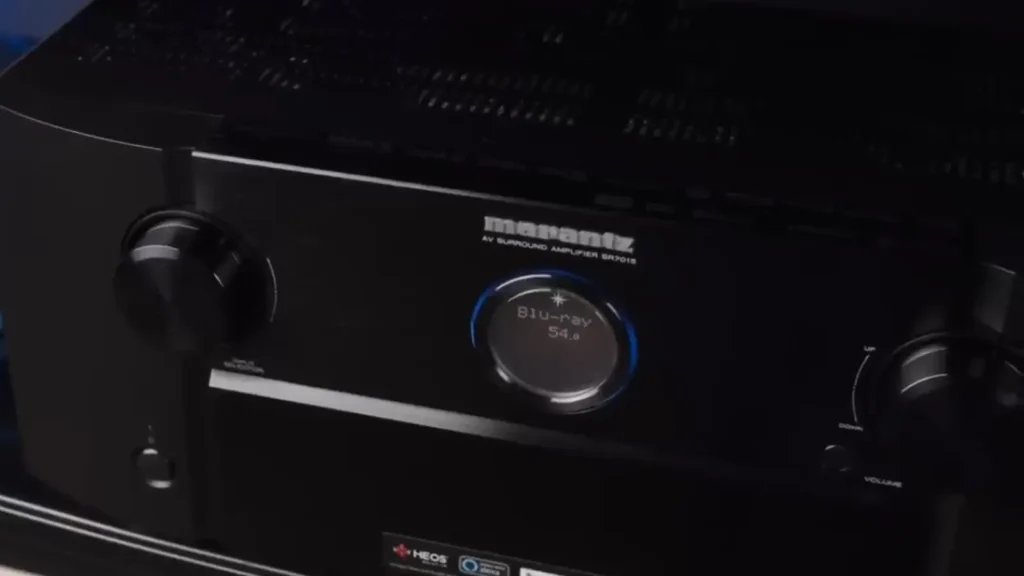
Iconic milestones like the Marantz Model 9 vacuum tube mono amplifier (1960) introduced the circular porthole display that remains a brand staple today. We must also acknowledge the late Ken Ishiwata, whose colossal influence shaped the Marantz identity for decades. Today, under the direction of Yoshinari Ogata at the Shirakawa Audio Works in Japan, modern Marantz components represent a refined evolution of that 70-year heritage.
Marantz SR7015: Design and Aesthetics
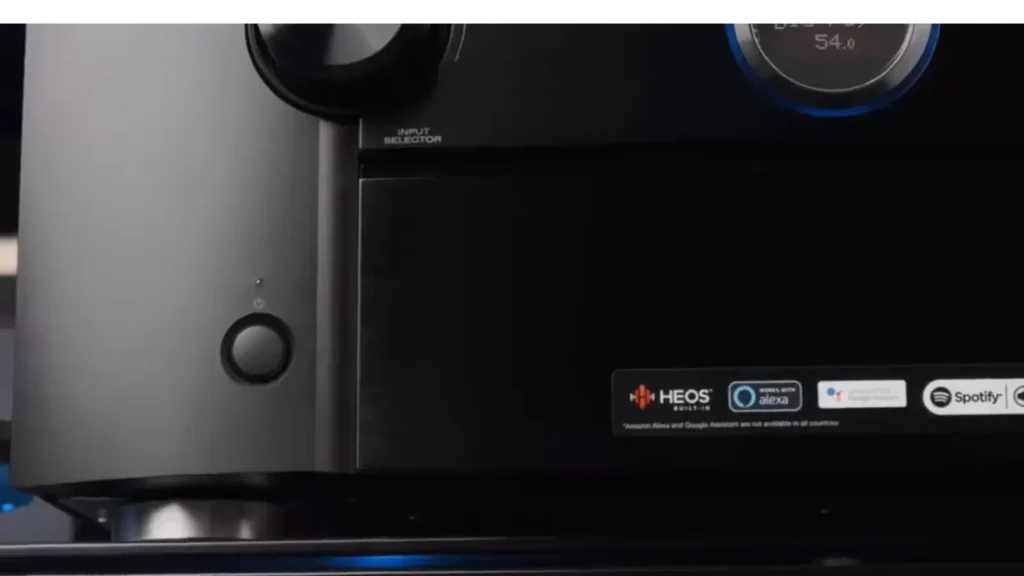
The SR7015 is a substantial all-in-one unit that manages to look impressive yet minimalist. The chassis features the classic Marantz symmetry: a small, round porthole display with blue backlighting flanked by two large knobs, volume on the left and input selection on the right.
Why the Marantz AV7706 Still Reigns as the Audiophile’s Choice
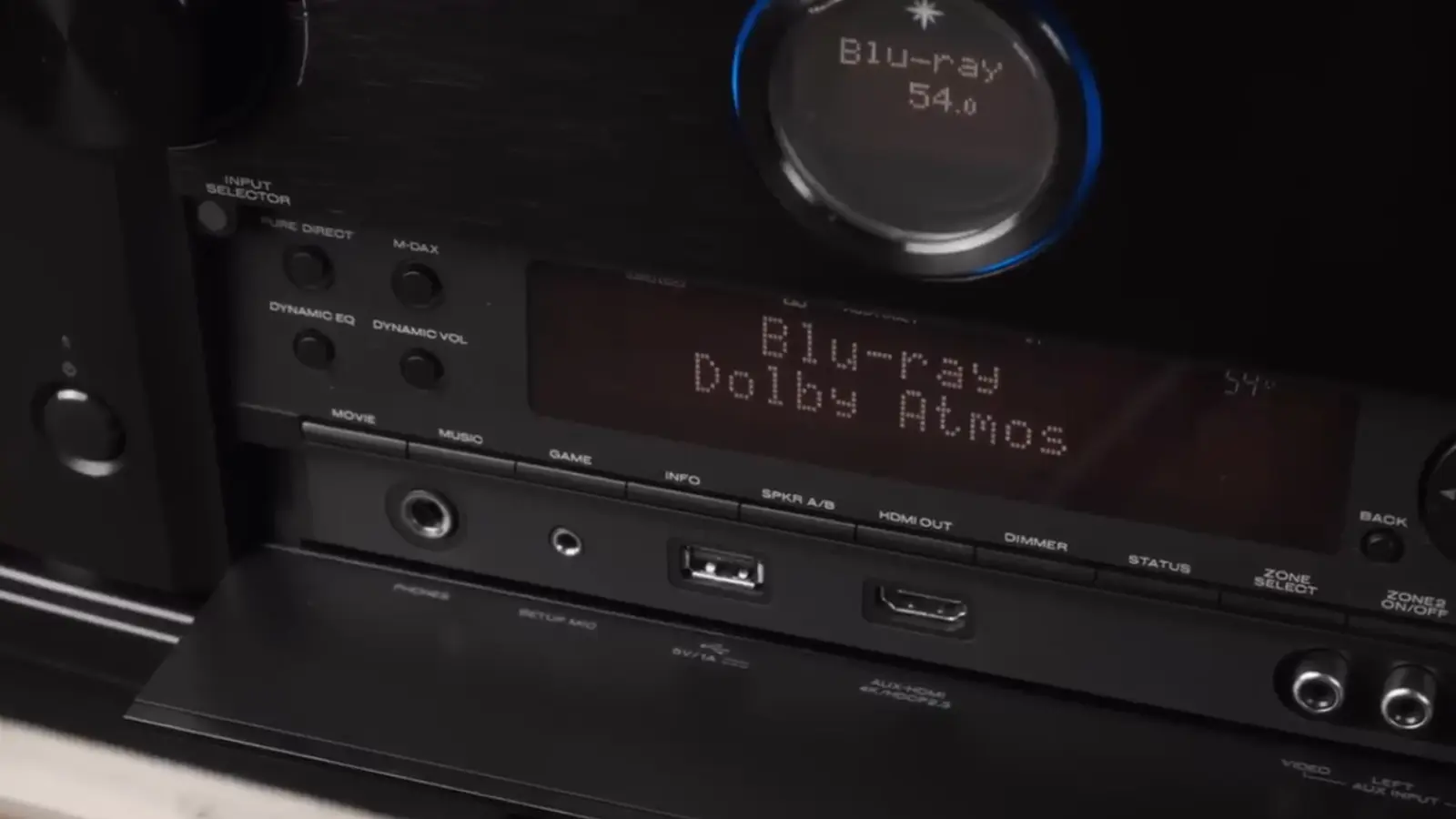
While the porthole display is iconic, its functional readability is limited. Marantz compensates for this by hiding a much larger, informative FL display behind a brushed-metal hinged front panel. This hidden bay also houses “hot” connections, including a USB port, HDMI input, headphone jack, and the Audyssey setup microphone input. This design ensures your home cinema remains free of distracting lights and “spaceship” button clutter during dark-room viewing.
Connectivity and Back Panel Features
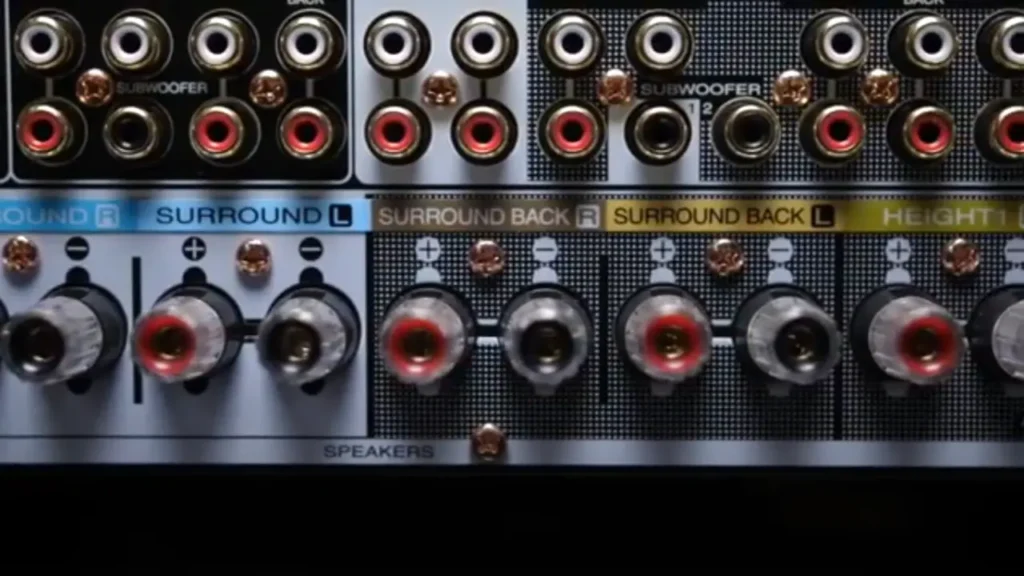
The rear of the SR7015 is a masterclass in AV receiver connectivity. Here is the breakdown:
- Amplification: While there are 11 pairs of speaker terminals, the unit features 9 discrete high-current amplifier channels. It can process up to 11.2 channels, allowing you to expand to a full 7.2.4 Atmos setup with an external two-channel power amp.
- HDMI 2.1 & 8K Video: Featuring 8 HDMI inputs and 3 outputs. It supports 8K/60Hz and 4K/120Hz pass-through, making it a future-proof choice for PS5/Xbox Series X gaming.
- Gaming Features: Full support for ALLM (Auto Low Latency Mode), VRR (Variable Refresh Rate), and QFT (Quick Frame Transport).
- Analog & Vinyl: Includes a dedicated Moving Magnet (MM) phono stage for turntable enthusiasts and a full set of 11.2-channel RCA pre-outs.
- Network Streaming: Integrated HEOS Built-in, AirPlay 2, and Bluetooth.
Note: Interestingly, the SR7015 lacks a built-in FM/AM tuner, technically categorizing it as an AV Amplifier rather than a traditional receiver.
Internal Engineering & HEOS Functionality
The “inner world” of the SR7015 utilizes proprietary HDAM (Hyper Dynamic Amplifier Modules) and current feedback topology. For digital-to-analog conversion, it employs two 32-bit AKM AK4458 DACs, capable of handling Hi-Res audio up to 24-bit/192 kHz and DSD 5.6 MHz.
Why This $1,000 Slimline Receiver Feels Like a High-End: Marantz Cinema 70s Review
Room calibration is handled by the flagship Audyssey MultEQ XT32 suite, which includes Sub EQ HT for seamless dual-subwoofer integration. While the HEOS app provides easy multi-room control and supports Spotify, Amazon Music HD, and Tidal, it is worth noting that it does not support full MQA decoding or Deezer HiFi at maximum resolution.
Performance: Cinematic Impact vs. Stereo Musicality
The Home Theater Experience: Using a system featuring Definitive Technology BP9080X towers and Canton height modules, the SR7015 proved its cinematic mettle. The surround soundstage was cohesive and immersive, with explosions providing tactile physical impact without losing the fine micro-details of a film’s score.
The Stereo Challenge: For critical music listening, we paired the Marantz with Canton Reference 5K floorstanders. Streaming DSD files and Tidal masters, the SR7015 delivered a surprisingly refined stereo performance. The tonal balance was warm yet articulate, typical of the Marantz house sound. Whether it was the raw energy of rock or the delicate nuances of vocal jazz, the receiver maintained excellent structure and dynamics.
Conclusion:
The Marantz SR7015 successfully challenges the idea that you need separate systems for movies and music. It is a versatile, well-engineered AV amplifier that brings “audiophile magic” to a multi-channel world. For those looking to simplify their rack without compromising on sound quality or future-ready 8K features, the SR7015 is a top-tier recommendation.
Marantz SR7015 Specifications:
- Number of processor channels: 11.2
- Number of power amplifier channels: 9
- Power: 200 W (6 Ohm, 1 kHz, 1% THD, 1 channel), 125 W (8 Ohm, 20 Hz-20 kHz, 0.08% THD, 2 channels)
- Input sensitivity: 200 mV
- Frequency range: 10 Hz – 100 kHz (Pure Direct mode)
- Signal-to-noise ratio: 100 dB (Pure Direct mode)
- Built-in decoders: Dolby Atmos, Dolby Atmos High Virtualization, Dolby True HD, Dolby Surround, DTS-HD Master, DTS:X, DTS Neural:X, DTS Virtual X, Auro-3D, IMAX Enhanced, MPEG-H
- Video: 8K/60 Hz, 4K/120 Hz, 4:4:4, HDCP 2.3, Dolby Vision, HDR, HDR 10+, Dynamic HDR, BT.2020, HLG
- Audio DAC: AK4458 (32-bit)
- Auto calibration: Audyssey MultEQ-XT 32, Audyssey LFC
- Supported audio file formats (USB, Ethernet, Wi-Fi): MP3, WMA, AAC, ALAC (24-bit/96 kHz), FLAC, FLAC HD (24-bit/192 kHz), WAV (up to 24-bit/192 kHz), DSD 2.8 MHz, DSD 5.6 MHz
- Inputs: 8xHDMI/HDCP2.3 (one on the front panel), USB, four composite video (one on the front panel), three component, 7.1-channel, seven linear RCA (one on the front panel), MM-phono cartridge, two coaxial, two optical
- Outputs: 3xHDMI (one with eARC), composite, component, 11.2-channel output from the processor, two-zone, two subwoofer, 6.3 mm headphone jack, remote control, 2xDC 12 V/150 mA
- Wireless connection: Bluetooth, Wi-Fi, AirPlay 2
- Other connectors: Ethernet port, RS232, IR input, Wi-Fi and Bluetooth antenna sockets, ground socket
- Output terminals for connecting speakers: 11 pairs of screw terminals
- Voice control support: Amazon Alexa, Google Assistant, Apple Siri
- Number of additional zones: main + 2 additional
- Power consumption: 710 W
- Minimum power consumption in standby mode: 0.2 W
- Dimensions (WxDxH): 440x185x411 mm
- Weight: 14.2 kg