Klipsch Reference Signature: The New Speakers That Could Change How We See the Reference Line
Klipsch has been making speakers for 80 years, so you’d think there wouldn’t be much left to surprise us.
And yet, here we are.
The company has introduced its new Reference Signature loudspeaker series at CEDIA Expo 2026, and this is not simply another cosmetic refresh of the familiar Reference formula. Klipsch has taken something it has been doing for years and made a fairly significant change: the new Reference Signature speakers use a true three-way design with a dedicated midrange driver.
That might not sound revolutionary on paper. But for Klipsch, it is a pretty big move.
The company first previewed Reference Signature behind closed doors at CES 2026. CEDIA is where attendees finally got the chance to hear the new range, ahead of its planned winter launch. Klipsch is celebrating its 80th anniversary this year, and Reference Signature feels like a more serious attempt to push the modern Reference family forward rather than simply attach an anniversary badge to an existing design.
The Biggest Change Is Hidden Inside the Horn
Here’s what really caught my attention.
For years, Klipsch’s modern Reference speakers have largely relied on two-way designs, with one driver handling the lower frequencies and the horn-loaded compression driver taking care of the midrange and treble. Reference Signature changes that approach.
The main Reference Signature models are now true three-way speakers, with separate drivers handling bass, midrange, and high frequencies. Klipsch says the arrangement allows each driver to concentrate on the part of the spectrum it was designed to reproduce, while moving the crossover points away from the ear’s most sensitive region.
But the clever part is what Klipsch has done with the midrange.
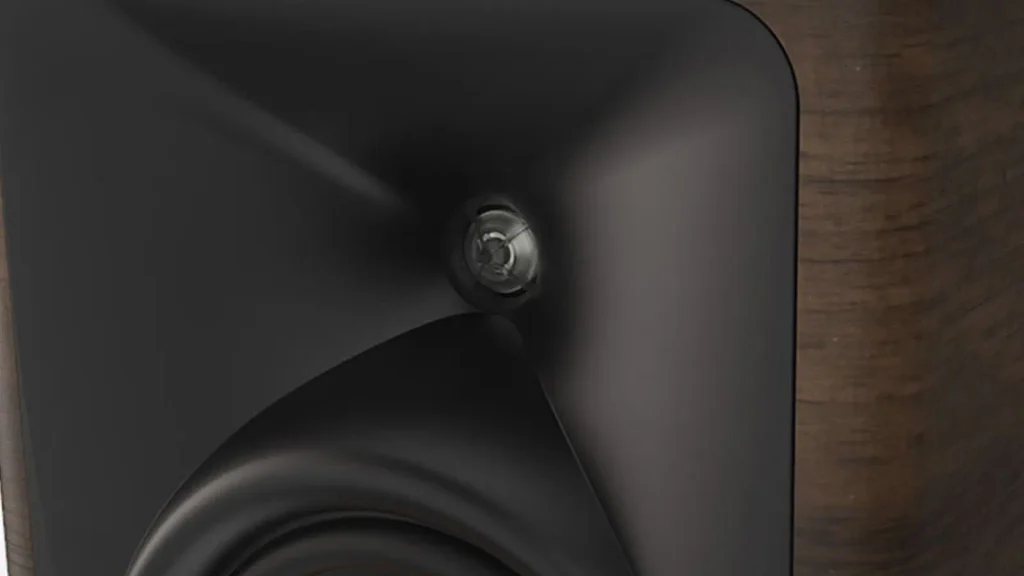
The midrange driver sits directly inside the tweeter horn, allowing the two drivers to share the same acoustic center. Klipsch calls this a new phase-aligned horn design, and the goal is to produce more coherent behavior around the crossover region while keeping tonal balance more consistent across a wider listening area.
In other words, Klipsch isn’t simply adding another driver because three-way speakers look more impressive on a specification sheet. It’s trying to solve one of the problems that comes with separating the midrange and treble into different acoustic sources.
And something is fitting about that considering Paul W. Klipsch’s famous observation that “the midrange is where we live.” For music and movie dialogue, that’s still one of the most important parts of the entire frequency range.
Six Speakers, One New Reference Family
Reference Signature isn’t a single flagship speaker. Klipsch has built an entire family around the new architecture.
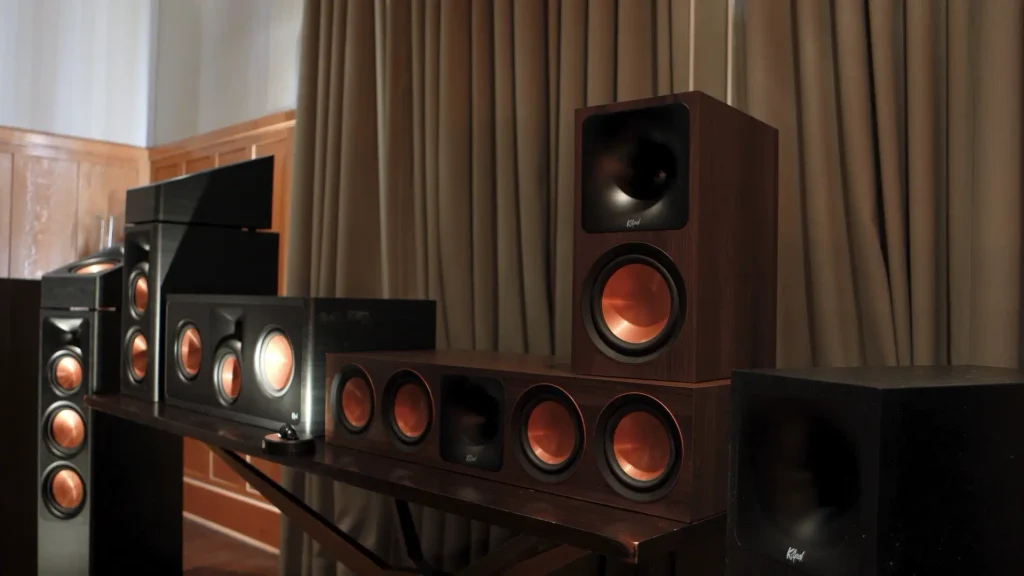
The range includes the RS-8301F and RS-6301F floorstanders, the RS-8301M and RS-6301M monitor speakers, the RS-6301C center channel, and the RS-6101SA Dolby Atmos height and surround module. The main floorstanding, monitor and center models use the new three-way architecture, while the RS-6101SA remains a two-way design.
The larger models combine an 8-inch bass driver with a 6.5-inch midrange, while the smaller models use a 6.5-inch woofer and 5.25-inch midrange. The floorstanders and center channel use dual bass drivers, while the monitors use a single bass driver.
Klipsch has also retained some familiar ingredients. The new speakers use the company’s titanium-diaphragm Linear Travel Suspension tweeter and spun-copper Cerametallic cones, so there is still plenty here that looks and feels unmistakably Klipsch.
The Center Channel Might Be the Most Interesting Speaker Here
If you’re building a home theater, I’d pay particularly close attention to the RS-6301C.
Center speakers have a strange problem. They are often designed around a horizontal layout, with the tweeter and midrange arranged across the front of the cabinet. It looks perfectly logical, but that arrangement can create unwanted horizontal dispersion behavior and cause the tonal balance to change as you move away from the center seat.
Klipsch has gone in a different direction with the Reference Signature center.
The RS-6301C uses a vertical driver arrangement rather than the familiar horizontal layout. The idea is to provide more consistent dialogue and tonal balance across the listening area rather than making the person sitting directly in front of the screen the only one getting the ideal presentation.
That’s the sort of engineering decision I like because it addresses an actual problem people experience in their living rooms.
Best Klipsch Speakers of 2026: Every Model Ranked for Every Budget
The center channel carries an enormous amount of dialogue and front-stage information in a movie soundtrack, yet it is often the speaker that gets the least attention when people build a system. If Klipsch’s approach works as intended, the RS-6301C could end up being one of the most important pieces of the Reference Signature lineup.
Of course, we need to hear it from off-axis before making any serious conclusions.
One Speaker That Can Do Three Jobs
Then there’s the RS-6101SA, which might be the most practical speaker in the entire range.
Rather than making it a dedicated Atmos-only module, Klipsch designed it to handle several roles. It can sit on top of a speaker and fire upward for Dolby Atmos, or it can be mounted on a wall as a height or surround speaker.
There’s also a rear-panel switch that changes the crossover configuration depending on how the speaker is being used.
That sounds like a small detail, but it makes a lot of sense. Home theater systems change. People move rooms, change layouts, and sometimes decide that reflected Atmos isn’t working as well as they hoped. Having one speaker that can adapt to those situations is considerably more useful than buying a completely different model for every position.
Klipsch Has Finally Toned Down the Look
I’ll be honest: traditional Klipsch speakers aren’t exactly shy.
The copper-colored drivers are iconic, but the overall look can be pretty aggressive. That’s part of the appeal for some people, but it isn’t necessarily what everyone wants sitting in the middle of a carefully designed living room.
Reference Signature takes a more restrained approach.
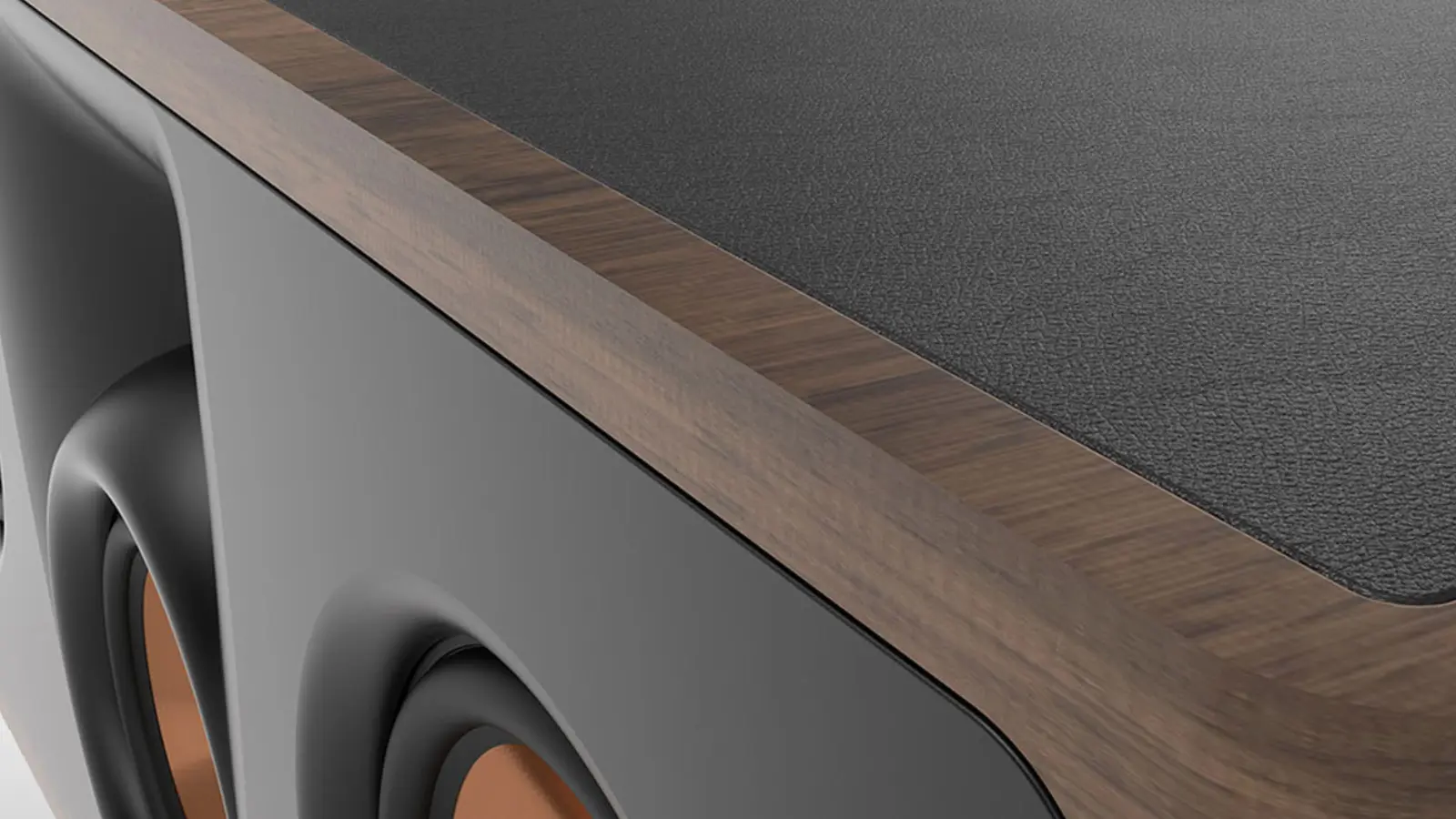
Klipsch is using a one-piece BMC front baffle, curved cabinet edges, and continuous horizontal wood-grain patterns in Ebony and Walnut finishes. There’s also a decorative leather panel on top, along with metal carpet spikes and rubber feet. The curved edges aren’t just there for appearance either; Klipsch says they’re intended to reduce diffraction and help improve off-axis performance.
The result is still recognizably Klipsch, but it looks considerably more sophisticated.
And yes, aesthetics matter.
Audiophiles sometimes pretend that they don’t care what their speakers look like. Then they spend three hours deciding whether Walnut or Ebony will work better with the furniture.
Reference Signature Sits in an Interesting Place
Klipsch’s lineup has become complicated enough that figuring out where a new speaker belongs can almost be a hobby in itself.
Reference Premiere III remains the company’s major modern passive speaker family, while Reference Signature sits above it with the new three-way architecture, upgraded materials and more elaborate horn design. Above that, Klipsch still has its Heritage models for buyers looking for something considerably more traditional and uncompromising.
And then there’s Project Apollo, which is a very different proposition altogether.
That makes Reference Signature interesting because it isn’t trying to be a laboratory experiment or a cost-no-object statement speaker. It’s a more ambitious version of the modern Klipsch idea, designed to work in both stereo and home theater systems.
That could actually make it more important than a much more expensive flagship.
Klipsch doesn’t need another speaker that only makes sense in a dedicated listening room with unlimited space and an unlimited budget. Reference Signature needs to work in real homes.
There Are Still Some Big Questions
This is where I’m going to pump the brakes a little.
The new design looks interesting. The engineering decisions make sense. But we still don’t have the independent measurements needed to know exactly how these speakers perform.
We also don’t have final pricing for each individual model yet. Klipsch is targeting roughly $1,600 to $3,000 per pair, but the company says final pricing and complete specifications will be announced closer to launch. Select models are expected to arrive in winter 2026.
That’s important because the price will determine how Reference Signature competes with everything else around it.
A $1,600 pair is one conversation.
A $3,000 pair is a very different conversation.
And until independent measurements and serious listening tests are available, it’s simply too early to say whether the new three-way architecture delivers the performance jump Klipsch is promising.
I Put This Klipsch Sub Through a James Bond Chase. Big Mistake for a Budget Subwoofer
Klipsch Might Actually Have Something Interesting Here
I’m cautiously optimistic about Reference Signature.
Not because Klipsch has slapped a new name on another speaker range, but because the company has made a genuinely meaningful change to the architecture.
The dedicated midrange makes sense. The phase-aligned horn is an interesting solution to a real acoustic problem. The center-channel design could be particularly useful for home theater. The flexible Atmos module is practical. And for once, Klipsch has managed to make the whole thing look more refined without completely losing the visual identity that made its speakers famous in the first place.
Will they sound as good as Klipsch claims?
That’s the part we still need to find out.
But after 80 years of making horn-loaded speakers, seeing Klipsch rethink one of the most important parts of its modern Reference design is enough to get my attention.
Reference Signature may not completely reinvent Klipsch.
It doesn’t need to.
If it can take the familiar Klipsch sound and make it more coherent, more refined, and easier to live with, this could end up being one of the company’s more interesting speaker launches in years.
And I’m definitely curious to hear them.
Note: This article is based on Klipsch’s official announcement and CEDIA 2026 trade coverage. AmpReviews has not yet had hands-on time with the Reference Signature series. Final specifications and individual model pricing are still pending, with select models expected to launch in winter 2026.