
I Tried JBL’s Biggest Party Speaker at a Housewarming. Here’s What Happened
We’d barely unpacked the kitchen when my wife and I decided the new house needed a proper christening — a housewarming with friends and family, boxes be damned. The problem was, most of my audio gear was still sitting in a storage unit across town, and a party without decent sound felt wrong. So I did what any reasonable person does: I called the one friend who owns a JBL PartyBox Ultimate and asked him to bring it over. He showed up, we wheeled the thing in, and somewhere between the second round of drinks and the third playlist, my curiosity got the better of me. I’ve never been able to leave a piece of hi-fi alone at a party — so while everyone else was catching up, I started running through some of my favorite tracks, just to hear what 1,100 watts actually does in a living room that still had bubble wrap in the corner.
The Forgotten JBL Speaker Audiophiles Are Still Buying Used
Take the JBL PartyBox Ultimate out of its box and the first thing you’ll want isn’t the power cable — it’s a second pair of hands. At 87 pounds and standing nearly three and a half feet tall, this isn’t a speaker you tuck under an arm on the way to the car. It’s a speaker you wheel into position, plug in, and build the night around. JBL still calls it portable. What it actually is, is permanent — in the best sense of the word.
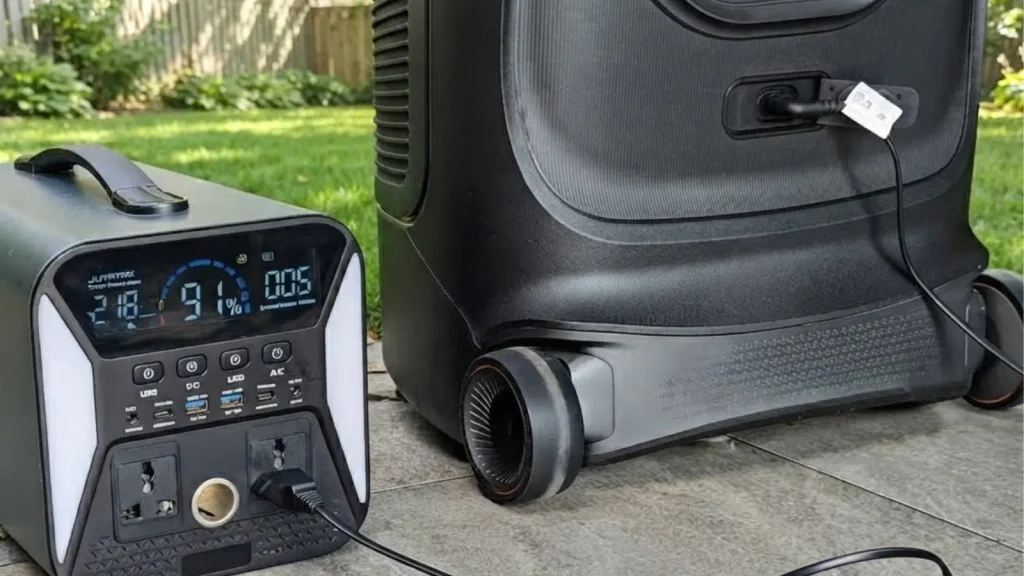
That distinction is worth sitting with, because JBL’s PartyBox line built its name on go-anywhere battery life. The 310 runs 18 hours cordless. The Encore 2 does the same in a fraction of the size. The Ultimate takes a very different approach: there is no built-in battery, so it’s designed to live near an outlet. It reads like a downgrade until you look at what the trade actually buys: 1,100 watts RMS pushed through six drivers, a wattage figure that would burn through any battery in under an hour of real use anyway. JBL isn’t apologizing for the cord. It’s betting that at this size, nobody was carrying this thing to the beach regardless.

What’s Actually Making the Noise
Inside the tower-shaped cabinet: two 9-inch subwoofers, a pair of 4.5-inch mid-range drivers, and dual 2.75-inch tweeters, all running what JBL brands its Original Pro Sound. Frequency response is rated 30Hz to 20kHz, and JBL’s own line at launch was that the Ultimate could fill a space the size of two basketball courts — a claim worth the usual grain of salt reserved for any manufacturer spec, but not an unreasonable one given the six-driver design and 1,100W RMS output. A self-tuning feature adjusts the sound profile automatically depending on whether the speaker senses it’s boxed against a wall, sitting in an open room, or set up outdoors, which matters more than it sounds like it should — big drivers in a bad spot turn to mud fast, and most owners of a speaker this size won’t be pulling out a measurement mic to fix it themselves.
Buried in the spec sheet is one genuinely unexpected feature: Dolby Atmos support over Wi-Fi, provided the streaming service and the track both support it. It’s an odd inclusion on a speaker whose main job is filling a backyard with bass rather than placing sounds precisely around a room, but it says something about how JBL wants this positioned — less beefed-up boombox, more a legitimate hub that happens to also throw a party.
Built to Run the Party, Not Just Soundtrack It
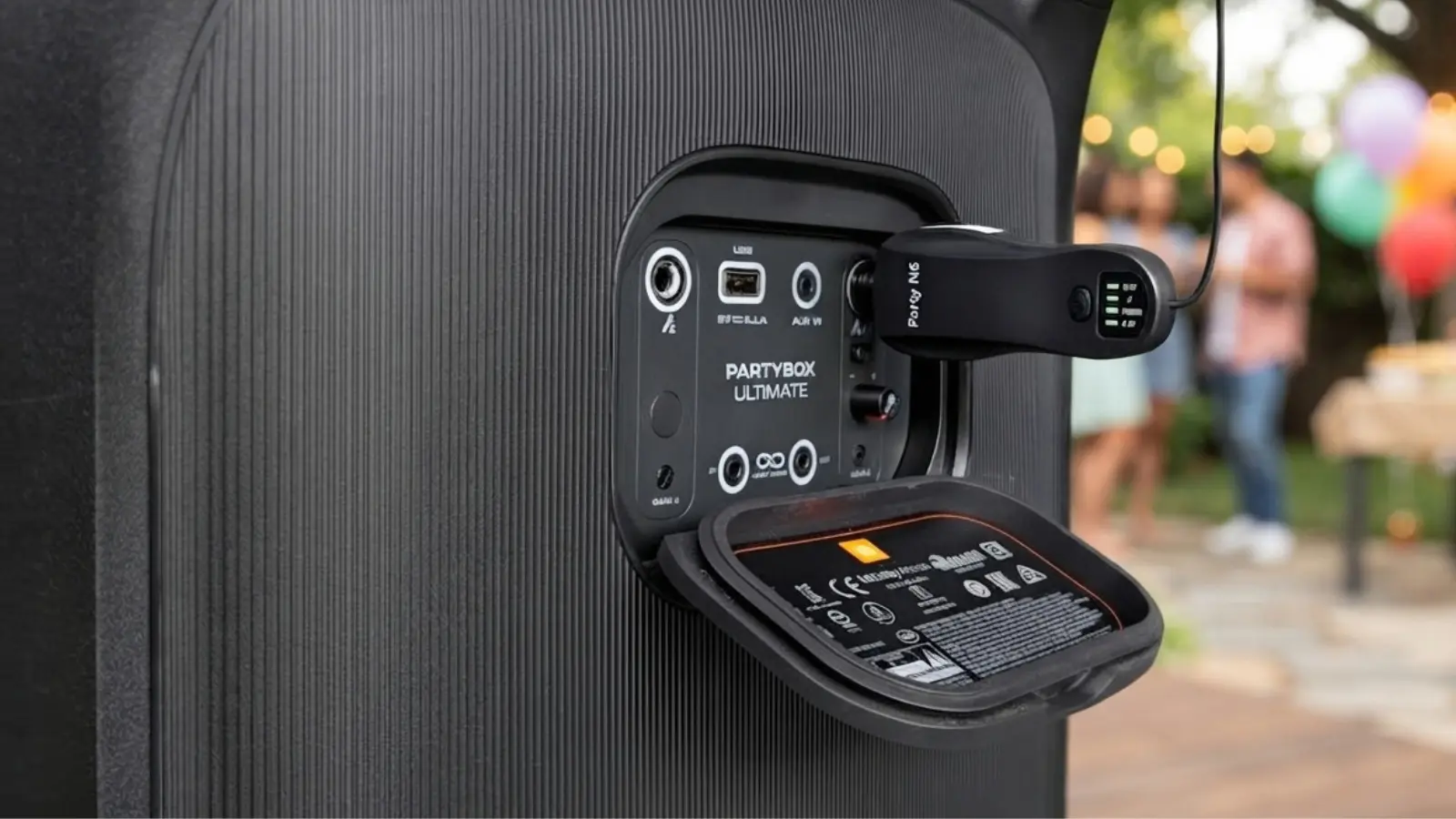
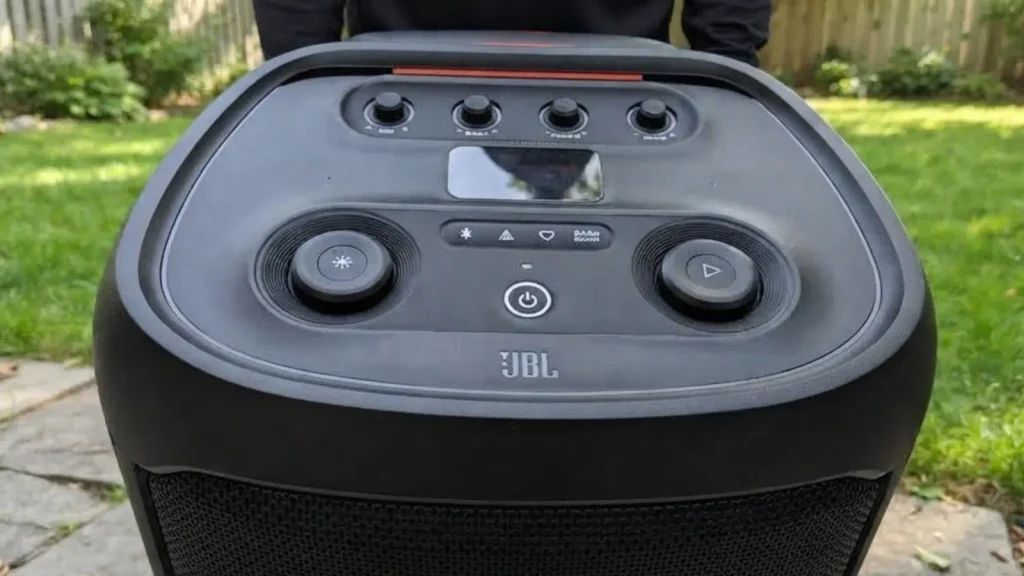
The rest of the spec sheet reads like JBL built this for someone actually running the event, not just providing background music for it. Two microphone inputs and a dedicated guitar input, each with independent volume and gain, turn the Ultimate into a functional PA for karaoke or a live acoustic set. The JBL PartyPad layers three gesture controls — tap, hold, slide — over sound effects and lighting cues, which is more fun in the hands of whoever’s actually working the crowd than it is impressive as a bullet point. Multiple Ultimates link together for stereo sound or a wider network of speakers, and Bluetooth 5.3 with LE Audio readiness means it’s built for that kind of multi-speaker future even beyond JBL’s own ecosystem. A USB-A port handles playback straight off a drive, and everything — the self-tuning, the lightshow, the pairing — is steered through the JBL One app, though the important controls also live on the top panel, handy at 1am when nobody wants to be squinting at a phone screen.
The lightshow itself is the multidimensional kind JBL’s marketing always promises: starry projections, moving light trails, strobes, all synced to whatever’s playing rather than running on a separate loop.
Big, Heavy, and Fine With That
For all its size, JBL clearly designed the Ultimate to be moved, just not carried. A built-in handle and a set of sturdy wheels handle the base, and an IPX4 rating means it can shrug off a splash of pool water or a spilled drink without drama. IPX4 stops well short of waterproof, though — it covers splashes, not rain, and definitely not submersion, so anyone picturing this as a permanent poolside fixture should still plan on getting it under cover when the weather turns. At just under 40 kilograms, moving it between rooms is a two-person job in practice, wheels or not.
Songs Worth Testing It With
If you’re looking for material to actually put a speaker like this through its paces, current chart activity isn’t short on options built for exactly that. Karol G’s “BbY WOW” is a useful modern bass test, with the low end giving the PartyBox’s twin 9-inch woofers plenty to work with. Tame Impala’s “Dracula” tests something different — its bass is layered and textured rather than simply deep, a decent stand-in for checking whether a system stays controlled at volume or starts to blur into mush. Bruno Mars’s “Risk It All” brings punchy, horn-driven funk built for exactly the kind of crowd energy this speaker is aimed at, and Taylor Swift’s “I Knew It, I Knew You” is a fair check on whether vocals stay intelligible once the volume climbs well past conversation level. And if the goal is simply picking something everyone in the yard will already know, Ella Langley’s “Choosin’ Texas” has become one of the defining chart hits of 2026, making it an easy choice if you want something almost everyone at the party will recognize.
So, What Happens When You Put 1,100 Watts in the Living Room?
JBL introduced the PartyBox Ultimate in 2023 as one of the biggest and most powerful speakers in its PartyBox range, and it’s commonly found for meaningfully less at retail three years on but still priced well above everything else in the range. That price only makes sense for the person this was actually built for: someone hosting real gatherings on a semi-regular basis, with a wall outlet within reach and enough space to justify the extra output. Anyone weighing this against JBL’s smaller, battery-powered PartyBox models — the 310, the 710, the Stage 320 — should be honest about which problem they’re actually solving. Those speakers go where the party is. The Ultimate expects the party to come to it.
JBL PartyBox Ultimate Specifications
| Specification | JBL PartyBox Ultimate |
|---|---|
| Speaker Type | Portable party speaker |
| Power Output | 1,100W RMS |
| Frequency Response | 30Hz – 20kHz |
| Low-Frequency Drivers | 2 × 9-inch woofers |
| Midrange Drivers | 2 × 4.5-inch |
| High-Frequency Drivers | 2 × 2.75-inch tweeters |
| Connectivity | Bluetooth 5.3, Wi-Fi |
| LE Audio | Ready |
| Dolby Atmos | Yes, over Wi-Fi |
| Audio Inputs | USB-A, microphone inputs, guitar input |
| Microphone Inputs | 2 |
| Guitar Input | 1 |
| Multi-Speaker Connection | Yes |
| App | JBL One |
| Lighting | 360° lightshow with starry projections, trails and strobes |
| Automatic Sound Optimization | Yes |
| Water Resistance | IPX4 |
| Battery | None |
| Wheels | Yes |
| Weight | 87.1 lb / 39.5 kg |
| Dimensions | 17.9 × 41.3 × 17.3 in |
| Original Launch | 2023 |