
Why the Definitive Technology Mythos ST Is More Than Just a Pretty Speaker
Some speakers make you question how much equipment you really need to build a powerful home theater. The Definitive Technology Mythos ST is a particularly interesting example. Its slim, elegant cabinet houses a powered subwoofer, giving it the kind of low-frequency capability many conventional floorstanding speakers require additional equipment to achieve.
The idea is simple but ambitious: deliver full-range sound, deep bass, and the dynamics needed for serious movie watching without filling the room with oversized speakers and separate subwoofers. The Mythos ST was designed to blend into a living room, but its specifications suggest something far more substantial than its narrow profile might lead you to expect.
In this review, we’ll look back at what made the Mythos ST stand out, from its unusual powered-bass design to its performance with music and movies, and why it earned such a strong recommendation when it was originally reviewed.
This Discontinued 175-Pound Subwoofer Packed 2,000 Watts and Serious Bass
Definitive Technology Mythos ST: A Slim Tower With a Different Approach to Bass
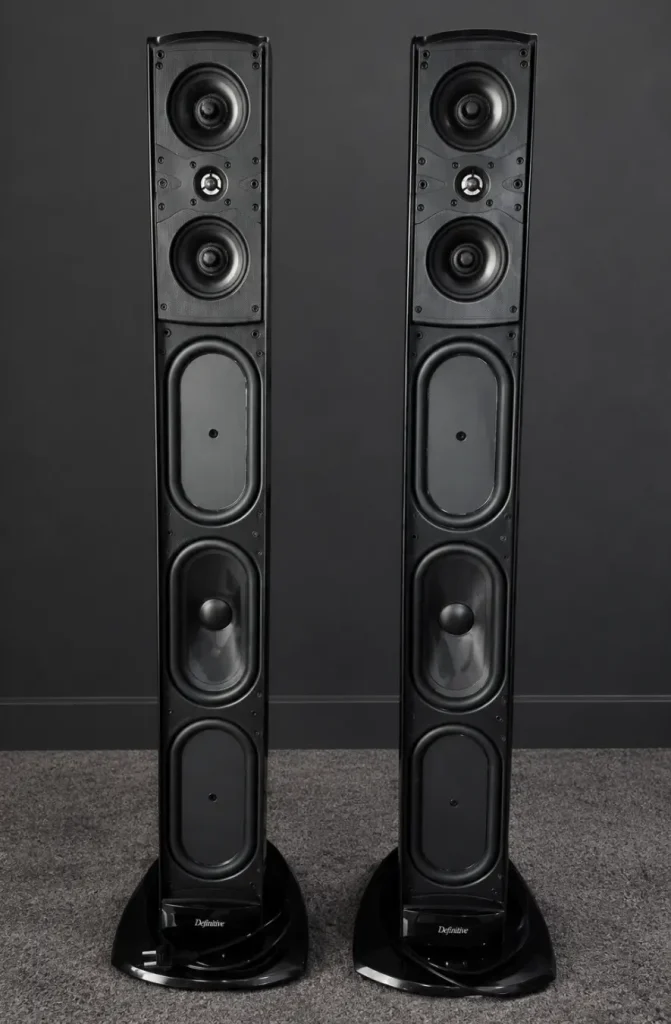
The Mythos ST doesn’t look like a conventional full-range floorstanding speaker. Its tall, narrow cabinet and brushed aluminum or gloss black finish were designed to blend into a room rather than become its main visual feature. Yet behind that understated appearance sits a speaker built to deliver considerably more bass than its dimensions might suggest.
Each tower stands 51.5 inches tall, measures just 6.75 inches wide, and extends 9.5 inches deep. A polished black granite base provides stability, with five adjustable feet to help level the speaker on the floor. The base measures 11 by 15.5 inches, giving the tower a relatively small footprint for a design with a built-in powered subwoofer.
The construction impressed me immediately. The review samples arrived in gloss black, and the finish looked excellent from every angle. The cabinets felt exceptionally solid, while the granite bases were beautifully polished. Despite the speakers’ narrow profiles, there was nothing flimsy about their construction.
The Mythos ST’s proportions are particularly appealing if you want substantial sound without placing bulky cabinets around your television. Its slim front profile makes it visually unobtrusive, while the curved front and sloping top add character to an otherwise understated design.
For anyone balancing home theater performance with living-room aesthetics, that combination remains one of the most appealing aspects of the Mythos concept.

How the Mythos ST Produces So Much Bass
Definitive Technology built the Mythos ST around a D’Appolito-style driver arrangement. Two 5.25-inch midrange drivers with cast magnesium baskets and polymer cones flank a 1-inch pure aluminum dome tweeter. This arrangement handles the midrange and treble, while the powered low-frequency section takes care of the deeper bass.
That bass section is what separates the Mythos ST from many conventional slim towers.
Each speaker incorporates a 6-by-10-inch racetrack-shaped woofer driven by a 300-watt Class D amplifier. Two similarly shaped, long-throw passive radiators work alongside it to extend low-frequency output. The result is a self-powered bass system housed inside the tower itself.
In a five-speaker setup like the one used for the original review, four Mythos ST towers provide four independently powered bass sections, while the Mythos Ten handles the center-channel duties.
Definitive Technology specified a frequency response of 14Hz to 30kHz for the Mythos ST, along with a nominal impedance of 4 to 8 ohms and sensitivity of 93dB. The recommended amplifier power was 20 to 350 watts per channel.
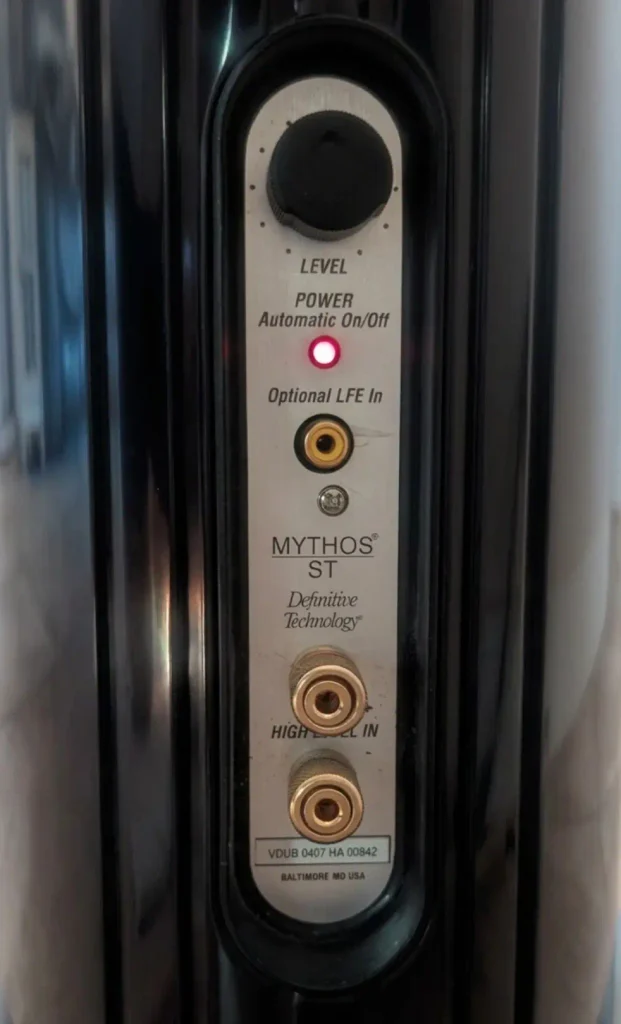
The powered subwoofer section still needs an electrical outlet, so the tower isn’t entirely free of additional cabling. However, integrating the bass system into the cabinet can eliminate the need for a separate subwoofer, depending on your room, listening preferences, and home theater configuration.
The built-in woofer also offers a level adjustment, giving you another way to balance the bass when experimenting with speaker placement.
The Mythos Ten Completes the Home Theater System
For the front soundstage, Definitive Technology supplied the Mythos Ten, a versatile speaker intended for left, center, or right-channel use.
It uses the same midrange drivers and aluminum dome tweeter as the Mythos ST, helping maintain a consistent tonal character across the front channels. Its drivers sit in the middle of a 34.5-inch-wide cabinet, with two 5-by-8-inch passive radiators flanking the main array.
The Mythos Ten measures just over 6 inches tall and 4.375 inches deep. Its specified sensitivity is 93dB, with a frequency response of 31Hz to 30kHz.
Unlike the ST towers, the Mythos Ten has no built-in powered subwoofer and therefore requires no power cord. It comes with wall-mounting brackets for vertical or horizontal installation, rubber feet for shelf placement, and a rear leveling mechanism.
That flexibility makes it easier to position beneath a television or mount on a wall, depending on the room. More importantly, using matching drivers across the front channels helps create a more seamless transition as sounds move from left to right across the screen.
For a system built around the Mythos ST towers, the Mythos Ten is a logical partner rather than an afterthought.
What Did the Definitive Technology Mythos ST System Cost?
When the Definitive Technology Mythos ST speakers were released, each tower was priced at $1,999, while the Mythos Ten cost $899. Four Mythos ST towers and one Mythos Ten brought the total system price to $8,895.
At those prices, the system offered an interesting alternative to conventional high-end speakers. Each Mythos ST integrated a powered subwoofer into its slim cabinet, delivering substantial bass without necessarily requiring a separate subwoofer. The matching driver technology across the Mythos ST and Mythos Ten also helped create a consistent five-channel home theater presentation.
These are historical launch-era prices, not current market values. Anyone considering a used Mythos ST today should check the asking price, overall condition, and functionality of the built-in amplifier before buying.
Setting Up the Mythos ST: Placement Matters More Than You Might Expect
Definitive Technology had already broken in the review samples, so they were ready for listening after assembly. Installing the granite bases was straightforward, and all four towers were assembled in roughly half an hour. Because the listening room had tiled floors, plastic-tipped feet were used instead of the supplied spikes.
The speakers were connected to a reference system comprising a Meridian 861v4 AV preamplifier, Meridian G98DH transport, Teac Esoteric DV-50s universal player, Sony BDP-S1 Blu-ray player, PlayStation 3, and Toshiba HD XA2 HD DVD player. A Mark Levinson 433 amplifier powered the front three speakers, while a Proceed HPA-2 handled the surrounds.
One practical complication appeared at the back of the towers. The binding posts sit inside deep recessed grooves, making it difficult to connect the original reviewer’s spade-terminated speaker cables directly. Spade-to-banana adaptors solved the problem, although it is worth considering your own cables before installation.
The more interesting discovery came when experimenting with placement.
The Mythos STs were initially positioned where the previous speakers had stood. Many speakers need considerable adjustment before their bass response and tonal balance settle into place, particularly when positioned close to a rear wall. The Mythos STs offered more control than expected.
With the towers closer to the wall, adjusting their bass level helped restore the desired balance. Moving them farther into the room allowed the midrange to open up and gave the treble a greater sense of space. In this room, the television also projected about 26 inches from the rear wall, making placement more complicated.
The final position was approximately 40 inches from the wall. That arrangement produced the open midrange and spacious highs that made the biggest difference during the evaluation.
Toe-in required additional experimentation. Aiming the speakers directly at the listening position made the sound brighter. More toe-in improved imaging, while less toe-in helped create a wider soundstage. The final arrangement aimed the speakers slightly behind the listening position, balancing precise imaging with a broad presentation.
This experience reinforced an important point: built-in powered bass doesn’t eliminate the need for careful speaker placement. It gives you another tool for adjusting the result.
Music Listening: Delicate Details and Serious Dynamic Range
Tori Amos Reveals the Mythos ST’s Range
Tori Amos’ Boys for Pele was one of the original reviewer’s reference discs, particularly because it combines delicate instrumental details with demanding low-frequency passages.
On “Blood Roses,” the Mythos ST handled the harpsichord’s attack without losing the weight and depth of the surrounding presentation. Amos’ vocals occupied the soundstage naturally, and transitions between musical elements were quick and convincing.
“Father Lucifer” brought out the clarity of the background horns, while “Muhammad My Friend” demonstrated how comfortably the speakers reproduced the deep piano notes that open the track.
What stood out was the consistency. The speakers reproduced quieter passages with convincing depth, then moved into louder sections without the presentation becoming congested. Their dynamic range made the music feel unrestricted, and the bass remained controlled even when the volume increased.
The speakers also maintained a satisfying presentation when listening away from the main sweet spot. Some designs lose their balance when the listener moves around the room, but the Mythos STs continued to deliver convincing midrange and treble alongside their substantial bass output.
Jimi Hendrix Sounds Alive and Immediate
Jimi Hendrix’s Blues was another important test. On “Hear My Train a Comin’,” the Mythos ST conveyed the emotion of the performance, while the guitar and vocals retained their character.
“Catfish Blues” was particularly impressive. The guitar notes had a convincing attack, Hendrix’s vocals sounded smooth, and the rhythm carried the kind of momentum that makes you want to replay a track immediately.
The presentation wasn’t merely about producing more detail. Instruments occupied clear positions, and the music had a sense of timing and energy that kept the listener engaged.

Iron Maiden Pushes the Towers to Their Limits
For a more demanding test, the original review turned to Iron Maiden’s Piece of Mind.
“Where Eagles Dare” combines fast percussion, driving bass, and dense musical passages that can expose weaknesses in a speaker’s ability to maintain control. The Mythos STs delivered reported peaks of 110dB in the reviewer’s 16-by-25-foot listening room, without the compression he was listening for.
The bass remained tight, and the upper frequencies didn’t become unpleasantly harsh as the volume increased. The track had the force and physical impact expected from a full-range system, and the performance was exciting enough to prompt repeated increases in volume.
“Flight of Icarus” filled the room with energy, with vocals and instruments creating a broad presentation that extended beyond the individual speaker cabinets.
Eventually, the volume had to come down for a break. The experience demonstrated the Mythos ST’s impressive output capabilities, although these reported listening levels should not be treated as safe for prolonged exposure.
Movie Performance: Four Powered Towers Make an Impact
Music showed how well the Mythos ST could balance detail and output, but home theater was where the complete system demonstrated its potential.
Spider-Man 3 on Blu-ray
Spider-Man 3 offered plenty of opportunities to assess dialogue, effects, and dynamic transitions. Voices remained clear and easy to follow, even as the action intensified.
Explosions had tremendous weight, and the low-frequency effects were felt as much as heard. With four powered Mythos ST towers in the room, bass had a physical presence that extended beyond what their slim cabinets might suggest.
The effect wasn’t limited to the loudest moments. Low-frequency energy added weight to voices and action, while the background strings helped create a soundstage that seemed larger than the room itself.
The matching drivers across the five speakers also helped maintain continuity as sounds moved around the listening space. Dialogue, effects, and music felt like parts of a coherent presentation rather than separate elements coming from individual boxes.
Transformers on HD DVD
The next test was Transformers, played through the Toshiba HD DVD player in the reference system.
The helicopter sequences immediately put the surround channels to work. Rotor blades moved through the room convincingly, while the powerful bass gave the action the scale it needed.
The rear towers’ powered subwoofer sections added extra low-frequency capability, and subtle effects remained distinct even during the busiest passages.
The scenes involving the giant robots were especially effective. The roar accompanying Megatron’s fall had a sense of depth and physical scale that made the on-screen action more convincing.
These demonstrations highlighted the Mythos system’s greatest strength: it could deliver powerful bass without sacrificing the clarity of dialogue, music, or smaller effects. That combination is essential in a home theater, where the loudest sound in a scene shouldn’t automatically become the only thing you notice.
The Downsides: Power Outlets, Cable Access, and LFE Setup
The Mythos ST isn’t without compromises.
First, every tower needs access to a power outlet for its built-in subwoofer amplifier. That requirement can complicate installation, especially if you want to keep power cables hidden or position speakers far from convenient outlets.
Second, the recessed binding posts may not accommodate every speaker cable comfortably. Owners using large spade connectors should check the arrangement before committing to their existing cables.
Finally, the integration of the powered bass sections with an AV receiver or preamplifier deserves attention. Depending on the processor and its bass-management settings, sending a line-level subwoofer signal to the towers may provide more control over the low-frequency effects channel.
During the original evaluation, line-level subwoofer outputs were connected to all four towers to provide additional flexibility. Whether that approach is beneficial will depend on your equipment and configuration, so it is worth checking the processor’s bass-management options rather than assuming the towers will handle every LFE requirement automatically.
These are practical installation considerations, not fundamental flaws in the speakers’ sound quality, but they matter when planning a complete system.
Verdict: The Definitive Technology Mythos ST Made a Strong Case for Slim, Full-Range Speakers
The Definitive Technology Mythos ST and Mythos Ten formed one of the most impressive speaker systems experienced during the original review. They combined an attractive, space-conscious design with deep bass, convincing midrange performance, clear highs, and the ability to play at genuinely high levels.
The built-in powered subwoofers were central to that experience. They gave the towers the low-frequency authority needed for demanding music and home theater without requiring a separate subwoofer to achieve the impact the reviewer wanted in his room.
Equally important, the Mythos STs weren’t one-trick speakers. They handled the delicacy of Tori Amos, the expressive guitar work of Jimi Hendrix, the speed and aggression of Iron Maiden, and the explosive effects of action movies with impressive composure.
The Mythos Ten completed the system with a matching driver arrangement and flexible placement options. Together, the five speakers delivered a cohesive soundstage with the dynamics and bass output expected from a much larger system.
At the original review-era prices, the system represented a compelling alternative to more expensive high-end speaker packages. Those prices are historical, however, and should not be mistaken for current retail or second-hand values.
The original reviewer was so impressed that he reconsidered a plan to sell his Mercedes CLK 55 AMG to help fund a $50,000 Revel Ultima2 surround system. After hearing the Definitive Technology Mythos speakers, he decided to keep both the car and the speakers.
That anecdote captures the enthusiasm behind the original verdict. It doesn’t establish that the Mythos ST would outperform every ultra-high-end system in every room, but it illustrates how convincingly the speakers met the reviewer’s expectations at a substantially lower price.
The Mythos ST remains a compelling example of how an intelligently integrated powered-bass design can deliver full-range performance without demanding enormous cabinets or a separate subwoofer beside every speaker. For anyone considering a used pair today, condition, amplifier functionality, replacement-part availability, and the asking price deserve careful consideration.
The lasting appeal of the Mythos ST is its combination of elegant proportions, powerful bass, and the ability to move comfortably between music and movies. It demonstrates that a slim tower can offer a serious home theater experience without requiring the room to revolve around the speakers.
Definitive Technology Mythos ST Specifications
| Specification | Details |
|---|---|
| Speaker type | Floorstanding speaker with built-in powered subwoofer |
| Driver configuration | Two 5.25-inch midrange drivers, one 1-inch pure aluminum dome tweeter |
| Subwoofer driver | One 6 × 10-inch racetrack woofer |
| Passive radiators | Two 6 × 10-inch racetrack radiators |
| Built-in amplifier | 300-watt Class D |
| Frequency response | 14Hz–30kHz |
| Sensitivity | 93dB |
| Nominal impedance | 4–8 ohms |
| Recommended amplifier power | 20–350 watts per channel |
| Dimensions (H × W × D) | 51.5 × 6.75 × 9.5 inches |
| Base dimensions | Approximately 11 × 15.5 inches |
| Weight | Approximately 70 lbs per speaker |
| Cabinet finish | Gloss black or brushed aluminum |
| Original launch-era price | $1,999 per speaker |
Specifications are for the Mythos ST, not the later Mythos ST-L or STS models. Dimensions for the tower exclude the granite base; base dimensions are approximate