
Qobuz Is Now Labeling AI-Generated Music. Here’s How Much of Its Listening It Actually Represents
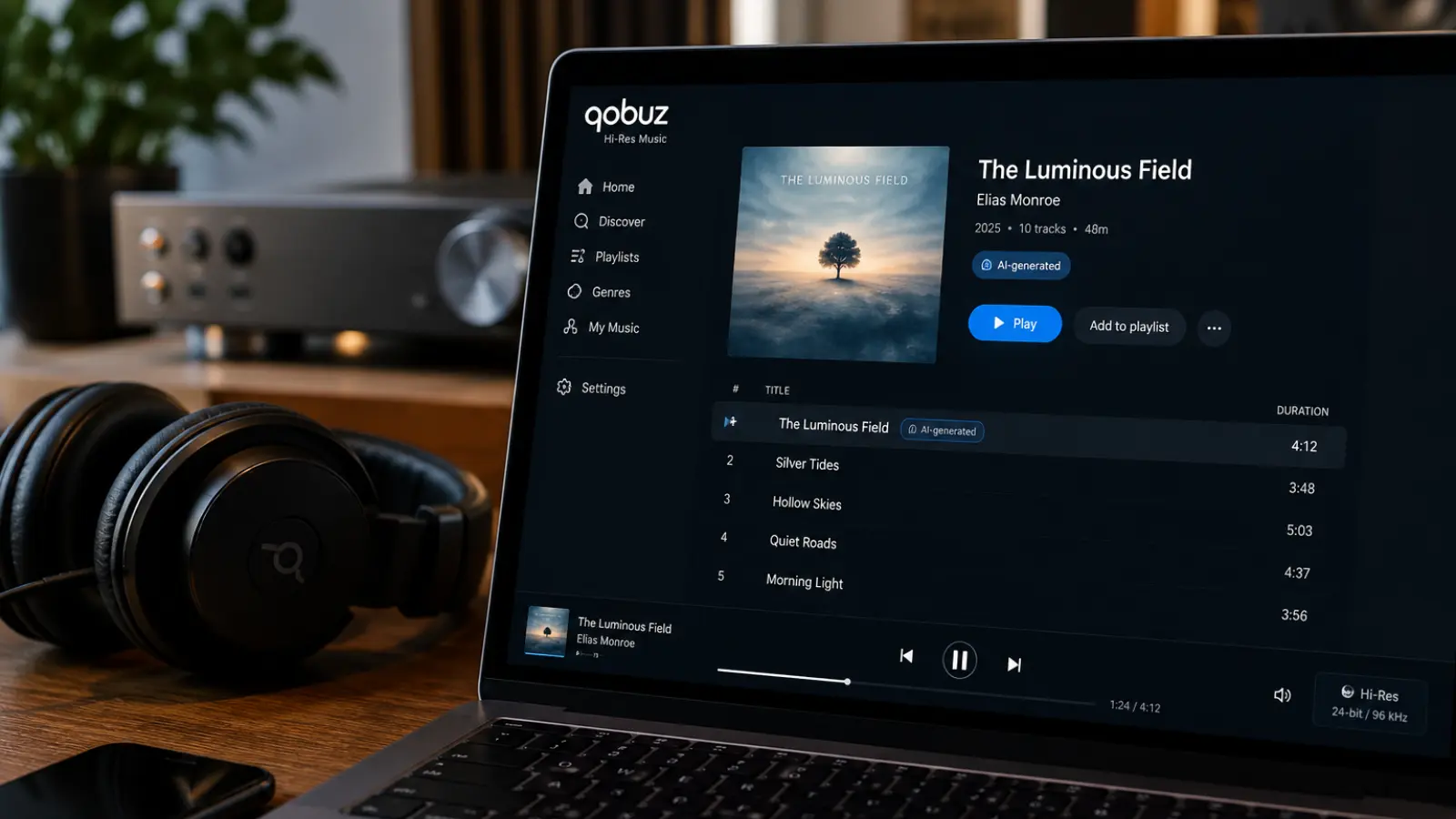
Qobuz has started labeling music tracks that its systems identify as being generated entirely by artificial intelligence, giving listeners a clearer indication of where the music they are hearing came from.
It is a relatively small change on the surface, but it addresses a question that is becoming increasingly difficult for streaming listeners to answer on their own: was this music actually made by people, or was it created by a generative system?
For anyone still getting familiar with how streaming works, our guide What Is Music Streaming? A Beginner’s Guide To Streaming Audio explains the basic technology and how streaming services have changed the way we listen to music.
Qobuz says the new labeling is intended to make that distinction more transparent, rather than leaving listeners to work it out for themselves. The company also stresses that its editorial playlists, recommendations and collections continue to be curated by humans.
AI-Generated Music Still Represents a Small Share of Qobuz Listening
Despite the growing attention around AI-generated music, Qobuz says tracks it identifies as entirely AI-generated currently account for only around 0.38% of all listening on the platform.
That figure puts the scale of the issue into some perspective. AI-generated tracks may be appearing across streaming services in increasing numbers, but at least on Qobuz, they currently represent only a very small portion of what listeners actually play.
For listeners who use more than one platform, that wider streaming landscape can already feel very different from service to service. I previously tested five major music streaming platforms, looking at the differences between them from a listener’s perspective.
Qobuz is also dealing with the problem from a different direction: fraudulent streaming activity.
According to Qobuz, its anti-fraud system currently identifies around 60% of streams involving entirely AI-generated tracks as fraudulent. Those streams are then excluded from royalty calculations.
Qobuz has also removed more than four million tracks associated with AI-generated albums from search results when those tracks had recorded no actual listening activity.
Qobuz Wants Listeners to Know What They Are Hearing
For Qobuz Deputy CEO Georges Fornay, the issue ultimately comes down to transparency.
Listeners, he argues, should understand what they are listening to and have the ability to make their own choices.
That distinction is important because Qobuz is not presenting the new label as a judgment on whether AI-generated music is good or bad. Instead, the company is trying to give listeners information about the origin of the material so they can decide for themselves.
That also fits with the way Qobuz positions its editorial side. While algorithms can play a role in the wider streaming experience, the company says its editorial playlists, recommendations and collections remain curated by humans.
The Difficult Part Is Knowing Where AI Ends, and Humans Begin
There is, however, a significant complication.
Qobuz acknowledges that AI-content recognition technology is not perfect. Identifying a track becomes particularly difficult when it has been produced using a mixture of human creativity and generative algorithms.
That makes a simple label of “AI” or “human” harder to apply in every situation.
A completely AI-generated track is relatively straightforward to categorize if the detection system can identify it reliably. But music created by a human using generative tools introduces a much less clear boundary. The technology may have contributed to the composition, performance, or production without completely replacing the human creator.
Qobuz says the industry will therefore need more consistent standards for identifying and labeling synthetic content as these technologies continue to develop.
Streaming Services Are Facing a New Transparency Problem
For listeners, the change is less about whether AI-generated music belongs on a streaming service and more about knowing what is actually sitting inside the catalog.
Streaming platforms already have to deal with enormous libraries, fraudulent streams, and tracks uploaded at a scale that makes human oversight difficult. The arrival of generative music adds another layer to that problem.
Qobuz’s approach is to put more information in front of the listener while also using its existing anti-fraud systems to address streams that it considers illegitimate.
And for now, the numbers suggest that entirely AI-generated music remains a small part of listening on Qobuz. The 0.38% figure is perhaps the most revealing detail in the company’s announcement: the technology may be attracting enormous attention, but it has not yet become a dominant part of what Qobuz listeners are actually playing.
The more interesting question may be what happens as AI-generated music becomes harder to distinguish from human-made recordings.
For Qobuz, the answer appears to be greater transparency, better detection, and, eventually, industry-wide standards for telling listeners exactly what they are hearing.