
JL Audio Dominion d108 Review: Can These Small Subwoofers Really Add Something to a Full-Range System?
JL Audio, based in Miramar, FL, is without question one of the handful of top-tier subwoofer manufacturers in the world. Some of the best-sounding and most lavish systems I’ve heard had JL Audio subs in place, even with full-range loudspeakers. JL Audio is actually quite diversified, producing not only subs, but full systems and components for cars, boats, and custom applications.
Audiophiles, however, know JL for their impressive-looking, audiophile-grade subwoofers like their mighty Gotham V2 flagship model, which costs approximately $30,000. The Gotham V2 goes down past 20 Hz and weighs a back-breaking 372 lbs! Next in line is the Fathom V2, followed by the E-Sub line, and now the recently designed entry-level models, the Dominion Series.
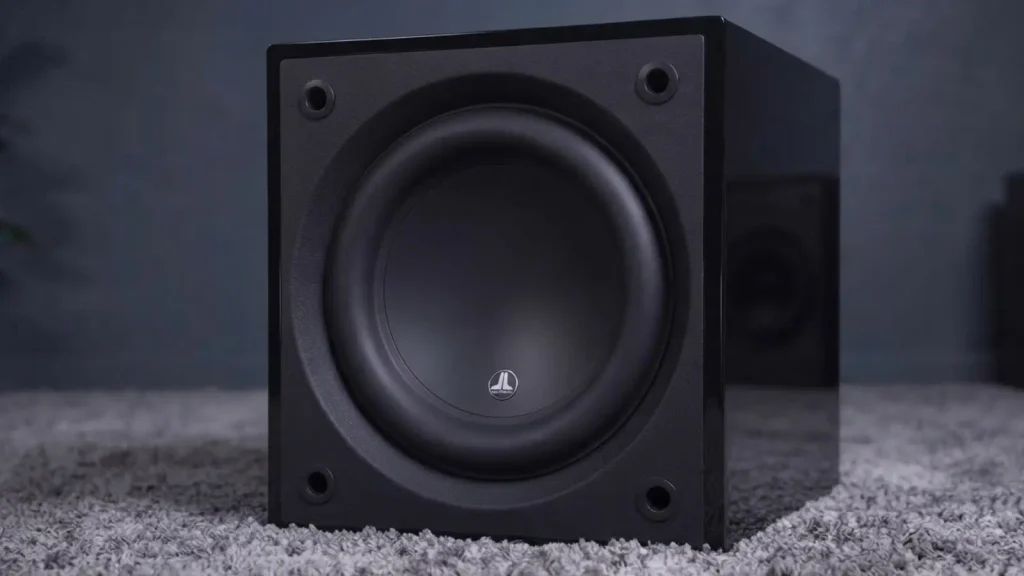
The Dominion series allows audiophiles entry into JL’s famous designs at a fraction of the cost, but with little compromise, according to the company’s design notes. Dominion subs come in two flavors: the d108 and d110. The d108 has an eight-inch woofer and an onboard 500-watt amplifier, while the JL Audio Dominion d110 has a ten-inch woofer and 750 watts of power on tap.
I received it for review in a stunning black gloss finish. Black Ash is also available. The Dominion d108 generally retails from $1,000 to $1,100 for the standard Black Ash finish and $1,100 to $1,200 for the Black Gloss finish, depending on the retailer.
Features
According to JL Audio, the Dominion series employs proprietary DMA (Dynamic Motor Analysis) technology to produce higher output levels with reduced distortion, as well as improved dynamic tracking and resolution. As a result, Dominion™ subwoofers are capable of peak-to-peak excursions well in excess of 2.5 inches (63 mm – d108), and 2.7 inches (68 mm – d110), without distress or audible distortion. Dominion™ amplifiers utilize an advanced Class D design in order to extract the most from the long-excursion driver platform. This design features a tightly regulated switching power supply, allowing the amplifier to generate prodigious amounts of unclipped output voltages. These technologies ensure that the Dominion™ powered subwoofers remain in their comfort zone, which is well beyond the point where most small subwoofers run out of power or driver capability.


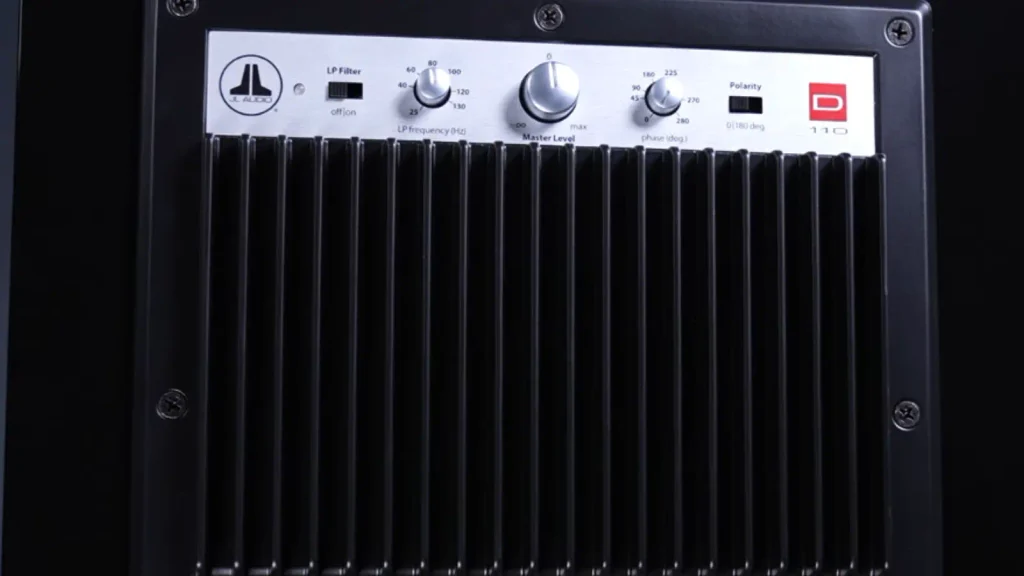
Other features include a built-in low-pass crossover with 24 dB/octave Linkwitz-Riley alignment. Phase and polarity controls are onboard to aid in achieving the optimal acoustic transition between the subwoofer(s) and main speakers.
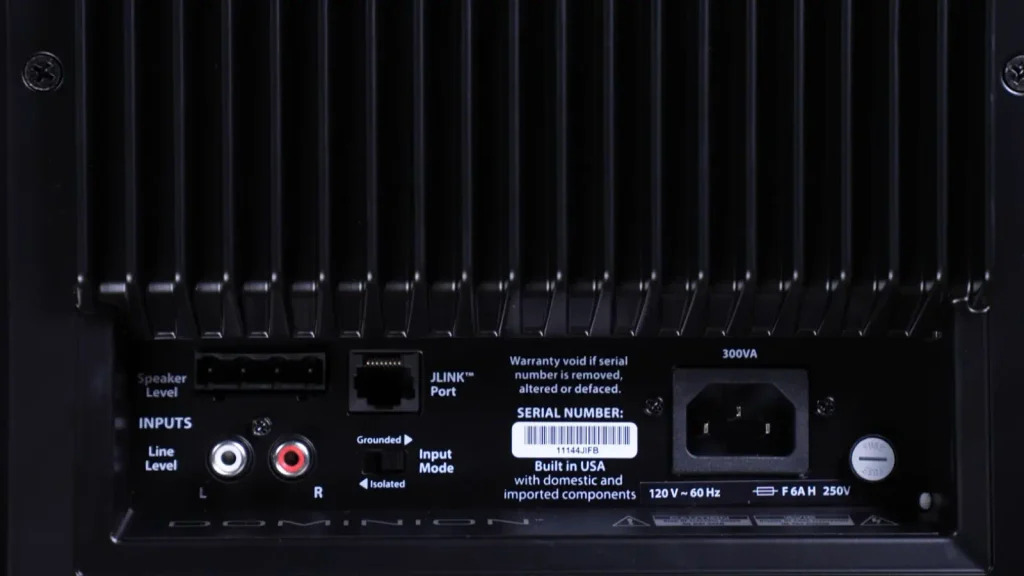
Flexible input options are on hand to accept either line-level or speaker-level signals. Connect a JLINK™ TRX system (sold separately) to the onboard Wireless Link port and enjoy the freedom to position your Dominion almost anywhere, up to 100 feet (30 meters) away from your source unit.
The cabinet is carefully engineered and constructed using solid, CNC-cut MDF material with extensive internal bracing and advanced assembly techniques. The Dominion is built in JL Audio’s U.S. factory.
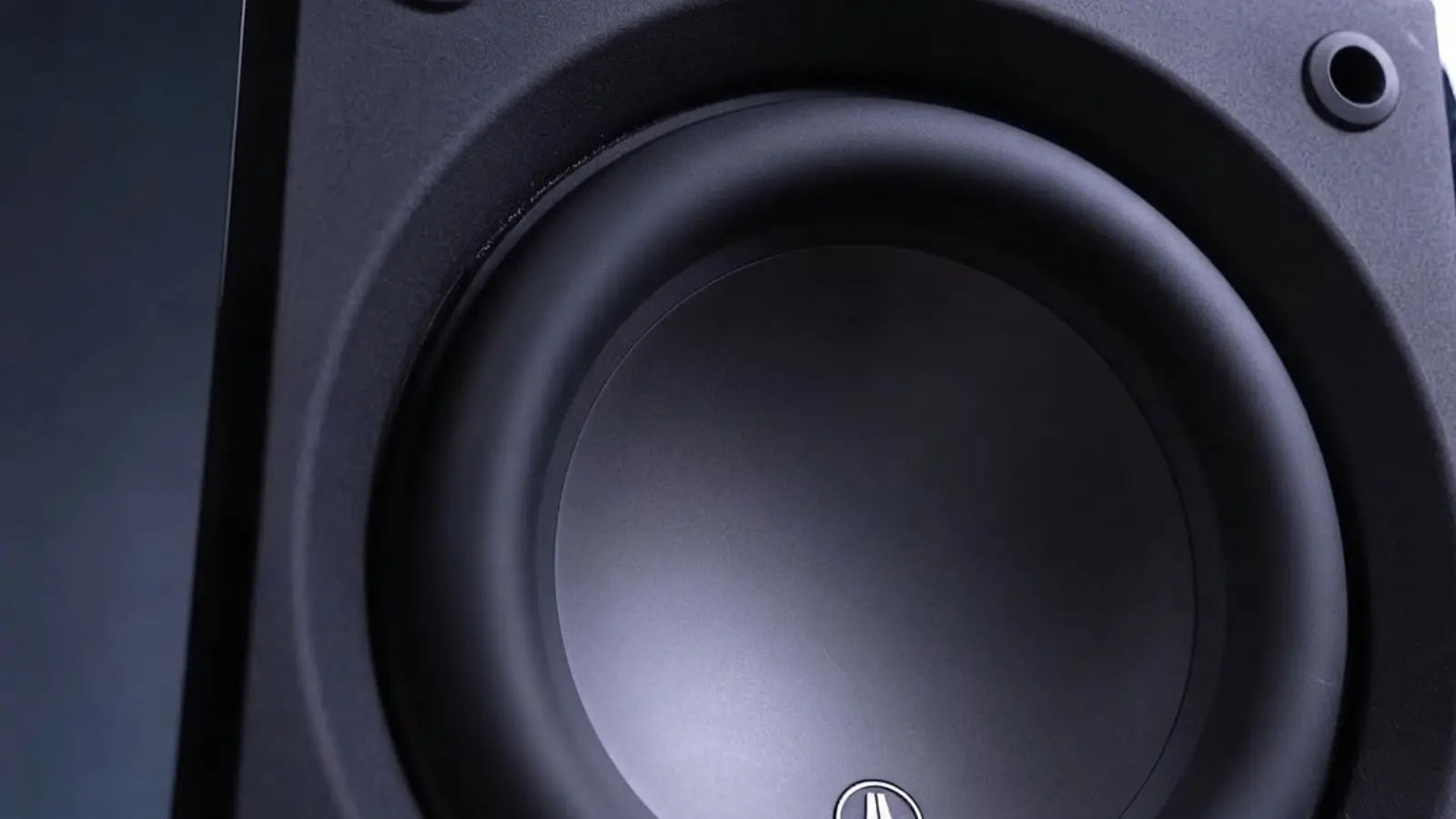
The Dominion d108 in person is beautifully finished and solid as a rock. It comes equipped with a power cord, informative manual, and adapters for speaker-level input. The driver is protected with a cloth grille that features the JL Audio logo at the bottom. Four solid support feet complete the picture.
Set Up The Dominion d108
Here is a little secret. Having used subwoofers years ago with smaller satellite speakers, I grew tired of trying to integrate them and gave up. I opted instead for larger, fuller-range speakers that had satisfying bass. Having recently moved into a new house with a listening space with high ceilings, I began to wonder if the addition of subwoofers to my Bryston Mini T stand-mounts would make a difference. The Mini T has an eight-inch woofer and, according to Bryston, goes down to 33 Hz, which is pretty decent extension. In other words, the Bryston are not bass-shy.
It just so happened that the opportunity to review the JL Audio Dominion subs came about as I began to question my anti-subwoofer policy. I used the review samples in several configurations in two separate rooms. In my office system, I used them with Spendor S35/R monitors, an Aric Audio Expression tubed preamp, a variety of power amplifiers, and a Simaudio 280D streamer/DAC. In the main system, the speakers were, as mentioned, Bryston Mini T, Rogue RP-5 preamp, a Simaudio 760 power amp, and a Bryston BDP2/BDA-3 file player and DAC combo.
There are several ways to set up subwoofers. One is with external calibration gear, which includes microphones, software, and DSP. Another way is by ear. It can get as complicated as you like. I chose the “by ear” method.
Also, with most subs, you have a choice of either using speaker-level input or line-level input. Speaker-level input means you run your speaker cables directly into your subwoofer, then an additional run of speaker cable to your main speakers. Line-level input means the sub receives the line output from your preamp or integrated amp, and you will use either your preamp/amp’s onboard bass management or the controls available on the subwoofer. In either case, your speakers run full range.
In both my systems, I ran a stereo set of RCA cables from my preamps, both of which have dual sets of variable stereo outputs, one for an amplifier and one for a sub. The Dominion sub takes the stereo input and sums it to mono.
After some experimentation, I set up each sub in each system just behind the left speaker. In the office system, I ended up with the crossover set at 60 Hz, and the gain control set at the reference point, twelve o’clock. In the main system, I ended up with the crossover at 40 Hz, and the gain backed off, set at roughly 9 o’clock. I experimented with, but ultimately did not change, the phase and polarity settings.
After using one each in two systems, I combined the Dominions in the main system for a stereo sub setup.
Performance
Listening to a variety of music, I did not specifically seek out bass-heavy stuff, but definitely material with high-quality bass content. I called on one of my very favorite albums, System, by Seal. The near-perfect blend of acoustic guitar, electronica, and moody grooves was great for helping dial in the Dominions. Stellar tracks like “Dumb,” “Amazing,” and the title track let me hear the shimmering top end and mellow midrange, with the Dominion’s low-end reinforcement.
A recent remaster I have been enjoying, Michael Jackson’s Off The Wall, 24/96 FLAC, is full of amazing melodies, dazzling polyrhythms, and, of course, classic bass lines. The Dominions allowed the entire mix to breathe, and the weight of the bass lines to propel the tracks forward. Shutting off the subs decreased the sense of drama and reduced the scale of the music.
As I streamed numerous albums, the Dominion subs were extremely precise, quick, and nimble. I was quite surprised by how well they integrated with the Brystons’ eight-inch woofers, and just how much they aided the Spendors.
To be clear, I don’t look for subwoofers to provide “bass” for a system. What they do is add weight and gravitas, adding lifelike solidity to the lower end that makes the presentation more believable and more anchored. In my opinion, a subwoofer should provide a foundation, but not be asked to do beyond what it was designed for, which is augmentation. But that augmentation is critical for a satisfying presentation.
A word about stereo and mono setups. I very much enjoyed the stereo setup, one sub on each side of the room. There was a “rightness” about the presentation, and localization of the subs seemed not to be an issue. Since program material can have bass-specific information mixed to one channel or the other, I preferred the stereo setup.
However, even with one Dominion sub in the system in a summed-mono setup, the added weight, low-bass augmentation, and the blend between the main speakers were excellent.
I have known fellow audiophiles that have spent weeks, and even months, dialing in their subwoofers. As I said, it can be as complicated or stress-free as you make it. Because the JL Dominion subs are so clean and quick, it was much easier than I anticipated to integrate them seamlessly.
Of course, it is possible I could have gotten even more satisfying results with sophisticated DSP calibration, but I don’t have the patience or the budget for high-quality calibration gear. “By ear” is the way I roll, and the very responsive controls on the Dominion let me do that.
I should note I used no special tweaks on the Dominions aside from swapping out the stock power cord midway through the review with Shunyata Venom power cords, and I situated the subs on Auralex subwoofer platforms. I can’t say I really heard much of a difference with the aftermarket power cords, but I did feel the Auralex platforms made a difference in taming floor resonances. At around $60 each, they are a worthy accessory.
Final Verdict:
The Dominion subs, once dialed in, essentially disappeared and ended up being indispensable additions to my system. When they were turned off, it was quite noticeable. Noticeable to the point that I feel my system is better off with them.
Here is a huge bonus: if excellent sonic performance was not enough, Dominion subwoofers are made right here in the USA in JL Audio’s Florida factory. How JL Audio does this and prices the Dominion starting at $1,000 is beyond me. It must be economies of scale.
If you are looking for the last missing piece for your system — the sense of lifelike weight and scale — and don’t want to break the bank, I can’t possibly recommend the JL Audio Dominion subwoofer series highly enough.
JL Audio Dominion d108 Specifications:
| Specification | JL Audio Dominion d108 |
|---|---|
| Driver | 8-inch woofer |
| Amplifier | 500 watts |
| Maximum excursion | 2.5 inches / 63 mm peak-to-peak |
| Crossover | 24 dB/octave Linkwitz-Riley |
| Inputs | Line-level and speaker-level |
| Wireless | JLINK™ TRX compatible |
| Wireless range | Up to 100 feet / 30 meters |
| Enclosure | CNC-cut MDF with extensive internal bracing |
| Manufacturing | JL Audio U.S. factory |