Dynaudio Confidence 30 Review: A High-End Window into Your Rig’s True Potential
Dynaudio doesn’t rush a flagship redesign, and the current Confidence range shows it. The Dynaudio Confidence 30 sits in the middle of the line — a three-way floorstander built around ideas the company has clearly spent years refining rather than reinventing.
Esotar3: Refining an Icon
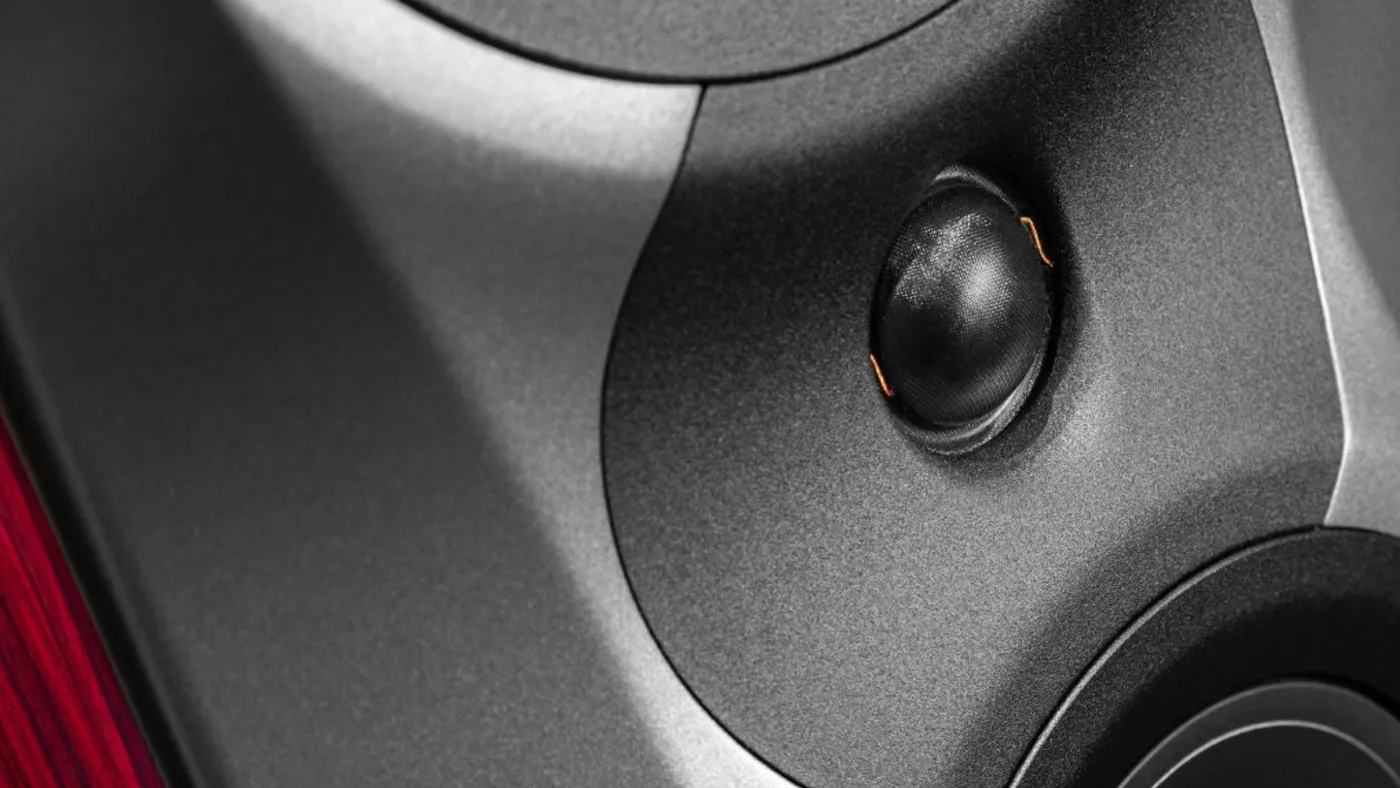
The biggest change across the whole Confidence range is that every model now shares a single tweeter design. In the Confidence 30’s case, that’s the 28mm Esotar3 soft-dome. Dynaudio has stuck with soft domes for decades, on the belief that they deliver the most natural high-frequency balance with the least listening fatigue — and generation after generation of Esotar drivers has done enough to back that belief up.
Is This the New Class Leader? KEF Q350 Review vs. Dynaudio Emit M20
What’s new here is a structure called Hexis, sitting just behind the fabric dome. It’s a precision-moulded inner dome that manages airflow, damps unwanted resonance, and smooths out the frequency response. Pair that with a larger rear chamber and an upgraded magnet system, and you get lower distortion and more transparency without losing the effortless quality Esotar tweeters are known for. It sounds like a small addition on paper. In practice, getting Hexis into production reportedly took a fair amount of re-engineering, which tells you something about how seriously Dynaudio takes details most listeners will never see.
Confidence 30 Design
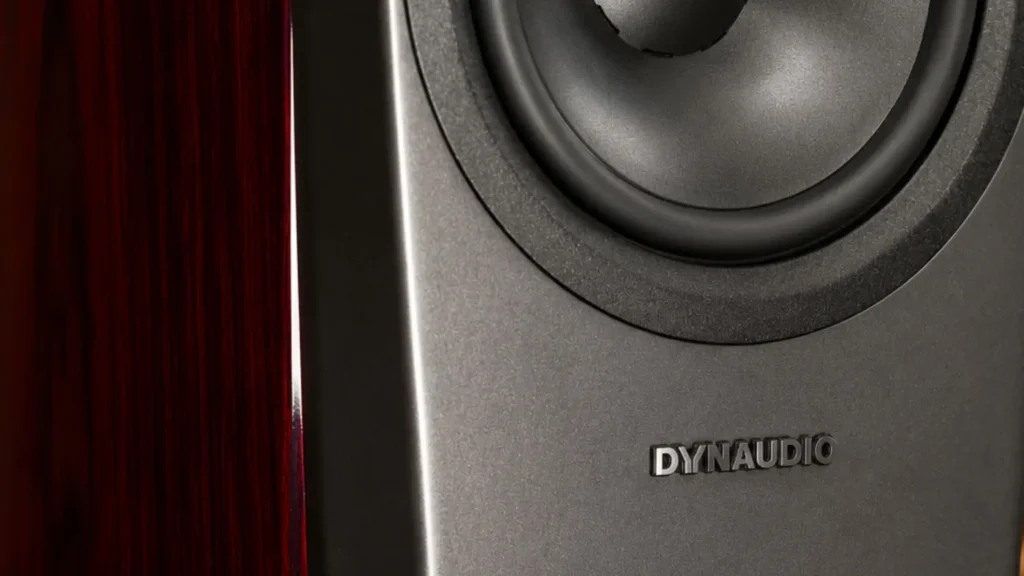
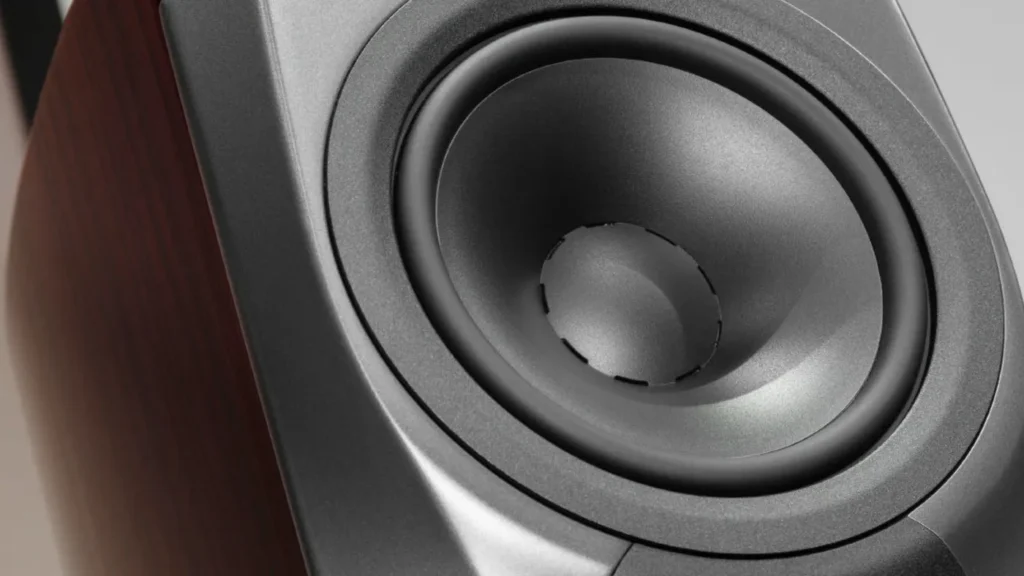
Dynaudio Confidence 30 is a three-way floorstander: twin 18cm bass drivers, a 15cm midrange, and the Esotar3 tweeter up top, crossing over at 290 Hz and 3.7 kHz. Every driver uses Dynaudio’s own Magnesium Silicate Polymer (MSP) cones, where the diaphragm and voice-coil former are moulded as one continuous piece rather than bonded together afterwards. The result is a stiffer assembly with less unwanted colouration.
The sculpted front baffle is one of the more eye-catching design touches, and it’s not there just to look distinctive — it’s part of Dynaudio’s DDC (Dynaudio Directivity Control) system, shaping dispersion and cutting down on room reflections. The baffle itself is machined from an advanced composite, which adds rigidity and helps isolate vibration from each driver. Having watched these being built, it’s a lot more engineering than a front panel usually gets.
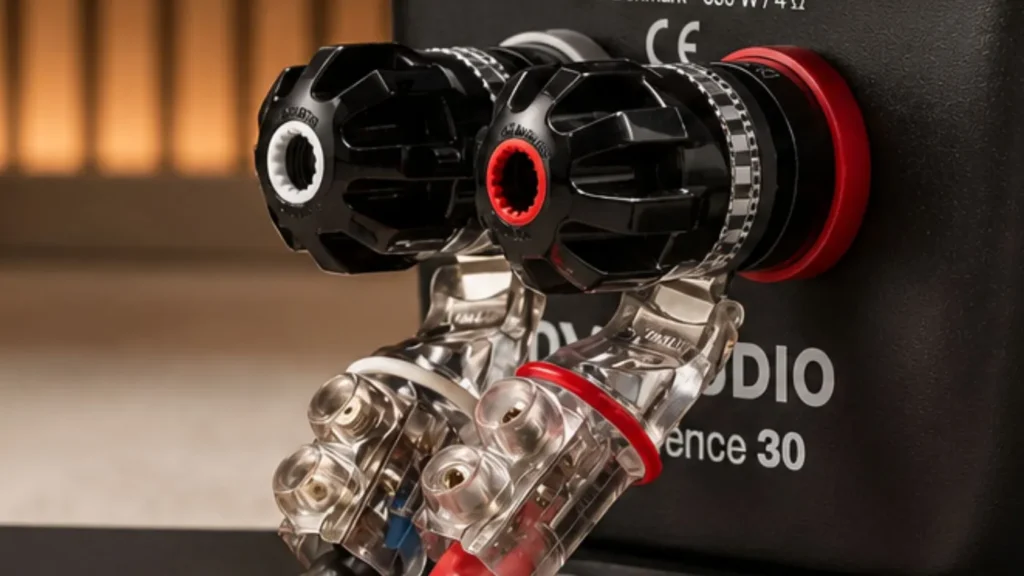
Around the back, you’ll find a single pair of WBT terminals — no bi-wiring option here, with Van den Hul supplying the internal wiring, and magnetic grilles that keep the cabinet looking clean when fitted. Overall, the Confidence range walks a fine line between serious engineering and understated Scandinavian styling. Cabinet finish, machining, fit, and finish, it all read as flagship-grade.
Placement and Room Requirements
My review pair arrived with a fair number of hours already on them, so I can’t speak to how they sound fresh out of the box. Dynaudio speakers generally reward a proper run-in period, and I’d expect nothing different here.
Positioning them was easier than I expected. There’s a clear sweet spot, but move off-axis, and the tonal balance barely shifts; these aren’t speakers that punish you for sitting slightly off-centre, which makes them genuinely livable day to day.
They do still want space, though. Push them too close to the back or side walls, and you’ll shortchange them. Give them room — I’d say 30 to 35 square metres or more — and the soundstage opens up properly, letting that downward-firing bass port integrate with the room instead of fighting it.
Amplifier Matching
I ran the Dynaudio Confidence 30 with two very different amplification setups: an Esoteric F-05 integrated, and separately, Gryphon’s Essence pre/power combination, both fed by an Esoteric K-03XD SACD player as the only source.
On paper, either amp had the current to handle the Confidence 30’s 4-ohm load (dipping to 2.8 ohms) without breaking a sweat. In practice, that dip is a reminder these speakers want a genuinely stable, high-current partner — skimp here, and you’ll hear it.
What struck me most was how little the Dynaudio Confidence 30 got in the way. Swap the amplification, and you hear the amplification, not the speaker reasserting itself.
The Esoteric pairing sounded exactly like you’d expect from that brand: clean, resolved, almost forensic. I put on Gregory Porter’s Revival to start, and the presentation was calm and tightly controlled — not warm, but not cold or clinical either. Everything sat in its own place. Dynamics came through easily, low-level detail was excellent, and the tonal balance held steady top to bottom. Where the recording turned slightly bright, that was down to the recording — the speakers themselves stayed neutral. Imaging was just as convincing: stable, well-proportioned, with real depth. If anything, this pairing favoured precision and composure over outright excitement, which will suit plenty of listeners just fine on long sessions.
A Conversation with the Music
Next up was Hans Zimmer’s score for Dune, and it confirmed what I’d already suspected. This isn’t just a detailed speaker — it’s a genuinely honest one. It’ll show you everything upstream in the chain, good or bad, but it never turns the listening experience into an audit of your gear. You end up listening to the music, with the quality of the electronics simply along for the ride.
Don’t expect party-speaker energy from the Dynaudio Confidence 30; it’s too disciplined for that. It’s built for sitting down and paying attention, whether that’s critical evaluation or just getting lost in an album.
Tonally, it’s remarkably even: deep, controlled bass, an open midrange, and treble that extends cleanly without ever turning hard or splashy. Given Dynaudio’s engineering resources, that kind of integration isn’t a huge shock, but pulling it off this well, at any price, still deserves credit.
Bonobo’s Kerala showed a different side of the speaker’s talents, rhythm, dynamics, and transparency all handled with real confidence, and enough production detail coming through that you notice new layers without the presentation ever turning analytical or tiring. There’s precision here, but it never tips into clinical.
Changing the Electronics
Swapping to the Gryphon Essence pre/power combination, still with the Esoteric K-03XD as source, made the difference obvious straight away. Where the Esoteric setup leaned into neutrality, Gryphon added a richer tonal palette — more harmonic texture, more atmosphere, a slightly fuller and more relaxed presentation without giving up any transparency.
What didn’t change was the speaker itself. It just reflected whatever character the electronics gave it — arguably its single biggest strength, since it means the Confidence 30 gets out of the way and lets your amplifier choices actually matter.
It’s also worth noting how the speaker builds a sense of scale. A lot of loudspeakers fake size through boosted bass or exaggerated dynamics. The Dynaudio Confidence 30 does it through resolution instead — pull more information out of a recording, and the scale takes care of itself. Ask it for something explosive, and it delivers; ask for restraint, and it holds back just as convincingly.
Music Listening
Gary Clark Jr.’s This Land isn’t an aggressive recording, and the Confidence 30 didn’t try to make it one; it just played the track as captured. The soundstage stretched well beyond the cabinets, instruments stayed cleanly separated, and there was real depth to the image. Clark’s guitar sat in a fixed, stable spot in the mix, with all the surrounding ambience intact.
Across the board, the tonal balance stayed neutral and open rather than warm or overtly analytical — the kind of speaker that steps back and lets the recording carry the moment.
The real surprise, though, was Rivers of Nihil’s Terrestria III: Sacred Fire. Dense, technical extreme metal is where a lot of speakers fall apart. Layered guitars, blast-beat drumming, and vocals all fighting for the same space tend to collapse into mush. Not here. Every line stayed audible and distinct, and yet none of the intensity or cohesion was lost in the process. Getting that kind of resolution is one thing; keeping the music feeling like music while doing it is considerably harder. It’s the kind of moment where the engineering actually adds to the enjoyment instead of just being impressive on a spec sheet.
Finally, Verdi’s Requiem tested how the Dynaudio Confidence 30 handles full-scale orchestral and choral material — arguably the hardest genre to get right, since huge forces and big dynamic swings expose weak imaging fast. The speaker didn’t flinch. The orchestra spread across a large, deep soundstage, sections stayed where they belonged, and choral passages came through clean even at full intensity. Scale and intimacy weren’t traded off against each other; you got both.
Conclusion:
The Dynaudio Confidence 30 isn’t a speaker that flatters you with an obvious “house sound.” It’s closer to a very well-made window: transparent, composed, unfailingly honest about whatever you feed it. That makes it a demanding partner to build a system around; it won’t hide a mediocre amplifier or a poor recording. But for anyone chasing accuracy over easy excitement, that honesty is exactly the point.
Pros And Cons:
Pros:
Exceptionally even, neutral tonal balance top to bottom
Refined Esotar3 tweeter with genuinely audible improvements over its predecessor
Forgiving off-axis listening for a speaker, this resolves
Handles dense, complex material (metal, full orchestra) without congestion
Superb build and cabinet engineering
Cons:
Needs a stable, high-current amplifier to perform at its best
Wants a reasonably large room (30+ square metres) to fully open up
Not a forgiving speaker with poor recordings or mediocre electronics
Bottom line: A genuinely flagship-calibre loudspeaker that rewards a serious system and serious listening, rather than trying to impress in the first ten seconds.