Denon PMA-A110 Review: A Japanese Masterpiece Built to Last
Denon is a name carved into the very foundation of audio history. Founded in 1910 as Nippon Columbia, the Japanese company has spent over a century obsessively refining the art of sound reproduction. To celebrate its 110th anniversary, Denon released a series of special-edition components, each tuned to perfection, hand-assembled in Japan, and built to embody the spirit of pure hi-fi craftsmanship. This wasn’t merely a celebration; it was a declaration of principles.
At the heart of this celebration stands the Denon PMA-A110 integrated amplifier, a limited-edition marvel (only 3,000 units were produced worldwide) that serves as both a tribute to Denon’s past and a bold statement for the future. Initially perceived as a collector’s item, it has since been elevated to Denon’s new flagship amplifier, formally replacing the PMA-2500NE and cementing itself as one of the most refined and complete integrated amplifiers the brand has ever produced
Check Out: Denon DM41DAB Review
Design and Build Quality
The Denon PMA-A110 is unmistakably and profoundly Japanese in its design philosophy: functional, elegant, and obsessively precise. While its silhouette shares a familial resemblance with the PMA-2500NE, Denon’s engineers overhauled nearly every component within.
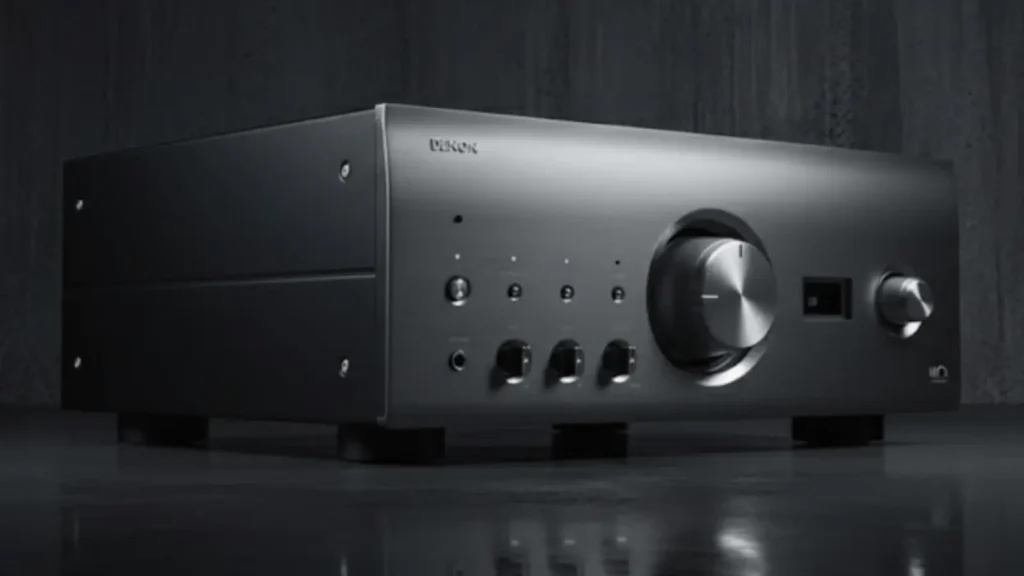
The amplifier is built around a monocoque, non-magnetic, double-layer aluminum chassis. This rigid structure is designed to suppress resonance and electromagnetic interference at a fundamental level. Replacing the steel panels of its predecessor, the A110 wears an all-aluminum armor—including the top panel, side panels, and reinforced front plate—which enhances structural integrity and provides superior vibration damping.
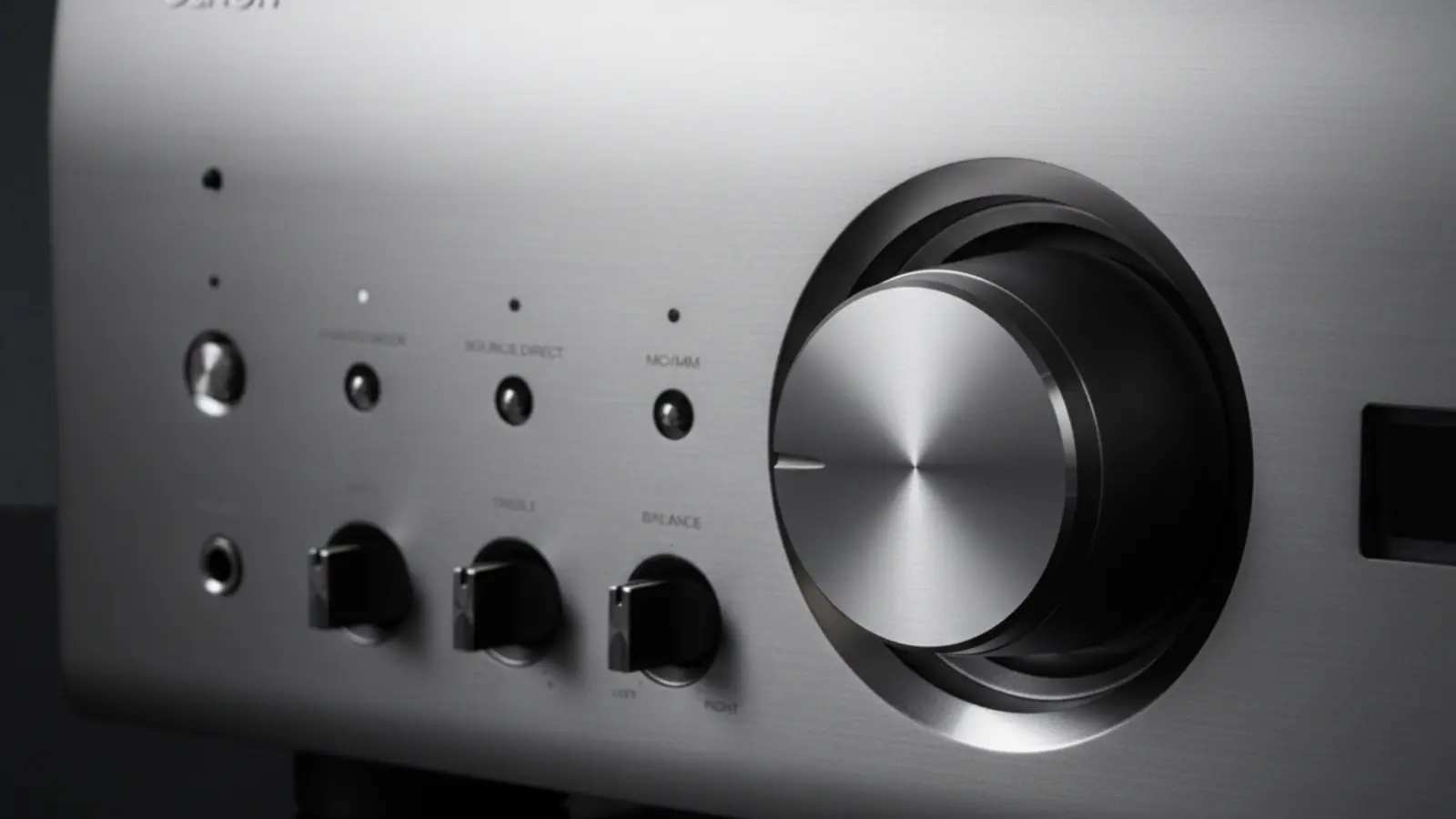
The front panel is dominated by a large, mute-capable motor-driven ALPS potentiometer for volume control, offering buttery-smooth operation and precise channel matching. The control knobs for input selection and tone controls (defeatable) have a satisfying, damped heft. The signature “Silver Graphite” finish is more than a color; it’s a meticulously applied coating that provides a sense of understated luxury and tactile sophistication.
Critically, each unit is hand-assembled and tuned in Denon’s legendary Shirakawa Audio Works factory in Japan. This is the spiritual home of Denon’s High-End series, where master technicians have carte blanche to build without compromise—no cost-cutting, no shortcuts. Internal wiring uses high-grade, oxygen-free copper cables, and all critical signal paths are point-to-point hand-soldered.
Technology: Ultra High Current Power and Intelligent Separation
Beneath the serene exterior lies some of Denon’s most advanced and purpose-built audio engineering.
Ultra High Current (UHC) Single Push-Pull MOSFET Design: This is the core of the A110’s amplifier section. Unlike conventional designs, it employs a single-stage configuration with massive Sanken bipolar/MOSFET hybrid output devices. These are capable of delivering a staggering 210 Amperes of peak current, allowing the amplifier to exert effortless control over even the most demanding, low-impedance loudspeakers. The result is high instantaneous power and exceptional dynamic headroom.
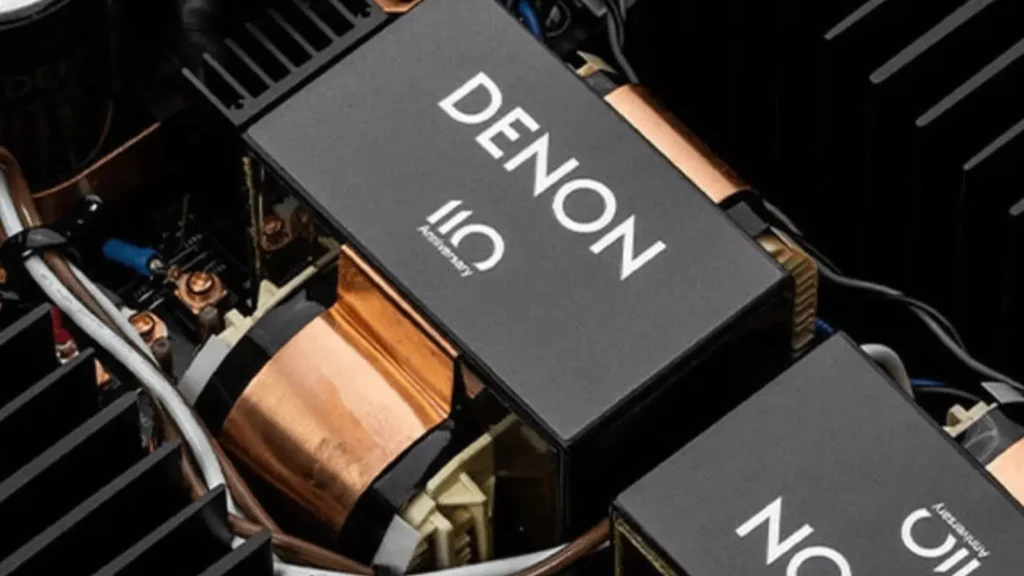
Advanced Power Supply & Intelligent Separation: The power supply is a work of art. It features two custom-designed, high-capacity EI transformers (one for the analog stages, one for the digital/control sections) placed in an asymmetrical layout to minimize magnetic interference. Each major circuit block—left/right channel analog amp, phono stage, DAC, and control system—is physically isolated in its own “chamber” within the chassis, with independent regulated power supplies. This “Intelligent Separation” architecture ensures a jet-black noise floor and pristine signal integrity.
Premium Quad-DAC Section: The digital heart of the A110 is a significant departure from standard designs. Instead of a single off-the-shelf chip, it utilizes a Quad-DAC configuration featuring four Burr-Brown PCM1795 chips. Operating in a parallel differential mode, this setup works in tandem with Denon’s proprietary Ultra AL32 Processing, which upsamples data to smooth out the waveform and drastically reduce noise. It supports:
- PCM: Up to 384 kHz / 32-bit via USB-B
- DSD: Native playback up to DSD 11.2 MHz (DSD256) via USB-B
- Coaxial/Optical: Up to 192 kHz / 24-bit
The USB-B input utilizes an XMOS xCore 200 series controller for stable, jitter-free asynchronous data transfer.
Phono Stage Excellence: A true highlight for analog enthusiasts. The fully discrete, symmetrical phono equalizer circuit supports both MM and MC cartridges. It is exceptionally quiet, dynamic, and reveals fine record details often lost in lesser integrated stages.
Additional Technical Highlights:
- Direct Mechanical Ground Construction: The massive, non-resonant heatsinks are directly bolted to the chassis, acting as a vibrational sink.
- High-quality Audio Components: Extensive use of film capacitors (including custom-made units) in the signal path, high-precision metal film resistors, and gold-plated brass terminals.
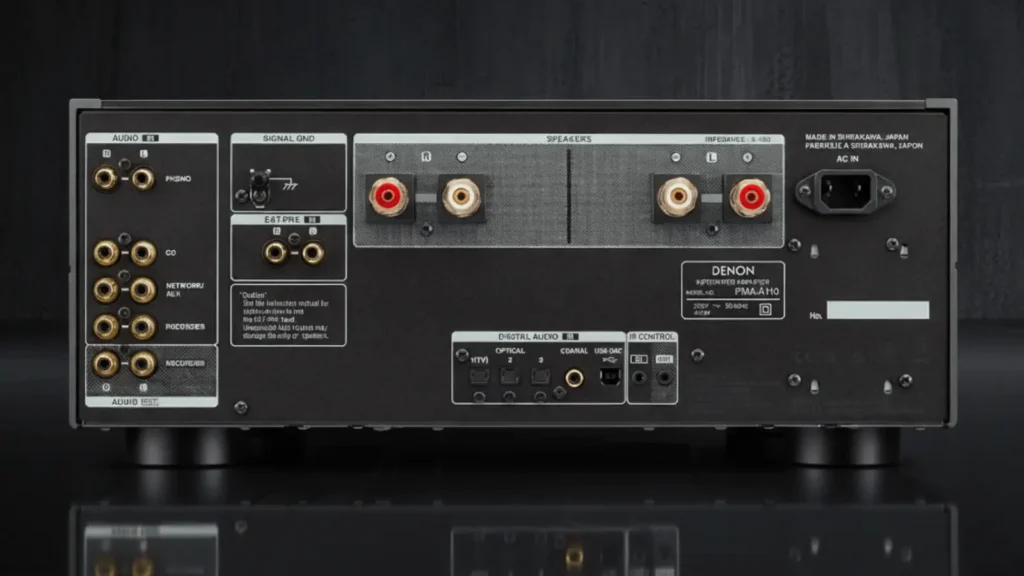
- Speaker Terminals: Heavy-duty, gold-plated brass binding posts that accept spades, bananas, or bare wire.
- External Pre-Input: The unit features an “EXT.PRE” input, allowing the Denon PMA-A110 to function purely as a power amplifier within a home theater setup.
- Remote Control: A solid, full-function aluminum top-plate remote is included.
Sound Quality
The Denon PMA-A110 does not have a “sound” in the colored sense; it has a sonic character defined by authority, transparency, and organic musicality.
Authority & Control: The first impression is one of immense, unflappable control. The amplifier grips speakers with an iron fist in a velvet glove. Bass is deep, articulate, and powerfully defined, never bloated or sluggish. Complex musical passages remain perfectly coherent.
Tonality & Texture: The midrange is where the A110 shines. It is rich in harmonic texture and lifelike in its portrayal of vocals and instruments. There’s a palpable sense of body and density without ever becoming thick or opaque. The famed “Denon warmth” is present but refined—it’s the warmth of reality, not of added euphonic coloration.
Soundstage & Detail: The soundstage is expansive, layered, and precisely focused. Instrument placement is stable and holographic. Detail retrieval is exceptional, revealing subtle ambient cues and low-level information, but it is never analytical or fatiguing. The background is profoundly silent, allowing micro-dynamics to flourish.
Source Performance:
- Phono Stage: Spinning Friedrich Gulda’s “Emperor Concerto” on vinyl, the phono stage is revelatory. Strings have sheen and body; the piano carries both weight and delicate, transient speed. It is so musically engaging that the notion of an external phono preamp becomes superfluous for all but the most exotic cartridges.
- DAC Performance: Streaming the same piece via USB, the Quad-DAC configuration reveals a slightly sharper focus and even greater dynamic slam. It masterfully avoids the sterility that can plague some high-resolution digital playback, retaining a natural, fluid musicality. The difference between high-res PCM and native DSD is clearly rendered, with DSD offering a notably smoother, more analog-like presentation.
Genre Mastery: Whether driving the complex orchestration of Moby’s Reprise, the intimate acoustics of McCartney’s McCartney III, or the driving electronic beats of modern productions, the A110 remains utterly faithful to the source. It is revealing yet forgiving, capable of showing a recording’s flaws without making them painful to hear.
Critical Comparisons & System Synergy
- vs. Marantz Model 30: The corporate cousin under Sound United takes a different path. The Marantz, with its Class D amplification, offers a punchier, more immediately “fun” sound with a warmer, richer midrange. The Denon is more agile, transparent, and refined, with superior low-end control and a more “traditional high-end” analog character. It feels more like a purist’s instrument.
- vs. Yamaha A-S3200: This is a clash of Japanese titans. The Yamaha, with its gorgeous meters and dual-mono construction, has a slightly sweeter, more relaxed top-end and magnificent build. The Denon counters with superior digital integration (the Yamaha lacks a DAC), a more authoritative grip on bass, and a marginally more dynamic and precise presentation. It’s a near tie on craftsmanship.
- vs. Luxman L-507Z: The Luxman exudes vintage charm with its modern build. It often presents a slightly more lush, romantic, and “tubelike” sound signature. The Denon is more neutral, faster, and offers a more feature-complete package (including the exceptional phono stage) at a significantly competitive price point.
System Synergy: The A110’s 80W/ch (8Ω) / 160W/ch (4Ω) rating, backed by its high-current design, means it partners well with a wide range of speakers. It excels with transparent, neutral to slightly warm speakers (e.g., Bowers & Wilkins 700 Series, Dynaudio, some Focal models) and can effortlessly drive moderately inefficient designs. Its transparency makes it an excellent match for high-resolution source components and premium cables that favor clarity over excessive warmth.
Comparisons: Denon vs Marantz and Beyond
Inevitably, comparisons arise, especially with the Marantz Model 30, Denon’s corporate cousin under Sound United. The Marantz delivers a punchier, warmer sound, driven by its fully digital amplification design. The Denon, on the other hand, is more agile, refined, and transparent, with a traditional analog heart that feels more natural to seasoned audiophiles.
Against rivals like Yamaha’s A-S3200 or Luxman’s L-507Z, the Denon PMA-A110 stands tall. It matches their craftsmanship while offering superior digital integration at a more accessible price point.
Conclusion:
The Denon PMA-A110 is not merely an amplifier; it is a convergence point. It converges Denon’s 110 years of technical heritage with modern digital demands. It converges no-compromise craftsmanship with genuine musical engagement. It converges the roles of a premium analog amplifier, a world-class phono stage, and a reference-grade DAC into one cohesive, breathtaking instrument.
For the Audiophile, it offers: The peace of mind of heirloom-grade build, the joy of a truly silent and dynamic phono stage, the convenience of a top-tier Quad-DAC, and the sonic performance of separates, all in one box.
You buy the PMA-A110 for: Its soul, its heritage, and its incredible, all-encompassing precision. It masterfully blends the classic, trustworthy Denon musicality with cutting-edge, modern performance. They built it to honor 110 years of history, but with its peerless construction and timeless design, it is an amplifier built to define the next decade and resonate for a hundred more.
Final Rating: 5/5 Stars – A Class-Leading Masterpiece.
Pros and Cons
Pros
- Stunning craftsmanship and premium materials
- Smooth, detailed, and powerful sound
- Excellent built-in DAC with DSD 11.2 MHz support
- Superb MM/MC phono stage
- Hand-assembled in Japan
- Balanced, transparent sound signature
Cons
- Limited availability due to anniversary production
- No streaming or network connectivity
- Large and heavy design
Denon PMA-A110 Specifications
| Feature | Denon PMA-A110 |
|---|---|
| Power Output | 80W + 80W (8Ω, 20Hz–20kHz, THD 0.07%) |
| Amplifier Design | Ultra High Current (UHC) MOS Single Push-Pull |
| DAC | PCM 384kHz/32-bit, DSD 11.2MHz |
| Inputs | 5x Line, 1x Phono (MM/MC), 2x Optical, 1x Coaxial, 1x USB-B |
| Output | Speaker A/B, Pre Out, Headphone |
| Frequency Response | 5Hz – 100kHz |
| THD | 0.01% (rated power) |
| Dimensions | 434 x 182 x 431 mm |
| Weight | 25.0 kg |
| Country of Manufacture | Japan (Shirakawa Factory) |