Audio-Technica AT-LP5 Review: A Direct-Drive Turntable That Still Makes Sense
Audio-Technica’s engineers are known for being super detailed and practical almost like they really care about doing things right. They don’t buy into weird audio myths or slap fancy wood on their gear just to make it look pretty. Instead, they focus on solid engineering, careful tuning, and smart choices that actually help the music sound better not just help the marketing team. This time, we’re looking at the Audio-Technica AT-LP5 turntable. It’s one of their more affordable models, but you can still see bits of Audio-Technica’s higher-end analog expertise in there.
I’ll be honest up front: I’m not some crazy vinyl fanatic. After years of listening to really expensive analog setups, I know exactly how much money, work, and patience it takes to build a record player that can truly beat a good digital setup. Despite what you read online, vinyl isn’t magic, and it’s not automatically more “musical.”
Audiophiles Are Obsessed With These Audio-Technica Turntables – Here’s Why
That said, even cheaper vinyl setups often have something that cheap digital gear struggles to match: a feeling of life. Vinyl might not be super precise, and it plays a little loose with timing and tone sometimes, but it rarely sounds boring. Cheap DACs, like the ones in phones, laptops, budget streamers, or tiny dongles, tend to make music feel clean but lifeless. Even imperfect analog playback usually keeps the texture, energy, and physical presence of the music. That’s exactly why I still pull out records once in a while, and why I got interested in the AT-LP5. It’s affordable, far from basic, and best of all, it’s direct-drive. That last point matters.
Digitization Included
The AT-LP5 is clearly aimed at modern music lovers who may be completely unfamiliar with analog playback. Accordingly, it includes everything necessary to get started immediately: a factory-installed cartridge, a built-in phono preamp, USB connectivity, and even bundled software for digitizing records. Predictably, the USB functionality will trigger the usual vinyl purist snobbery, but in reality, it’s more useful than many enthusiasts care to admit.
If you happen to come across a rare or obscure pressing unavailable online, being able to archive it digitally can be genuinely valuable. Of course, in most cases, it would probably be faster — and sonically superior- to simply download a high-quality digital release. Still, truly obscure records do exist, particularly regional pressings, private releases, and old live recordings that never made the transition to streaming services or torrent archives.
There’s also another, more sentimental use case: preserving old family records that have spent decades collecting dust on shelves. More often than not, these are children’s records, old folk recordings, or inherited albums with emotional value rather than audiophile significance. And not everyone who buys a turntable spends their evenings browsing obscure tracker forums. In that context, the USB output suddenly becomes much less gimmicky.
Grounding and Built-In Phono Stage
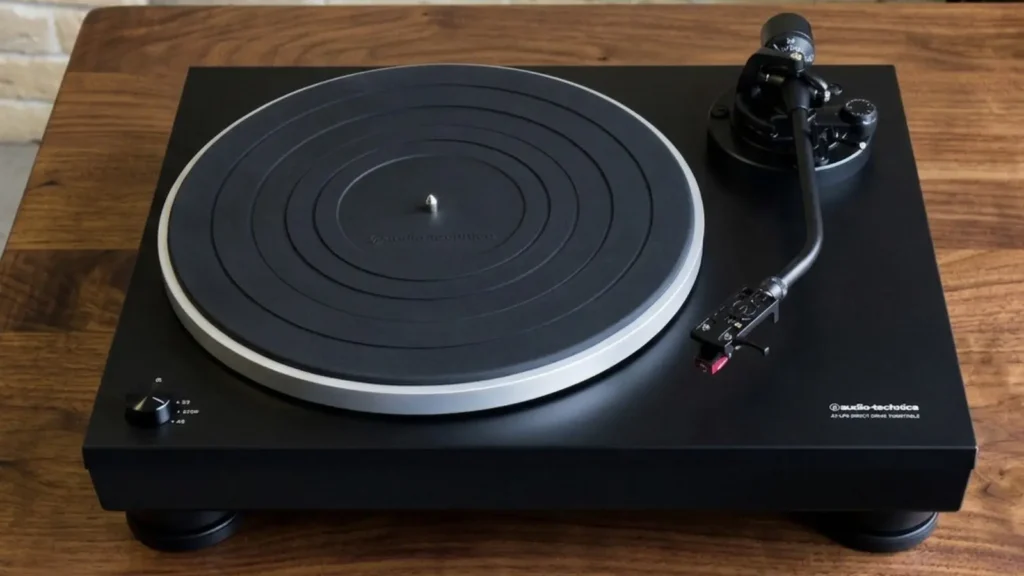
Unlike some of Audio-Technica’s more DJ-oriented entry-level models, the AT-LP5 looks unmistakably hi-fi. There’s nothing flashy or aggressively styled about it.
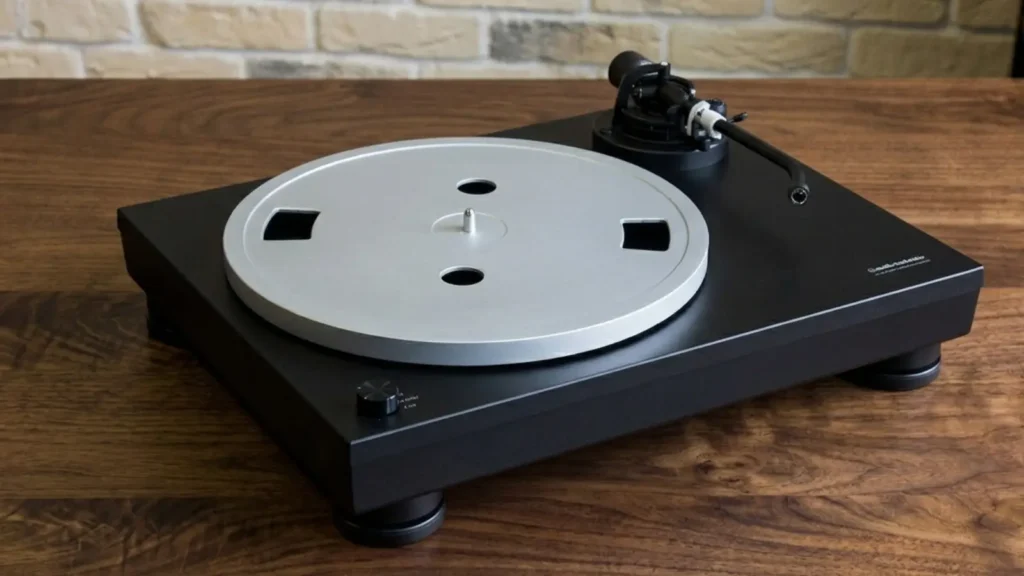
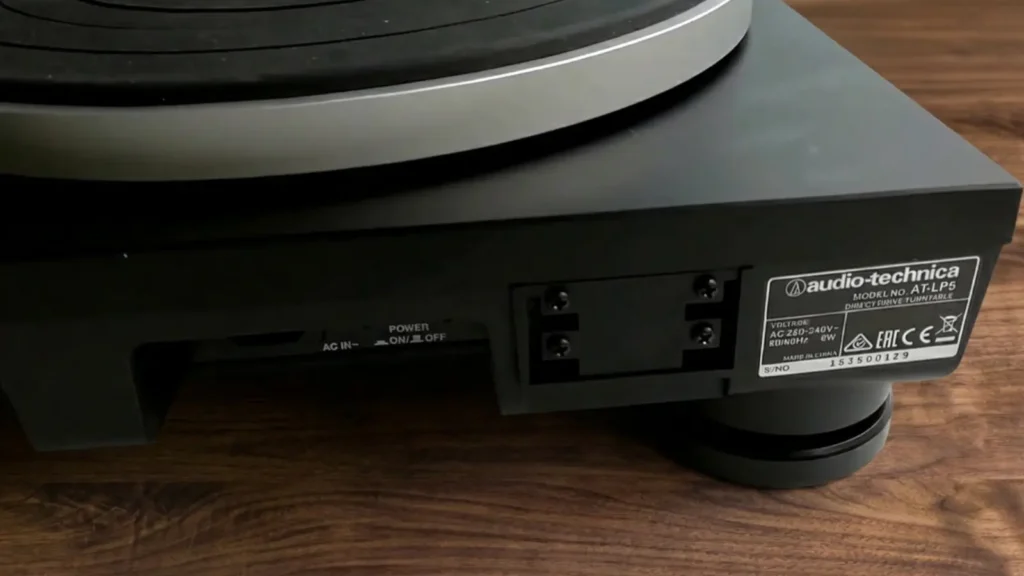
The plinth is a thick, weighty matte-black slab made from some sort of composite material of unspecified origin. It rests on large damped feet that initially appear more substantial than they really are, although in practice they do a perfectly respectable job of isolating the chassis from external vibration. The adjustable feet provide enough range for proper leveling, which is particularly important with vinyl playback.
The upper surface is refreshingly uncluttered. Aside from the tonearm assembly and platter, there’s only a single rotary control used for speed selection and motor activation.
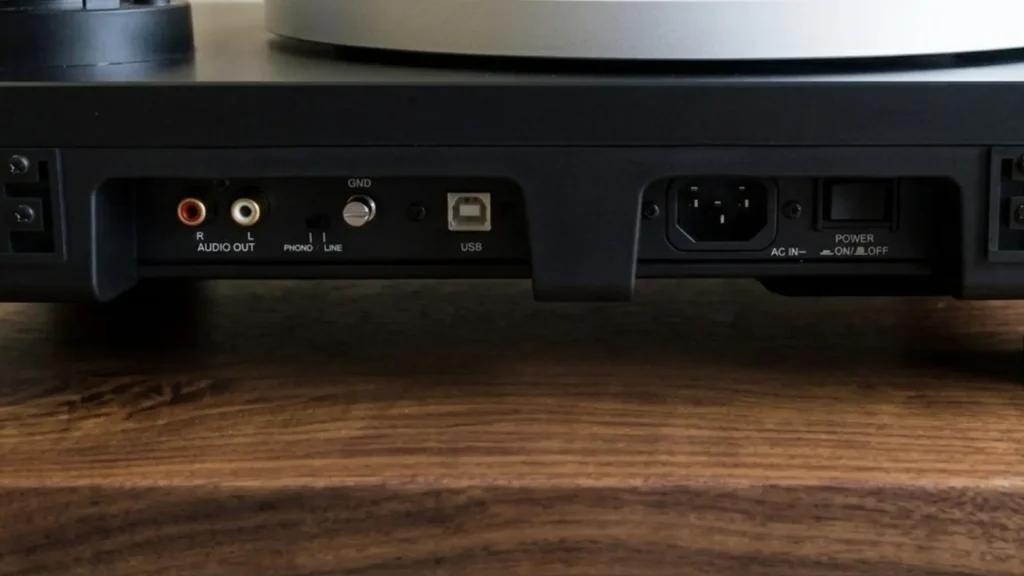
Curiously, the actual power switch is hidden on the rear panel — something you could easily miss without reading the manual. Fortunately, once the turntable is powered on, there’s little reason to touch it again.
The internal power supply is entirely reasonable at this price point, assuming competent implementation — and thankfully Audio-Technica appears to have done its homework here. More importantly, the turntable uses a standard IEC power connector instead of a permanently attached cable. Aside from simple practicality, this also allows proper chassis grounding, provided the electrical wiring in the listening room itself is correctly implemented.
The rear panel also houses a pair of RCA outputs capable of delivering either:
- a line-level signal via the internal phono preamp,
- or a direct phono signal from the cartridge itself.
This is one of the smartest decisions Audio-Technica made with the AT-LP5.
Beginners can connect the turntable directly to powered speakers or a conventional amplifier without needing to understand what a phono stage even is. More experienced listeners, meanwhile, can bypass the internal electronics entirely and integrate external phono preamps later on without replacing the entire deck.
That kind of upgrade flexibility is surprisingly rare at this level.
The tiny gain selector switch feels somewhat flimsy, but realistically, most owners will barely touch it after the initial setup. The grounding terminal itself, thankfully, feels much more confidence-inspiring.
Unboxing and Setup
Putting the AT-LP5 together is surprisingly easy. The cast aluminum platter just drops straight onto the motor spindle; that’s one nice thing about direct-drive turntables. No belts to mess with, no pulley adjustments, no awkward struggling.
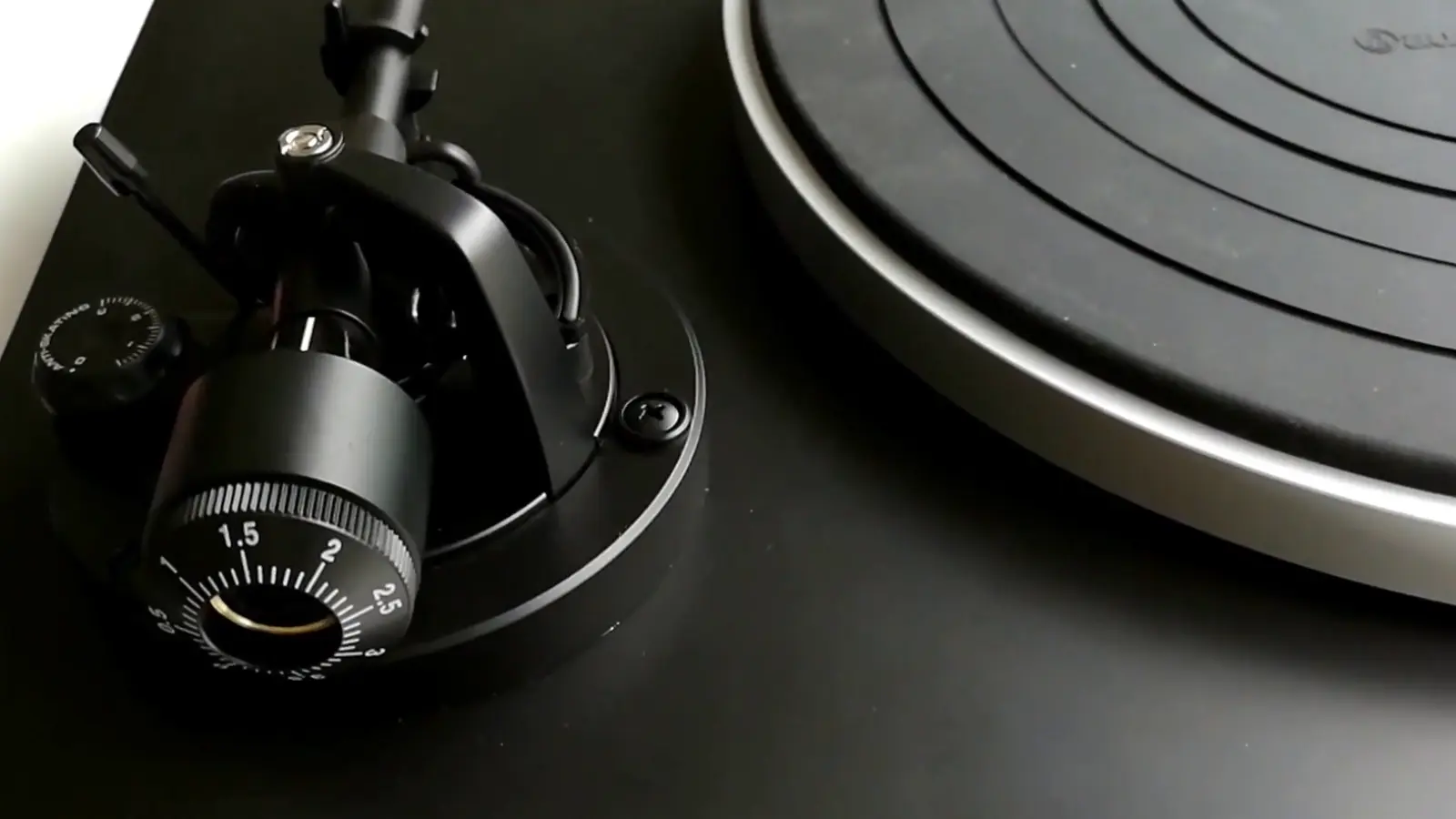
A thick rubber mat goes on top of the platter, and it does a decent job of soaking up vibrations. The J-shaped tonearm comes almost ready to go. You screw the counterweight onto the back, then take the AT-HS10 headshell — which already has the AT95EX cartridge attached- and lock it in with one twist of the collar. Within a few minutes, the turntable is ready to play records. Setting everything up is also pretty painless, though you still need to be careful and precise, just as with any turntable.
At first, I didn’t trust the tracking force markings on the counterweight because they just look kinda cheaply printed. But luckily, they turned out to be surprisingly accurate. Still, if you want things perfect, you’re better off using a dedicated stylus gauge.
For anti-skate, there’s a small dial near the tonearm base. Audio-Technica also throws in a cartridge alignment tool and some genuinely beginner-friendly instructions. One thing that is missing, though, is a built-in bubble level. For a turntable clearly aimed at newcomers, adding even a simple level to the body would’ve been a nice touch. A lot of first-timers don’t realize how important it is to have the turntable perfectly level when playing records.
Listening with the AT95EX Cartridge
The turntable was tested primarily through an NAD M32 integrated amplifier driving a pair of Dali Ikon 2 MK2 bookshelf speakers. Several external phono stages of varying price levels were also used for comparison.
The supplied AT95EX cartridge is a variation of the extremely well-known AT95E moving-magnet cartridge — long regarded as one of the strongest performers in the affordable MM category. In this version, Audio-Technica claims a slightly extended upper frequency response and revised tuning.
Before even focusing on tonal character, however, I was primarily interested in the quality of the direct-drive implementation itself.
Poorly executed direct-drive systems can produce all sorts of unpleasant artifacts: audible motor noise, low-frequency rumble, subtle speed instability, and an almost subconscious mechanical character that gradually becomes fatiguing over longer listening sessions.
Thankfully, the AT-LP5 avoids those pitfalls surprisingly well.
Motor noise and rumble remain impressively subdued, while speed stability feels confident and composed. More importantly, the turntable never draws attention to itself mechanically, which is exactly what a competent drive system should do.
The stock cartridge delivers respectable detail retrieval and a lively tonal balance, with a mild emphasis through the upper midrange and lower treble. There’s a touch of brightness, but not enough to become fatiguing in most systems.
The soundstage is reasonably organized, though understandably limited in ultimate dimensionality and separation compared to more ambitious cartridges or high-quality digital front ends. But expecting expansive holographic imaging from a cartridge at this price level would simply be unrealistic.
What impressed me more was the bass performance.
Entry-level vinyl playback often produces soft, poorly defined low frequencies that create the illusion of warmth while sacrificing rhythmic precision. The AT-LP5 behaves differently. Bass remains relatively taut, structured, and rhythmically coherent, which gives music a stronger sense of momentum than expected from a deck in this category.
The built-in phono stage also deserves some credit here.
In fact, it sounds noticeably better than many cheap external phono preamps currently flooding the entry-level market. Its presentation leans slightly warm and forgiving, perhaps intentionally so. There’s a subtle softening of edges and textures that makes records sound comfortably “vinyl-like” right out of the box.
Some enthusiasts may eventually outgrow that character, but beginners almost certainly won’t complain.
Upgrading to the VM750SH
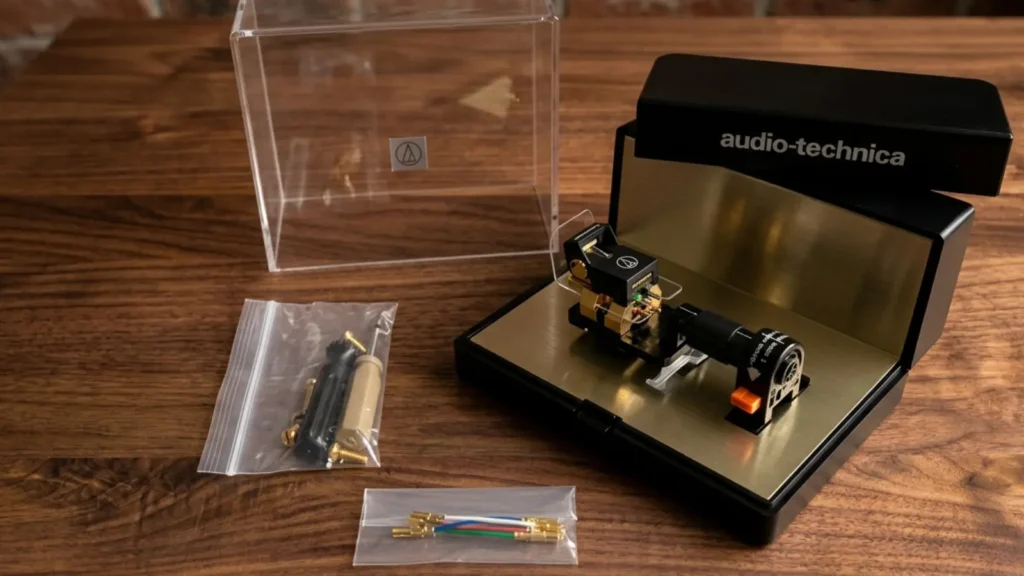
Things became substantially more interesting once the stock cartridge was replaced with Audio-Technica’s VM750SH, a far more ambitious moving-magnet design featuring a Shibata stylus and dual moving magnets arranged in Audio-Technica’s proprietary V-shaped configuration.
The VM750SH belongs to the company’s higher-end 700 series, developed partly as a tribute to the era when Audio-Technica was considered one of the dominant names in serious cartridge design.
The cartridge itself incorporates several thoughtful engineering solutions:
- a Shibata stylus profile for improved groove contact,
- permalloy shielding between channels to reduce interference,
- OFC copper coil windings
- and a rigid die-cast aluminum housing are intended to reduce resonance and external interference.
The AT-LP5 responded to the upgrade immediately and quite dramatically.
High-frequency microdynamics improved noticeably. The sound became lighter, faster, more transparent, and significantly more spacious. Instrument placement gained precision, while the soundstage expanded well beyond the boundaries established by the stock cartridge.
Most importantly, the turntable itself never appeared to become the bottleneck.
Instead, the built-in phono stage quickly revealed itself as the system’s weakest link. Compared to the increased openness and dynamic subtlety of the VM750SH, the internal preamp began sounding slightly simplified and dynamically restrained.
But that’s actually excellent news.
It means the core platform — motor, platter, plinth, and tonearm — possesses genuine upgrade potential beyond its original price category. And because the internal phono stage can be bypassed entirely, owners are free to continue refining the system gradually rather than replacing the entire turntable outright.
That flexibility gives the AT-LP5 a much longer lifespan than many similarly priced competitors.
USB Recording
The USB output supports digitization up to 16-bit/48 kHz.
No, the resulting files won’t compete with high-end archival transfers or dedicated studio-grade ADCs. But that was never really the point.
For casual archiving, portable listening, or preserving old records with sentimental value, the implementation works perfectly well. Younger vinyl enthusiasts experimenting with analog for the first time will probably enjoy the feature far more than hardened audiophiles care to admit.
And for listeners digitizing old family records, it may become genuinely valuable.
Conclusion:
The Audio-Technica AT-LP5 works so well because it really gets what people want. It’s great for beginners who want an easy, no-stress way to play records, but it doesn’t feel like a cheap toy. At the same time, it’s built well enough and lets you upgrade parts, so even after you’ve had it for a while and the newness wears off, it’s still fun to use. The direct-drive motor runs quietly and smoothly, the tonearm is better than you’d expect, and if you put on a nicer cartridge or better external gear, the whole turntable actually keeps up really well.
Look, it’s not going to beat those super expensive high-end setups. But for what it is and what it costs, the AT-LP5 hits a really smart balance, it’s convenient, thoughtfully made, and sounds genuinely good. And maybe most importantly, it doesn’t try to act like something it’s not.