
I Tried 5 Music Streaming Services So You Don’t Have To
Hello again, and welcome to the second edition of our beginner’s guide for streaming music at home.
In the first edition of our beginner’s guide to streaming music, we talked about streaming audio, explained a little bit about what it is, and the options it offers you.
In this part 2 edition, we’re going to bring you up to date on audio hardware and explain some of the options you now have for enjoying various sorts of music, including streaming audio throughout your house.
Audio Back In The Day
Back in the old days, your options for listening to music were pretty simple. A lot of people started with a phonograph. A phonograph was a single box. Most were plugged into a power socket, but a few were portable and ran on batteries.
It had a round platter on top where you put the records, one or two speakers on the front for the sound to come out of, and some controls for things like how loud you wanted it to play. If you wanted music in another room, you unplugged it and took it with you.
*The Zenith Cobra-matic Phonograph from 1954*
The next step up was usually affectionately known as “the big stereo.” The big stereo usually had a separate amplifier and two speakers, and allowed you to play music from several sources, like record albums and the radio.
In more modern equipment, the record player was often replaced with a CD player, and a tape deck might be added, so you could record things and play recordings other people made.
Some really serious listeners even had separate preamps and amplifiers. For the most part, the big stereo really was big – it was made up of several different pieces of gear, connected by lots of wires, and wasn’t very portable.
If you wanted music in another room, you put another pair of speakers in that room and ran wires from them back to the mothership.
*Marantz JBL Hi-Fi System from the 1970s*
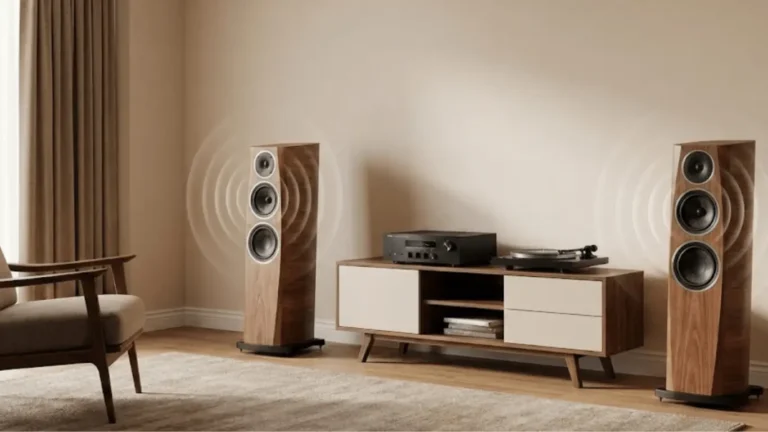
This sort of gear is still used by many audiophiles, if that’s really what you want, you can still find some excellent stereo gear around. The video below represents a newer breed of hybrid gear: traditional audiophile speakers with built-in amplifiers and wireless/Bluetooth connectivity. KEF Audio are a trusted brand in this space, and their bookshelf speakers like the new LSX are second to none.
KEF’s LSX is a more affordable hi-fi system in a box
Moving Onto Modern Audio Gear
For a while, separate little portable music players, like the well-known Apple iPod, were quite popular. However, nowadays, many people start out listening to music on their phone.
Smartphone Audio Streaming
A modern smartphone can be used to connect to those streaming audio services we talked about last time, and there are also various ways you can take music from your own CDs, or music files you download or get from your friends, and transfer them to your phone.
Spotify Is The Most Popular Streaming Music App By A Long Way
The Spotify app is the most popular music streaming app for smartphones
Unfortunately, while many smartphones have really nice screens, they all have small amplifiers and really dinky speakers. Because of this, while they’re actually OK for listening to music through earbuds or headphones, they don’t work very well for listening to music out loud.
Now, if you still have dad’s big stereo, you can connect the phone’s headphone output to that with a wire, and it will work pretty well.
Bluetooth Streaming
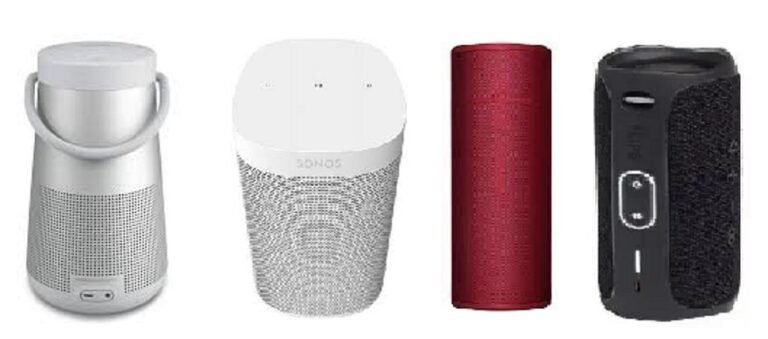
However, now there’s a better option. There’s a standard called Bluetooth, which allows devices (like phones) to connect to other devices (like speakers) – without wires. All you need is a good quality Bluetooth speaker, or pair of speakers, in your living room.
Now you can listen to music on your phone, whether it’s from your own collection or from your favorite streaming service. Then, when you get home, you connect to your Bluetooth speakers, and your music plays through them. Your phone is still the source, and you control everything from your phone, but “Look ma… no wires!”
There are all sorts of high-quality Bluetooth speakers available, from small ones the size of a soda can like the Vanatoo T0 speakers, to high-quality systems whose sound quality is even better than the best traditional speakers, like the Devialet Phantom.
Of course, this is nowhere near the end of the story…
How to Use Spotify (Beginners Guide)
Wireless Home Audio Systems
The wireless technology that started out as a convenient way to play music from your phone has evolved into extremely sophisticated whole-home audio systems that combine both great sound and the ultimate in convenience.
However, it is important to remember that each of these great products has a slightly different selection of features, so you’ll need to figure out exactly which one has the features you need and want.
Here at Rateyoursound, we not only rate products in terms of how well they work, but we also provide the detailed information you need to figure out which one is exactly right for you. Take a look at our Best Wireless Speakers list.
Sonos Whole Home Audio Is the Market-Leading Streaming Solution
Sonos gear is the most popular home audio streaming kit in 2019
Here are a few of the things you need to consider…
- Some systems expect you to use your phone to store your music or to connect to your favorite streaming service, and then relay the music to them. This is handy if you have all your stuff on your phone; just remember that your phone has to remain turned on and within range. If you turn your phone off, the music stops, and if you take your phone with you to run an errand, your family can’t listen to music while you’re gone. In contrast, some systems, like the Sonos Play:5, connect directly to streaming services with their own built-in software.
- Some of these products really are just a super high-quality Bluetooth speaker, or the equivalent of a separate stereo system. You can send music to them via Bluetooth, but they won’t pass it along to units in other rooms. The B&O A9 Speaker is an example of this standalone mode of streaming. However, if you go with a Sonos system, every Sonos device is part of a system. They can send music from one to the other, and if you add a second speaker or a subwoofer, they each simply take their rightful place in the system and play without a lot of complicated setup. Then you can do things like decide whether to play something different in each room, or play the same thing in every room, and make sure it remains perfectly synchronized. There are lots of different options here – so read the details carefully.
- Different products support different kinds of content. Most of the ones that connect to your phone using Bluetooth can play anything you can play on your phone. The ones that connect directly to your streaming service are going to have a specific list of streaming services they support. Some offer an analog input for connecting other audio sources, while others offer more interesting options, like a built-in FM tuner or a phono input. (Read the reviews carefully if you’re looking for specific options there.)
- And, of course, we’re still talking high-end audio gear, so sound quality is important. Some units, like the B&O Beolit 17, have truly superb audio quality but lack some other options. Others, like Sonos, are remarkably flexible and offer an incredible array of features, but may offer slightly less impressive sound quality. And, even among those that offer the best sound quality, some work better in small rooms, while others are capable of filling even a large room with superb sound.
If this is all new to you, the best way to figure out what you need is to read as many reviews as you can… Once you see what options are available, you’ll have a better idea which ones are important to you.
In the next edition of the newsletter, we’ll offer several examples of actual systems so you can see exactly what’s involved in choosing the best wireless audio system for you.
Best Music Streaming Service Comparison
Now that you’ve got a handle on the hardware side of things – from Bluetooth speakers to whole-home wireless systems – there’s another important question you’ll need to answer before you start filling your house with music. Which streaming service should you actually use?
Just like those big stereos from back in the day, not all streaming services are created equal. Some are great if you already know exactly what you want to listen to. Others shine when it comes to discovering new artists you’ve never heard of before. Some offer crystal-clear, high-resolution audio that will make your new KEF speakers sing. And others are simply the best bang for your buck if you’re just getting started.
Here at Rateyoursound, we believe in giving you the full picture. So let’s break down the most popular music streaming services out there, and help you figure out which one belongs in your system.
Which Streaming Service Is Best for Discovering New Music?
Now, if you’re the kind of person who still loves the feeling of finding a great new band – that thrill you used to get from digging through your friend’s CD collection or staying up late to hear the college radio DJ play something weird – then pay close attention to this next part.
Not all streaming services are good at discovery. Some will put you in a bubble and keep you there. Others will surprise you. Here’s how each one handles the art of finding new music…
| Service | Discovery Feature | How It Works | Best For |
|---|---|---|---|
| Spotify | Discover Weekly, Release Radar, Daily Mixes | AI learns your listening habits and serves 30 new songs every Monday | People who want new music handed to them weekly |
| Apple Music | Personalized station, curated playlists by humans | Mix of AI + real music experts | People who trust human curators over algorithms |
| Amazon Music | “My Discovery Mix” | Similar to Spotify but less refined | Alexa users who don’t overthink discovery |
| Tidal | My Mixes, Rising playlists, artist radio | Good, but not the main attraction | Audiophiles who prioritize sound first, discovery second |
| YouTube Music | Mixed for you, unlimited “radio” from any song | Uses your YouTube watch history (scary good or creepy, depending) | People who like deep cuts and weird finds |
Spotify – The People’s Champion
Spotify is, without a doubt, the most popular streaming music service on the planet. And there’s a good reason for that. It just works.
Spotify gives you access to over 80 million songs. You can create your own playlists, share them with friends, and follow playlists made by people who have eerily good taste in music. The free version includes ads and limits how many times you can skip tracks. But the premium version – which costs about the same as one CD from the old days – removes all the ads, lets you download music to your phone for offline listening, and gives you unlimited skips.
Where Spotify really shines is its discovery features. Their “Discover Weekly” playlist learns what you like and serves up new songs every Monday that you’ll probably love. It’s like having that one friend who always makes the perfect mixtape.
Best for: Beginners, playlist lovers, and anyone who wants a service that works on every device imaginable.
Sound quality: Good, but not the absolute best (320kbps on Premium).
Works with Sonos? Yes, directly.
Apple Music – The Tightly Integrated Choice
If you’re already living in the Apple world – iPhone, iPad, Mac, maybe even a pair of AirPods – then Apple Music is worth a serious look. It has over 100 million songs, which is even more than Spotify, and it offers lossless audio at no extra charge.
Apple Music also does something clever that Spotify doesn’t: it can merge your existing music collection with its streaming library. Remember all those CDs you ripped years ago, or those MP3s you downloaded from who-knows-where? Apple Music can mix them all together seamlessly. You don’t have to juggle two separate libraries.
The interface is clean and simple, and the radio stations – especially Apple Music 1 – are actually hosted by real DJs. It feels a little more like old-school radio, but without the terrible commercials.
Best for: Apple users, people with large existing music collections, and anyone who wants lossless audio without paying extra.
Sound quality: Excellent, with lossless and spatial audio options.
Works with Sonos? Yes, directly.
Amazon Music – The Surprise Contender
Amazon Music used to be an also-ran in the streaming world, but that’s changed dramatically. If you already have an Amazon Prime membership, you get access to Amazon Music Prime at no extra cost – that’s about 2 million songs right off the bat. Not bad for free.
But the real story is Amazon Music Unlimited. For about the same price as Spotify or Apple Music, you get access to over 100 million songs in HD, Ultra HD, and even spatial audio. And when we say HD, we mean it – some tracks go all the way up to 24-bit/192kHz, which is far better than CD quality.
Where Amazon Music really shines is with Alexa. If you’ve got Amazon Echo devices, or any Sonos speaker with Alexa built in, you can just say, “Alexa, play some jazz in the kitchen,” and off it goes. No phone required. It’s about as close to the old “push a button and music happens” as you can get in the modern world.
Best for: Amazon Prime members, Alexa users, and audiophiles on a budget who want high-resolution audio.
Sound quality: Outstanding, with true HD and Ultra HD tracks.
Works with Sonos? Yes, directly.
Tidal – The Audiophile’s Choice
Now we’re getting into serious territory. Tidal was built from the ground up for people who care deeply about sound quality. While Spotify gives you compressed audio, Tidal gives you lossless CD-quality sound, and their top tier delivers high-resolution audio that will make your Devialet Phantom or KEF LSX speakers sound better than you ever imagined.
Tidal also offers something the others can’t quite match: music videos, exclusive concert streams, and deep album credits. Remember reading liner notes while listening to a record? Tidal brings some of that back by letting you see exactly who played what on each track.
The downside? It costs more. Tidal’s top tier is about double the price of Spotify Premium. And the music discovery features aren’t quite as good. But if you’ve invested serious money in your audio gear – and you can actually hear the difference – Tidal might be worth every penny.
Best for: Audiophiles, people with high-end speakers, and music nerds who want credits and liner notes.
Sound quality: The best of the bunch, with true lossless and hi-res options.
Works with Sonos? Yes, directly.
YouTube Music – The Video Integration Pick
YouTube Music is often overlooked, but it has one killer feature: it gives you access to everything on YouTube. That means live versions, obscure demos, covers, remixes, and songs that were never officially released on any streaming service.
The audio quality isn’t going to knock your socks off, and the interface can be a little busy. But if you’re the kind of person who constantly finds yourself saying, “I wish I could stream that weird live version from that concert in 1994,” YouTube Music is your answer.
Best for: Live music lovers, people who watch a lot of music on YouTube, and anyone who wants access to rare and unusual recordings.
Sound quality: Average (256kbps AAC).
Works with Sonos? Yes, but not as smoothly as the others.
So Which One Should You Choose?
Here’s the truth: you can’t really go wrong with any of these. They all offer free trials, so our advice is to pick two or three and test them out for a couple of weeks each. Listen through your new Bluetooth speaker. Try them on your phone with your earbuds. See which interface you actually enjoy using.
If you want a simple recommendation from us here at Rateyoursound:
- For most people starting, start with Spotify Premium. It’s the easiest to use, works with everything, and has the best playlists.
- If you’re already an Apple family: Get Apple Music. The integration is seamless, and lossless audio is included.
- If you have Prime and use Alexa, Amazon Music Unlimited is a steal, especially with HD tracks.
- If you’ve spent more than $1,000 on speakers, get Tidal’s top tier. You owe it to your ears.
In the next edition, we’ll show you exactly how to build complete systems around these services – from a simple one-room setup to whole-home audio that follows you from the kitchen to the bedroom to the backyard.
Until then, happy listening.