
This Vintage Polk RM6500 5.1 System Still Has a Few Tricks Modern Speakers Don’t
There’s something oddly satisfying about opening the box of a compact home theater system and wondering whether it can live up to the promises on the packaging. Small speakers have always carried a certain stigma. They save space, sure, but they’re often expected to sacrifice the weight, scale, and excitement that make watching movies at home feel special.
That was exactly my expectation before setting up the Polk RM6500.
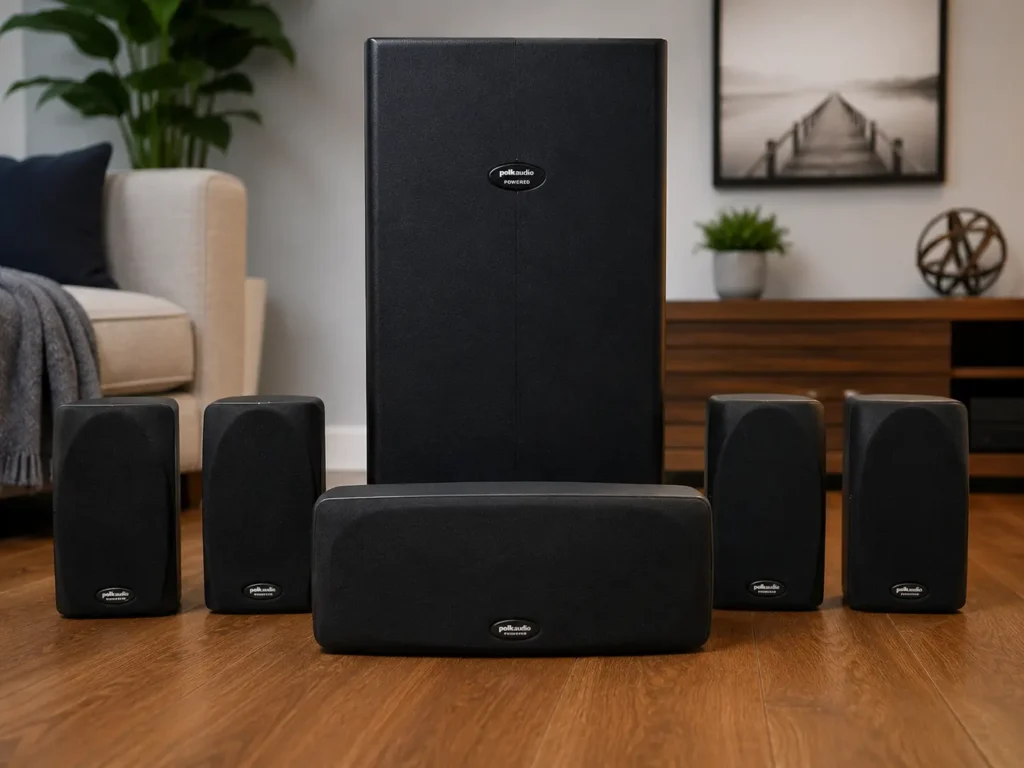
At first glance, it looks like a fairly typical satellite speaker package. The speakers occupy very little space, the subwoofer isn’t intimidating, and the entire system feels designed for people who want serious surround sound without filling their living room with large floorstanding cabinets. On paper, it seems like a sensible compromise.
It doesn’t take very long to realize that Polk had something different in mind.
For a system priced at $1,099, the RM6500 manages to deliver an experience that feels considerably larger than its physical dimensions suggest. It isn’t perfect, and it does ask you to follow Polk’s recommended setup rather closely, but once everything is connected correctly, it becomes surprisingly easy to forget you’re listening to six relatively compact speakers.
Design and Build Quality
The first thing that caught my attention wasn’t the styling—it was the weight.
Each satellite measures only about 6¾ inches tall, 4 inches wide, and 5 inches deep, yet they feel unexpectedly dense when you pick them up. That extra weight isn’t accidental. Polk constructed the enclosures from a polymer aggregate material that mimics many of the acoustic characteristics of stone. While that might sound like marketing language, it serves a very practical purpose.
I Tested the Polk Audio Monitor 30 in 2026: Here’s the Surprising Truth
Small speaker cabinets have a habit of vibrating along with the drivers, adding unwanted coloration to the sound. The denser enclosure helps suppress those vibrations before they become audible, allowing the drivers to do their job without the cabinet joining the performance.

The benefit becomes even more apparent if you decide to mount the speakers on a wall.
Polk includes an impressively flexible mounting system that allows each satellite to be installed vertically or horizontally while still letting you angle the speaker toward the listening position. That adjustability is more useful than it might initially appear because proper aiming can dramatically improve imaging and dialogue clarity in a surround system.
If you do mount the speakers horizontally, one small piece of advice is worth following: keep the tweeter positioned toward the inside of the listening area whenever possible. It helps preserve a more focused stereo image across the front soundstage.
Internally, each satellite combines a ¾-inch silk dome tweeter with a 3¼-inch midrange driver. Polk engineered the physical layout and acoustic centers of these drivers to ensure frequencies reach your ears simultaneously. Combined with their proprietary Dynamic Balance driver technology. The result isn’t something you consciously notice, but it contributes to a more cohesive presentation where voices and effects sound naturally integrated instead of coming from separate drivers.
The center speaker follows the same philosophy but expands on it with dual 3¼-inch midrange drivers flanking a silk dome tweeter. It’s also magnetically shielded, along with the satellites, making placement close to older CRT televisions safe—an important feature when the system was originally released, even if modern flat-panel displays no longer require it.
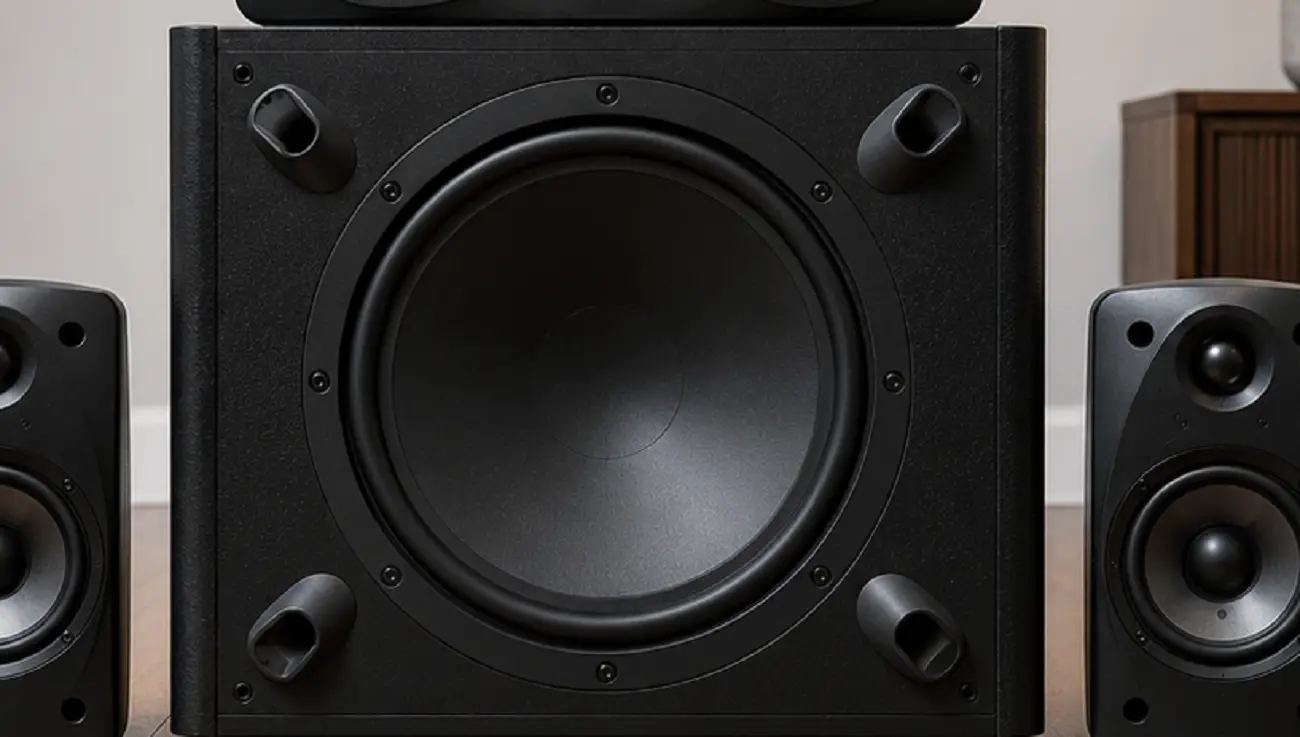
Handling bass duties is a powered subwoofer equipped with a 100-watt amplifier driving an 8-inch long-throw down-firing woofer featuring a 1½-inch voice coil. Looking at its specifications alone, it would be easy to underestimate its capabilities.
As I would soon discover, numbers don’t always tell the whole story.
Setup
Installing the RM6500 turned out to be refreshingly straightforward.
The mounting hardware is genuinely well thought out, and positioning the satellites around the room required very little effort. Polk clearly designed the system with ordinary living rooms in mind rather than dedicated theater spaces, and that practicality shows throughout the installation process.
What deserves more attention, however, is the way Polk expects you to wire the system.
Unlike many home theater speaker packages that allow the front speakers to connect directly to the receiver, the RM6500 is engineered around its powered subwoofer. The recommended configuration routes the receiver’s front left and right speaker outputs into the subwoofer first before passing the signal back out to the main satellite speakers. Meanwhile, the center and surround channels connect directly to their respective speakers.
At first glance, it feels slightly unconventional, but Polk designed the crossover network around this arrangement, and it’s worth following their advice.
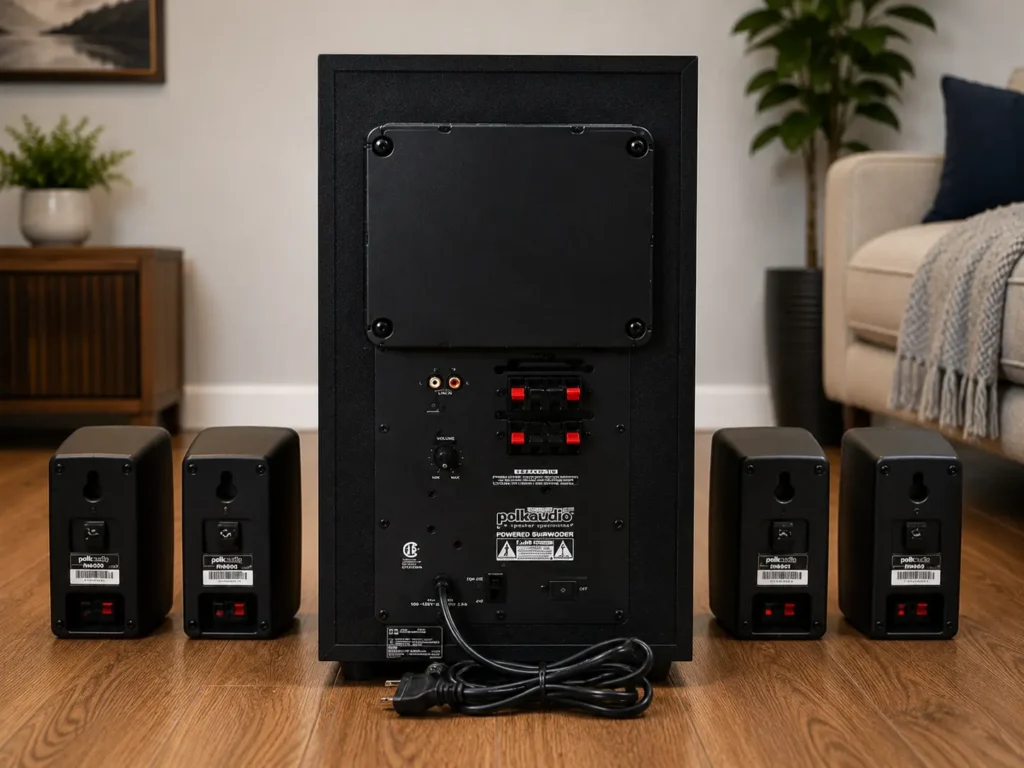
Out of curiosity, I experimented with bypassing the recommended wiring by connecting the front satellites directly to my Sherwood/Newcastle receiver while feeding only the receiver’s LFE output into the subwoofer.
The difference was immediately obvious.
The front speakers lost much of their warmth, sounding noticeably thinner than before, while the subwoofer seemed reluctant to contribute with the same authority. Nothing was technically broken, but the entire system felt disconnected. This happens because the RM6500’s internal crossover cannot be switched off. When you send it a filtered LFE signal from a receiver, you ‘double-filter’ the bass, creating a massive acoustic dead zone in the mid-bass. Returning to Polk’s recommended speaker-level wiring restored the balance almost instantly.
Returning to Polk’s recommended wiring restored the balance almost instantly. The satellites regained their body, the subwoofer blended naturally with the rest of the system, and the overall presentation became significantly more convincing.
It isn’t necessarily a flaw, but it does mean the RM6500 performs at its best when used exactly as Polk intended rather than as a collection of individual speakers mixed into another system.
First Listening Impressions
Movie soundtracks have a habit of exposing weaknesses almost immediately. A speaker can sound perfectly respectable playing background music, yet completely lose its composure the moment a film demands explosive dynamics, rapid transitions, or complex surround effects.
The opening battle sequence from Saving Private Ryan remains one of the most demanding surround sound demonstrations ever released. I expected the RM6500 to struggle. Instead, it surprised me.
The first thing that stood out wasn’t the explosions—it was the atmosphere. Long before artillery shells began landing on Omaha Beach, the room filled with distant waves, scattered gunfire, shouted commands, and the uneasy tension that makes the sequence so unforgettable. Rather than collapsing into an indistinct wall of sound, the Polk system managed to preserve individual effects while maintaining an impressively coherent surround field.
Then the heavier moments arrived. The subwoofer suddenly had considerably more work to do, and despite its modest size, it never sounded overwhelmed. Deep impacts carried convincing weight without becoming bloated. Polk credits much of this performance to its Power Port design, which helps move large volumes of air while reducing turbulence. The practical result was difficult to argue with: even during the most demanding passages, there was virtually no port chuffing or mechanical strain.
Movie Performance
One of the quickest ways to judge a surround system is to stop paying attention to the speakers themselves.
When the front soundstage begins to disappear and effects move naturally around the room, you know the speakers are doing their job. That’s exactly what happened during one particular sequence in Saving Private Ryan.
As the fighter planes sweep overhead, the RM6500 creates a remarkably convincing sense of movement. The transition from the front speakers to the surrounds is smooth enough that you instinctively follow the aircraft across the room instead of noticing which speaker is producing the sound. The effect is immersive rather than exaggerated, and more than once, I caught myself ducking slightly as the planes seemed to pass directly above the listening position.
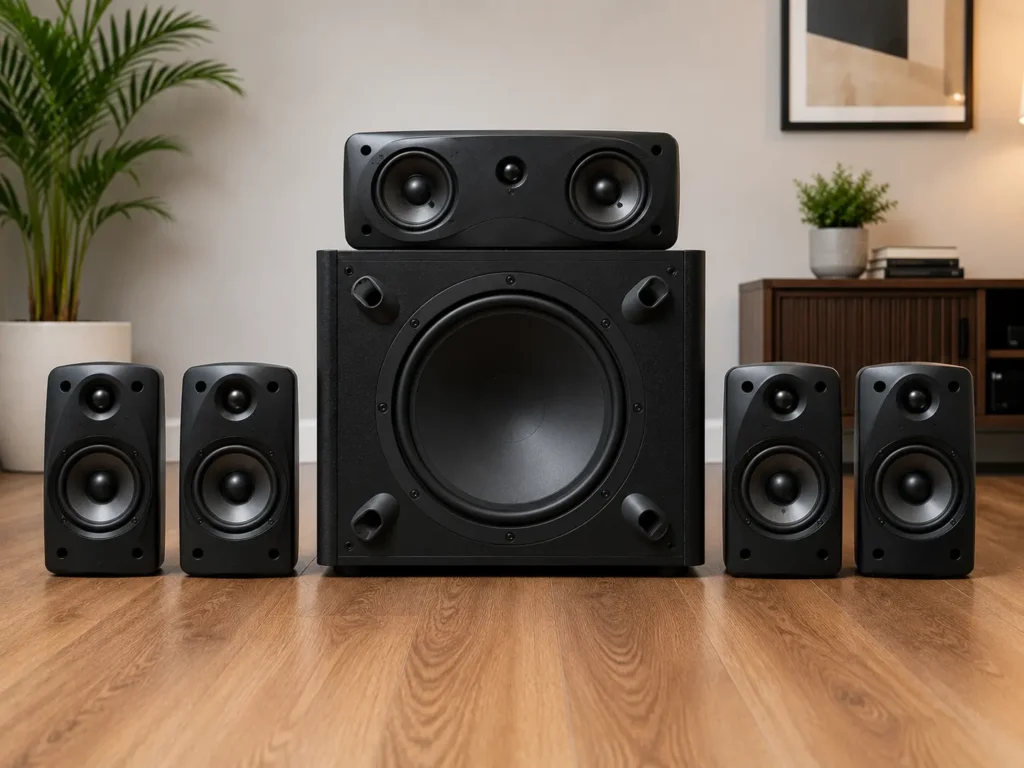
That’s the kind of illusion every home theater system tries to create, and for a compact satellite package, the Polk pulls it off surprisingly well.
Much of that comes down to imaging. Polk’s Dynamic Balance driver technology isn’t just a marketing phrase—it genuinely helps the speakers maintain focus during busy scenes. Effects remain locked in place, dialogue stays centered, and the soundstage doesn’t collapse into a confused wall of noise when multiple things are happening at once.
Another film that proved particularly revealing was Deep Blue Sea.
There’s a memorable sequence where one of the flooded corridors begins groaning under enormous water pressure before everything erupts into chaos as a shark suddenly bursts through the structure. It’s an excellent stress test because the soundtrack moves from near silence to explosive action in an instant.
The RM6500 handled those dramatic swings better than I expected.
The quiet moments remained genuinely quiet, allowing the tension to build naturally before the soundtrack exploded into life. When the shark finally appeared, the speakers delivered enough impact to make the moment genuinely startling without losing their composure.
Push the volume far enough and you can detect a slight hardness in the upper frequencies, particularly during extremely demanding scenes. Thankfully, it never crossed the line into obvious distortion. Instead, it simply reminded me that this is still a compact speaker system being asked to reproduce cinema-level dynamics.
For most listeners in a normal-sized living room, it’s unlikely to become an issue.
Music and Subtle Detail
Some systems can throw explosions around a room all day yet struggle when asked to reproduce quieter, more delicate recordings. That’s why I also spent time listening to the soundtrack from The Thomas Crown Affair.
Early in the film, there’s a beautifully mixed tap-dancing sequence that glides effortlessly across the front soundstage. The RM6500 reproduced it beautifully. Each step flowed naturally from one speaker to the next without gaps or abrupt jumps across the front channels.
Dialogue throughout the film also remained consistently clear. Despite the relatively small drivers, voices retained enough lower-midrange warmth to sound natural rather than thin or clinical—an area where many budget satellite systems completely fall apart.
Bass Performance
The subwoofer deserves special recognition because it’s arguably the component that exceeded my expectations the most.
Looking at an 8-inch driver powered by a 100-watt amplifier, it’s easy to assume the bass will be polite rather than exciting.
That assumption doesn’t last very long.
Whether reproducing artillery fire, collapsing structures, or the deep mechanical rumble of underwater scenes, the subwoofer consistently produced bass that felt larger than its cabinet suggested. More importantly, it blended naturally with the satellites instead of overwhelming them.
One feature that clearly contributes to this is Polk’s Power Port design.
Rather than simply chasing louder bass, the port reduces turbulence as air exits the enclosure. The result is cleaner low frequencies with remarkably little port noise, even when demanding scenes push the subwoofer hard.
The bass doesn’t reach the subterranean depths of significantly larger and more expensive standalone subwoofers, but within the context of a compact lifestyle-oriented package, it’s an impressively balanced performer.
Where the RM6500 Falls Short
No speaker system is perfect, and the RM6500 has one weakness that became impossible to ignore: its lack of component flexibility.
Unlike modern home theater packages, these speakers aren’t particularly happy being separated from the specific ecosystem Polk designed. Because the satellites rely so heavily on the subwoofer’s internal crossover network to fill out their lower-midrange body, you cannot easily upgrade individual pieces over time.
If you decide to swap out the subwoofer for a modern standalone unit down the road, the satellites will immediately sound thin and stressed. This system works brilliantly as a complete, self-contained package, but it is a poor starting point for a gradually evolving, mixed-brand setup.
Final Verdict
The longer I listened to the Polk RM6500, the more I appreciated what it was designed to do. It never pretends to compete with massive floorstanding speakers or reference-grade separates. Instead, it focuses on delivering an engaging, cinematic experience from a package that fits comfortably into real homes without dominating the room.
At its original asking price of $1,099, the Polk Audio RM6500 represented outstanding value. Even today, anyone fortunate enough to find a well-maintained set on the used market is likely to discover that it still has plenty to offer. It proves that thoughtful engineering can overcome physical limitations, producing a surround sound experience that feels dramatically larger than the speakers themselves.
Overall System Performance
- System Frequency Response: 28 Hz – 23,000 Hz (-3dB)
- Total Frequency Range: 25 Hz – 24,000 Hz
- Impedance: Nominal 8 Ohms compatible
- Recommended Power: 10 – 100 Watts per channel
- Original MSRP: $1,099
RM6500 Satellite Speakers (Front & Surround)
- Tweeter: ¾-inch (19mm) Liquid-cooled Silk/Polymer Composite Dome
- Midrange: 3¼-inch (82mm) Dynamic Balance Driver with Rubber Surround
- Frequency Response: 100 Hz – 24,000 Hz
- Sensitivity: 89 dB SPL (1W @ 1 meter)
- Enclosure Material: High-density Mineral-filled Polymer Aggregate (Acoustically Inert)
- Dimensions (H x W x D): 6¾” x 4″ x 5″ (17.1cm x 10.2cm x 12.7cm)
- Shielding: Magnetically Shielded
RM6500 Center Channel Speaker
- Tweeter: ¾-inch (19mm) Liquid-cooled Silk/Polymer Composite Dome
- Midrange: Dual 3¼-inch (82mm) Dynamic Balance Drivers with Rubber Surrounds
- Frequency Response: 100 Hz – 24,000 Hz
- Sensitivity: 91 dB SPL (1W @ 1 meter)
- Dimensions (H x W x D): 4″ x 11″ x 5″ (10.2cm x 27.9cm x 12.7cm)
- Shielding: Magnetically Shielded
☊ Powered Subwoofer (PSW650)
- Driver: 8-inch (203mm) Long-throw, Down-firing Dynamic Balance Woofer
- Amplifier Power: 100 Watts Continuous RMS
- Frequency Range: 25 Hz – 180 Hz
- Enclosure Type: Bass-reflex via patented Power Port floor-coupling design
- Crossover: Active 4th-Order Low-Pass Filter (Internal and fixed at speaker-level inputs)
- Inputs: High-Level Speaker Wire (Left/Right Inputs & Outputs), Low-Level RCA Inputs
- Dimensions (H x W x D): 13½” x 13″ x 14″ (34.3cm x 33cm x 35.6cm)