
I Didn’t Expect One 13-Inch SVS Subwoofer to Shake a 25-Square-Metre Room Like This
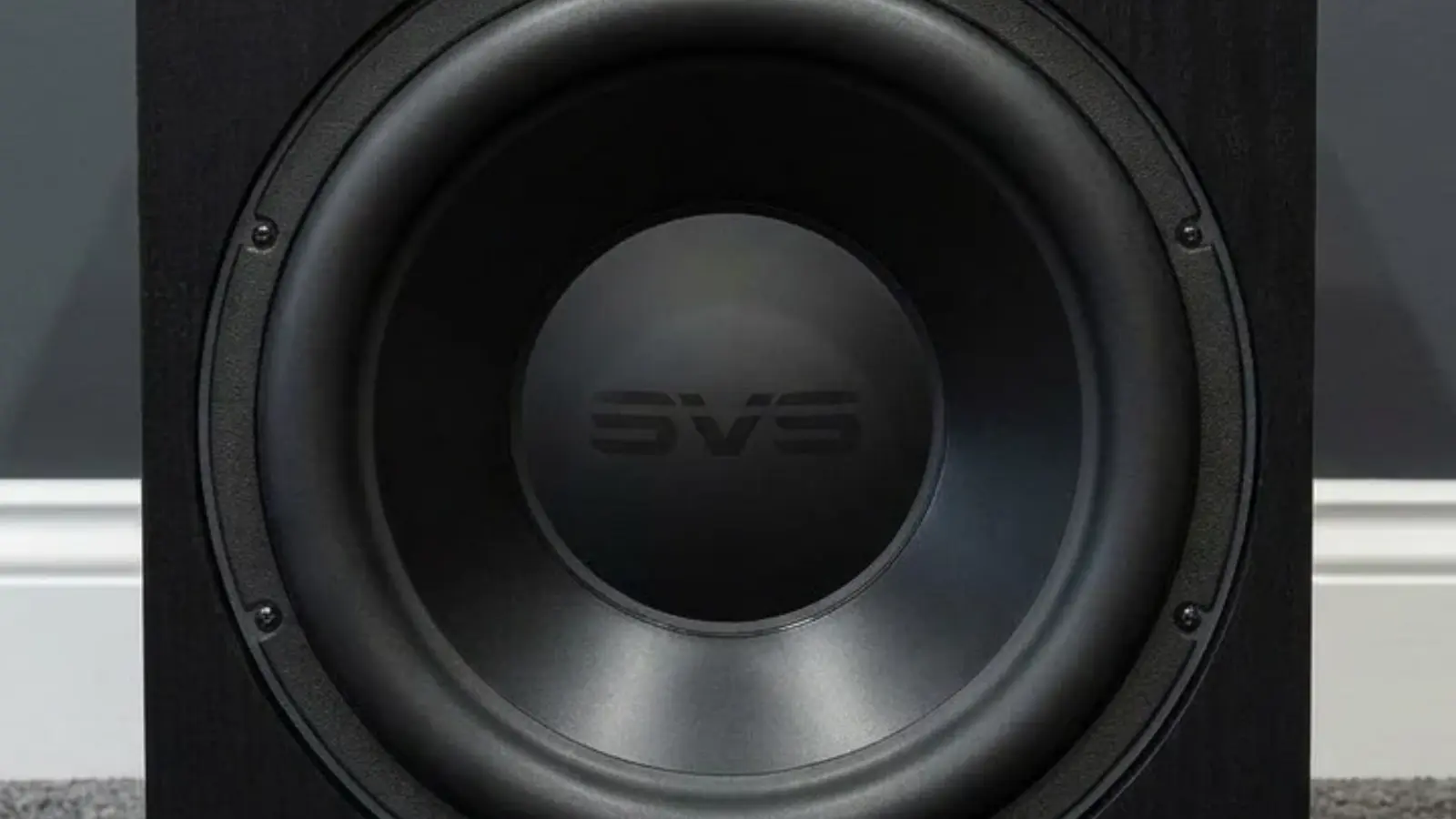
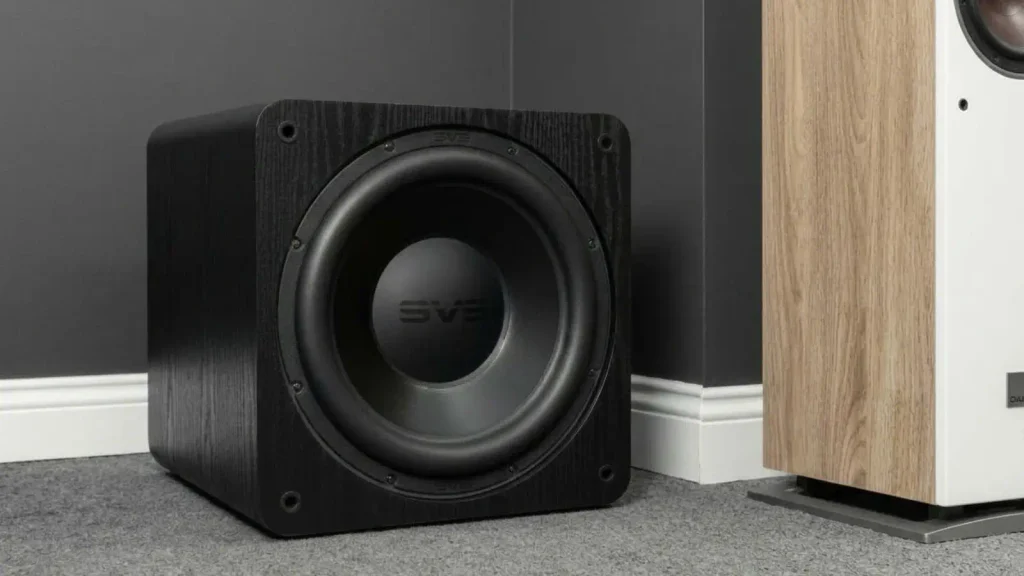
The SVS SB-3000 packs some serious hardware into a surprisingly compact sealed enclosure. At its heart is an all-new 13-inch driver, an unusual size for a subwoofer, featuring an aluminum cone, dual ferrite magnets, and a dual-winding voice coil made with flat-section wire.
A specially designed long-throw surround lets the driver move substantial amounts of air, while the curved metal grille gives the front of the cabinet a distinctive look. The grille is removable, and there’s another welcome design change: the bright blue front-panel LED found on some earlier SVS models is gone, eliminating an unnecessary distraction in a dark home theater.
SVS’s proprietary 800-watt Sledge Class D amplifier powers the system, with peak output reaching 2,500 watts. An Analog Devices 50 MHz DSP processor manages the system, while the relatively compact MDF enclosure keeps the overall dimensions manageable.
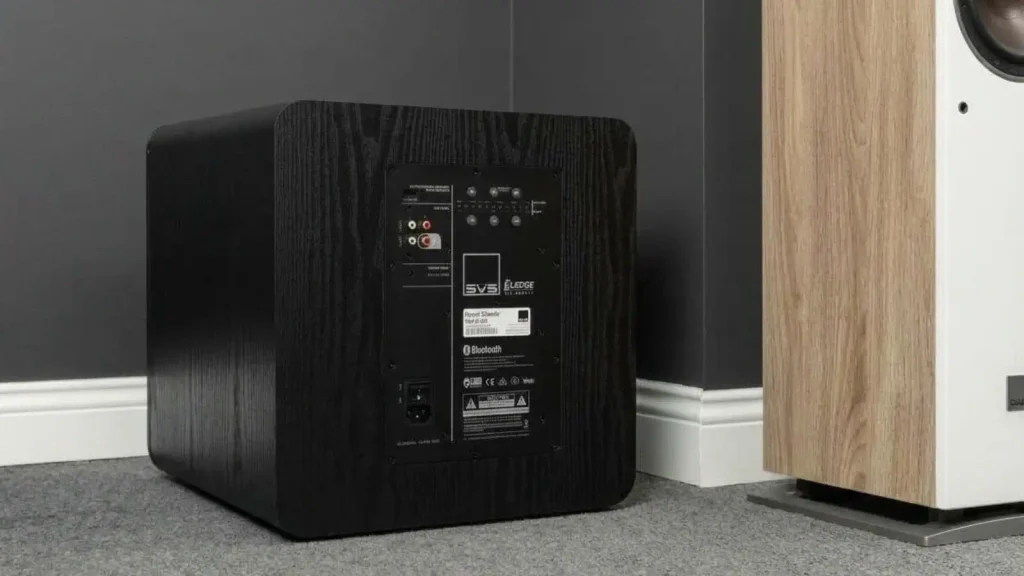
The rear panel houses the conventional controls and LED indicators, although the SVS mobile application provides a considerably more convenient way to configure the subwoofer.
Connectivity and Finish
Connectivity on the SVS SB-3000 is straightforward, with low-level inputs supporting both mono and stereo connections. Low-level outputs are also provided, allowing multiple subwoofers to be connected in a daisy-chain configuration.
There’s also a USB port on the rear panel for an optional wireless receiver, sold separately. Unfortunately, I didn’t get the opportunity to test this accessory. It’s a useful option, particularly because subwoofer placement isn’t always convenient. Many people assume the only suitable position is behind the sofa, without necessarily having planned the cable routing.
The SB-3000 is available in black, with two finish options: black oak veneer and piano gloss black.
SVS Smartphone App: Easy Subwoofer Control Without Complicated Setup
I decided to take the modern approach and configure the SB-3000 using the SVS smartphone application.
It isn’t particularly colorful or packed with elaborate graphics, but that’s hardly a disadvantage. The interface is straightforward, logically organized, and easy to navigate, even for users who aren’t familiar with advanced subwoofer settings.

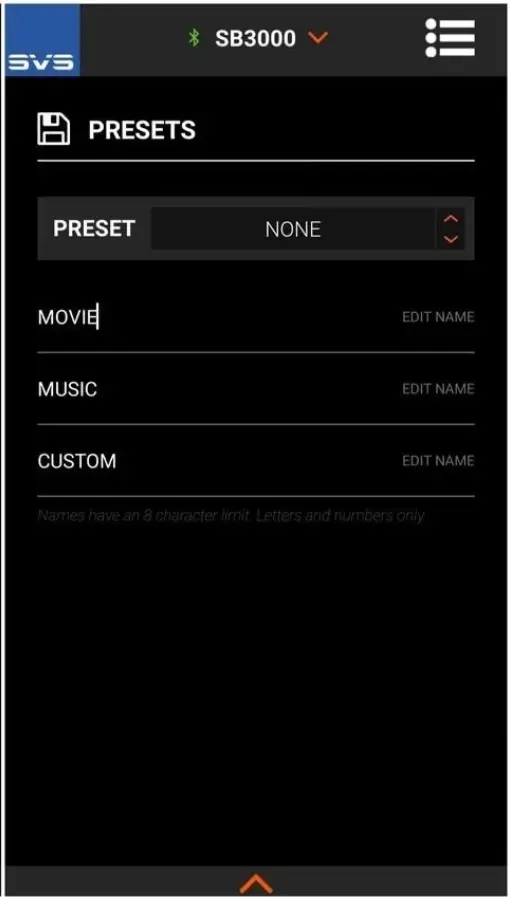
The application automatically detects the subwoofer through Bluetooth Low Energy (BLE) and establishes a connection remarkably quickly. It also reconnects automatically when you reopen the app.
Rather than spending time discussing standard adjustments such as volume and phase, it’s worth looking at some of the more interesting features.
The three-band parametric equalizer is particularly useful, allowing you to adjust the frequency response to address unwanted peaks and resonances. During my experiments, I accidentally discovered that it could eliminate a troublesome resonance that was causing the air-conditioning cover in the listening room to rattle.
That’s a practical demonstration of how useful this kind of adjustment can be. However, it’s worth remembering that the SB-3000 doesn’t include an automatic room-calibration system.
Another useful feature is room gain compensation. It allows you to select the cutoff frequency and slope, helping control excessive bass reinforcement caused by room acoustics.
The application also provides three customizable presets. Their names can be changed, although there is one minor limitation: Russian characters aren’t supported.
What I particularly appreciate is the built-in help system. Each setting comes with a straightforward explanation in English, along with a separate tutorial. Changes are applied almost instantly, and the application remained responsive and reliable throughout the setup process.
For systems using multiple subwoofers, individual units can be identified by their serial numbers and assigned different names. As with the presets, however, naming is limited to Latin characters.
Sound Quality: Serious Low-Frequency Power for Home Theater
For testing, I connected the SVS SB-3000 to a Marantz SR7015 AV receiver and paired it with DALI Oberon 5 speakers.
I saved Terminator Genisys for later and began with Hacksaw Ridge, a film that provides an excellent opportunity to evaluate a subwoofer’s ability to reproduce powerful, physical low-frequency effects.
The assault sequence, with its explosive action and visceral battlefield effects, was particularly revealing.
One Subwoofer Is Enough to Shake a 25-Square-Meter Room
Power and physical impact were my first impressions.
The room, measuring approximately 25 square meters, was suddenly filled with an enormous wave of low-frequency energy. Sitting around 2.5 meters from the subwoofer, I could actually feel the airflow against my legs.
The SB-3000 didn’t simply reproduce the soundtrack’s bass effects. It created a sense of pressure that extended throughout the room.

With less capable systems, two subwoofers positioned in opposite corners might be necessary to achieve a similar sense of scale. Here, a single SB-3000 was more than sufficient.
Was the experience completely mind-blowing? Not quite. I would have appreciated a little more depth at the very bottom of the frequency range. Nevertheless, the pressure, impact, and overall scale were impressive.
The 42-inch Loewe television in the listening room suddenly seemed rather inadequate for the experience. I immediately found myself wishing for a much larger screen and a projector to match the scale of the sound.
Fast, Punchy Bass With Plenty of Physical Impact
The SB-3000’s bass is sufficiently fast and controlled, without becoming excessively boomy. Of course, the acoustically treated listening room deserves some credit here.
Its presentation is big, punchy, and expansive. However, compared with more expensive subwoofers, it isn’t quite as structured or refined. That’s hardly surprising, considering that products in a higher class also come with considerably higher prices.
SVS positions the SB-3000 as a subwoofer equally suited to movies and music. However, I would make one observation from an audiophile perspective: the absence of high-level inputs and balanced connections limits its appeal in certain stereo systems.
That doesn’t necessarily make it a poor choice for music. Rather, it highlights the distinction between a subwoofer designed primarily for powerful home theater reproduction and one intended for more specialized audiophile applications.
If your priority is building an impressive home cinema, the SB-3000 makes a compelling case for itself. Spending considerably more to pursue subtle improvements in a mid-range home theater may not be the most sensible investment for everyone.
Terminator Genisys: Exactly What You Want From a Home Theater Subwoofer
I eventually moved on to Terminator Genisys and started with the familiar bridge chase sequence.
I quickly became absorbed in the film, enjoying not just that particular scene but the rest of the movie as well.
Everything felt right. The effects were spectacular, the bass was well-paced, and the subwoofer delivered the kind of physical impact that makes modern action movies so entertaining.
This is precisely what you expect from a capable home theater subwoofer: convincing explosions, powerful cinematic effects, and the feeling that the action unfolding on screen has a physical presence in your room.
The SB-3000 delivered on that expectation.
Verdict:
The SVS SB-3000 is a remarkably capable sealed subwoofer that combines substantial low-frequency power with a cabinet that is relatively easy to accommodate in a typical living room or dedicated home theater.
Its performance should be sufficient for many rooms measuring approximately 30 to 40 square meters, although actual results will depend on room acoustics, placement, listening preferences, and playback levels.
It’s also exceptionally convenient to operate. The controls are straightforward, configuration through the smartphone application is easy, and the available equalization and room gain compensation features provide useful flexibility.
In fact, the SVS application is among the best implementations I’ve encountered in this segment.
But is the SB-3000 worth buying?
If you’re building a home theater and want powerful, convincing bass without installing an enormous subwoofer, absolutely. It’s an excellent option, and a single unit should satisfy many owners in medium-sized rooms.
For larger spaces, however, I’d seriously consider purchasing two subwoofers rather than relying on one more powerful unit. A properly positioned pair can provide more consistent bass distribution throughout the listening area.