
Davis Acoustics Hera 250 vs Hera 150: A Direct Comparison Under Identical Conditions
Spending time with the Hera 150 floorstanders from Davis Acoustics initially left me with a subtle sense of understatement. At an earlier exhibition, where the larger Hera 250 was demonstrated, the presentation of musical material felt noticeably different from what I later experienced during extended listening sessions with the Hera 150.
One could attribute this discrepancy to differing listening environments; after all, the Hera 250 was heard in a show setting, while the Hera 150 was evaluated under controlled conditions. On paper, both models are nearly identical in every respect except one: the number of bass drivers. But speculation becomes unnecessary when both pairs of floorstanding speakers are evaluated in the same room, using the same electronics and layout.
Same Design Philosophy, Different Ambitions
First, it’s important to establish that we are dealing with the same “Davis” throughout. These are original loudspeakers, designed and manufactured in-house, with excellent build quality and assembly. Importantly, in this price segment, they are genuinely made in France rather than outsourced to mass production facilities.
Unlike the previously tested Hera 150, the Hera 250 is the flagship of the series. In theory, it should surpass its smaller sibling in scale, authority, and its ability to energise larger listening spaces.
Cabinet Design, Drivers, and Crossover Strategy
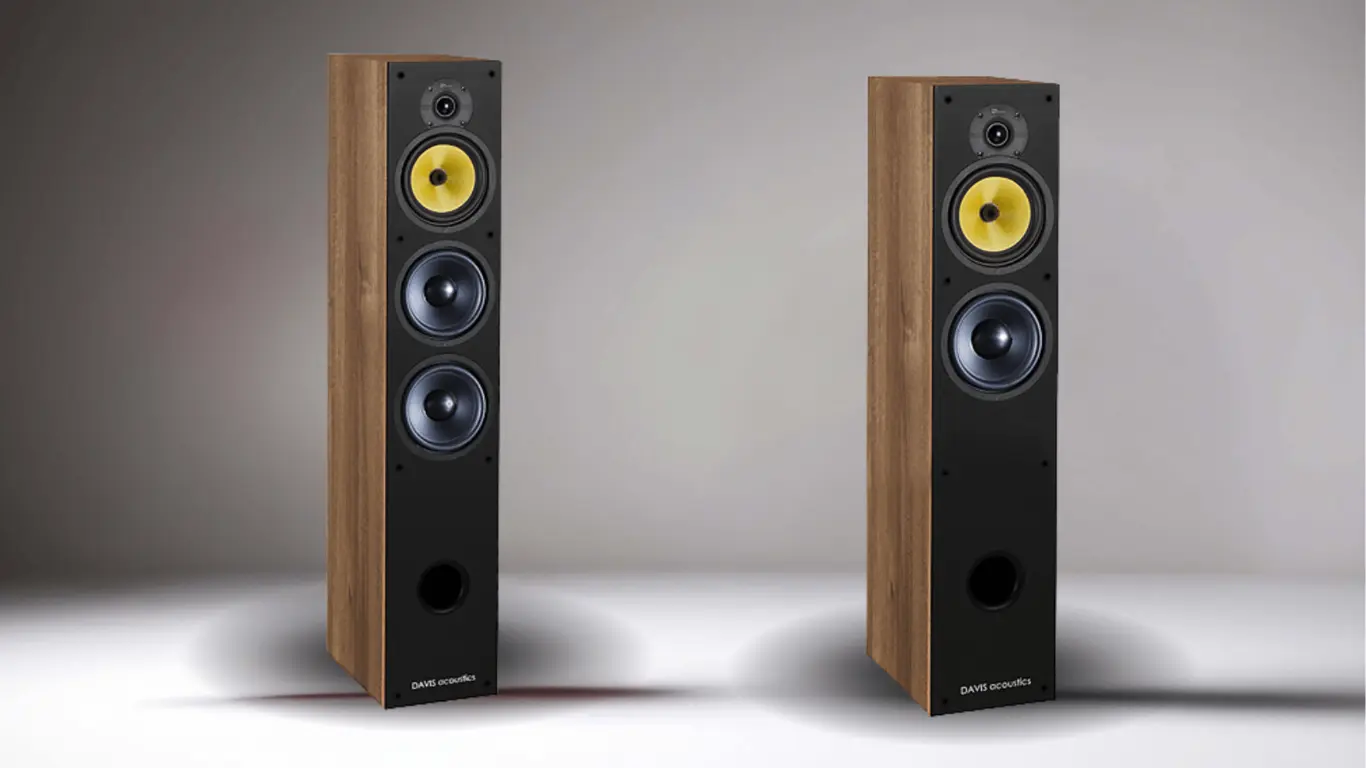
In terms of design and components, the Hera 250 is as close as possible to the junior floorstander. Even though the woofer diameter remains unchanged, the difference lies in quantity rather than size. Instead of a single bass driver, the Hera 250 employs two.
This does not automatically imply twice as much bass. Doubling the cone surface area gives designers several options. They may reduce excursion per driver to preserve tonal balance or selectively reinforce certain regions of the low-frequency spectrum. The Hera 250 is officially specified as a true three-way design, but as always, the real story lies in how the crossover is voiced.
Check Out: Heco Aurora 700 Review
Front-Firing Bass Reflex and Room Interaction
To accommodate the dual bass section, the cabinet volume has been increased by adding height and depth while preserving the same front baffle width. Visually, the Hera 150 and Hera 250 remain very similar.
The front-firing bass reflex port in the Hera 250 is tuned differently. Its purpose is to reduce sensitivity to placement rather than encourage positioning close to walls. Boundary reinforcement still plays a role, and careful placement remains important.
Listening Impressions: Soundstage, Scale, and Bass Authority
For consistency, the Hera 250 was evaluated using the same electronics, cabling, and speaker placement as the Hera 150. The speakers were positioned approximately three metres apart, with their axes almost parallel.
The first noticeable difference lies in soundstage presentation. With the Hera 150, sound images tend to form closer to the listening position. The Hera 250 moves the stage further back, placing the centre of the sound image closer to the speaker plane and increasing perceived scale.
Concert recordings and large-scale orchestral works benefit significantly from this presentation, sounding more expansive and convincing. The Hera 150, by contrast, offers a more intimate, chamber-like perspective.
Double Woofer Implementation: Control Over Quantity
Bass performance improves not by excess, but by control. The dual-woofer configuration delivers greater articulation and authority in the lowest registers, adding density and impact without overwhelming the midrange.
Crucially, the bass does not dominate or blur the rhythm. Improved low-frequency clarity enhances the overall sense of information and solidity across the spectrum rather than drawing attention to itself.
Genre Matching and Musical Preferences
Although the midrange and treble sections are largely unchanged, the overall musical character shifts subtly. The Hera 150 excels with jazz, vocals, chamber music, and intimate acoustic recordings.
The Hera 250, meanwhile, proves more confident with rock, metal, electronic music, modern pop, and R&B. Classic rock recordings gain additional drive and physicality, while the smaller model retains an edge in micro-dynamics and expressive nuance.
Both models share excellent rhythmic precision, allowing reggae and experimental jazz to shine. A defining strength of the Hera 250 is its seamless integration — no individual driver draws attention to itself.
Why the Hera 250 Sounds Bigger Without Sounding Louder
There is no secret technology at work. In-house driver design allows Davis Acoustics to achieve proper integration during development, reducing the need for complex crossover networks.
This results in cleaner signal paths, predictable phase behaviour, and exceptional coherence — even in a three-way design. Combined with the cost efficiency of in-house production, it explains how such performance is achieved at this level.
System Matching and Upgrade Potential
System matching is crucial. The Hera 250 benefits from high-quality amplification with good current delivery and control. When paired with capable electronics, it scales effortlessly.
In more modest systems, the speakers will quickly expose upstream limitations, but they will also comfortably survive several rounds of system upgrades, making them a strong long-term investment.
Final Verdict: Choosing Between Hera 250 and Hera 150
Direct comparison reveals that the difference between the Hera 250 and Hera 150 lies in emphasis rather than fundamentals. The larger model sounds more ambitious, energetic, and dense, while the smaller speaker offers a more intimate, academically precise presentation.
These distinctions are subtle, not dramatic. The shared core character tonal balance, coherence, dynamics, and rhythm remain intact across the range.
Despite their resolution and accuracy, Hera speakers never sound dry or analytical. When partnered with suitable electronics, they deliver an engaging and emotionally satisfying listening experience.
The Hera 250, in particular, stands out as a speaker that grows with your system, a compelling choice for listeners seeking scale and authority without sacrificing musical integrity.
Technical Specifications: Davis Acoustics Hera 150 vs. Hera 250
| Feature | Davis Acoustics Hera 150 | Davis Acoustics Hera 250 |
| Type | 3-way Floorstanding | 3-way Floorstanding |
| Bass Loading | Front-firing Bass Reflex | Front-firing Bass Reflex |
| Tweeter | $25$ mm Soft Fabric Dome | $25$ mm Soft Fabric Dome |
| Midrange | $170$ mm Fiberglass Cone | $170$ mm Fiberglass Cone |
| Woofer(s) | $1 \times 170$ mm Cellulose Pulp | $2 \times 170$ mm Cellulose Pulp |
| Frequency Response | $42$ Hz – $20$ kHz ($\pm 3$ dB) | $37$ Hz – $21$ kHz ($\pm 3$ dB) |
| Sensitivity | $92$ dB | $92$ dB |
| Nominal Impedance | $4$ – $8$ Ohms | $4$ – $8$ Ohms |
| Power Handling | $80$ W (Nominal) / $150$ W (Max) | $150$ W (Maximum) |
| Crossover Freq. | $300$ / $3000$ Hz | $300$ / $3000$ Hz |
| Dimensions (HxWxD) | $900 \times 190 \times 270$ mm | $1030 \times 190 \times 310$ mm |
| Weight | $15$ kg | $17$ kg |