
From Lockdown Streaming to Planar Headphones: Why Schiit’s Ragnarok 2 is a $1,799 Miracle Worker
I enjoy Schiit. The last couple of months I’ve had the pleasure of reviewing both the Asgard 3 and two versions of the Gungnir. The Gungnir is a fluid-sounding DAC, organic- and I hold it in very high regard. The Asgard 3 is a $200 miracle worker. To these ears, it performs way beyond its price point. It earned our first and so far only Green Award.
The Ragnarok 2 is an integrated amplifier. The one I was sent comes “Fully Loaded”, which means it has a True Multibit DAC onboard and a moving-magnet (MM) phono stage based on Schiit’s own Mani ($129). Fully Loaded, it comes in at $1,799. As “Just An Amp,” it’s $1,499.
Like every piece of Schiit, it has the same clean, straightforward aesthetic: bright, brushed aluminum, a few buttons, and a volume knob. Throw in black heat sinks on either side, and you’ve got a basic but functional-looking amplifier, which is how I prefer most things to look: honest.
Schiit Vidar Power Amplifier Review
The Ragnarok 2, like all Schiit products, is made and sourced in the U.S. Where possible, Schiit gets its parts from local manufacturers. That means less shipping, which translates to fewer carbon emissions, all while supporting the local community and economy. Very cool.
Power & Architecture
The Ragnarok 2, which Schiit simply calls the Ragnarok, pushes 60Wpc into 8 ohms and 100Wpc into 4 ohms. More on that later.
It is the first product from Schiit to sport their new Nexus differential gain stage. I’m not typically of the technically inclined, but essentially it offers seamless interaction between single-ended and balanced sources. Nexus converts single-ended inputs to balanced outputs, and balanced inputs to single-ended outputs, all in a single discrete gain stage, without gain differences between modes, and with excellent performance across the board.

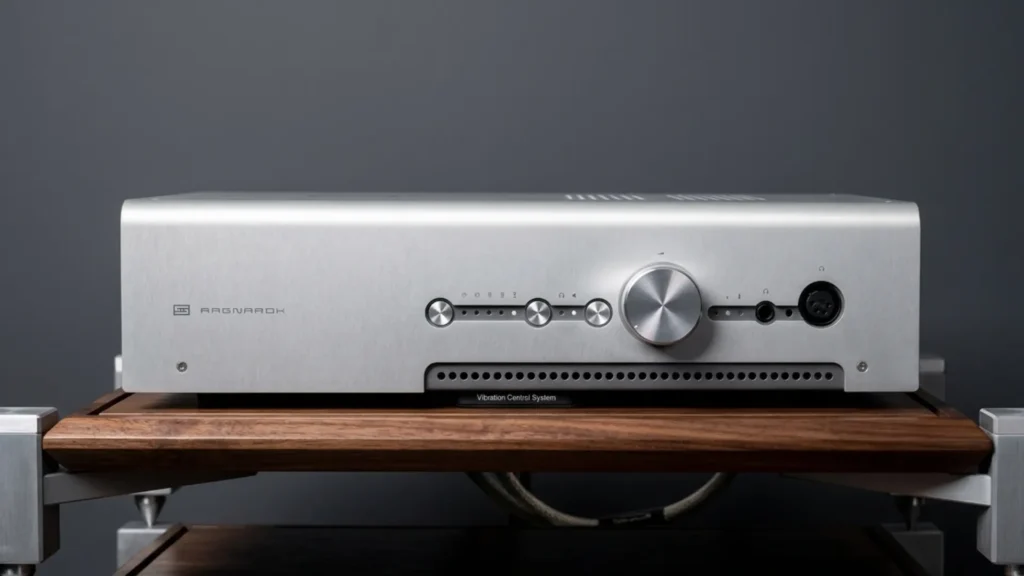
But looks can be deceiving, and the above might sound like the Ragnarok 2 is a fire-and-forget kind of rocket. It’s not. It is a finely adjustable and high-performing integrated amplifier.
Sound Quality
First impressions last, and the Ragnarok 2 made a great one: direct and uncolored sound. There is nothing harsh here; it yields a clean timbre and tonality right down the middle, backed by great dynamics and a vivid midrange.
I used a modest source: an iPad via an Audioquest Forest USB cable straight into the onboard Multibit DAC. Like everyone else, we’re in Corona-lockdown here, so it’s a great option because both my wife and kids can operate TIDAL from a tablet. Granted, my 3-year-old isn’t much of a reader yet, but my eldest at 6 can queue up Nirvana and Rage Against the Machine with the best of them.
A minor niggle: The Ragnarok 2 only accepts USB as a digital input. I would have liked a couple more options so I could have connected my Bluesound Node 2i streamer, which doesn’t have a USB output. The niggle cuts both ways, though: I think the Node 2i should definitely have had a USB out…
I used my Croft Micro 25R and Series 7R combo to compare and triangulate. The Croft setup is a bit less than double the money and features a tube-hybrid construction. It has that same-but-different functional design aesthetic that I like—no fat, all muscle. I find that it is very transparent with a sweet and airy tone. It doesn’t have an onboard DAC, and it doesn’t do headphones. It does, however, have a superb onboard phono stage which works splendidly with my Grado Reference Master 1 cartridge.
The Ragnarok 2 sounds less romantic than the Croft and is perhaps a truer teller of tales. The first surprise the Ragnarok 2 threw at me was the level of transparency it resolved. This is listening “Corona-style” to some quiet jazz while my wife is working on her computer and the kids wander to and fro, still running direct from the iPad.
A string of albums from the ECM label made the Ragnarok 2 play music with impressive clarity. Jacob Young’s guitar rang like a bell. Notes just hung there suspended and crisp while life went on around me.
The transparency from my Crofts is perhaps better, and they are airier. But the Crofts have a romanticism that colors the sound. I don’t mind color if it’s done the Croft way, but I really like the crisp immediacy and tonal accuracy that the Ragnarok exhibits. The Croft might dig out a bit more micro-detail, but Ragnarok 2 bests the Croft in instrument separation and structural clarity. It is a marvel that this level of versatility and sound quality is possible at this price point. Players are exquisitely outlined, and the space between instruments is widened and emptied. Very impressive.
Speaker Pairings
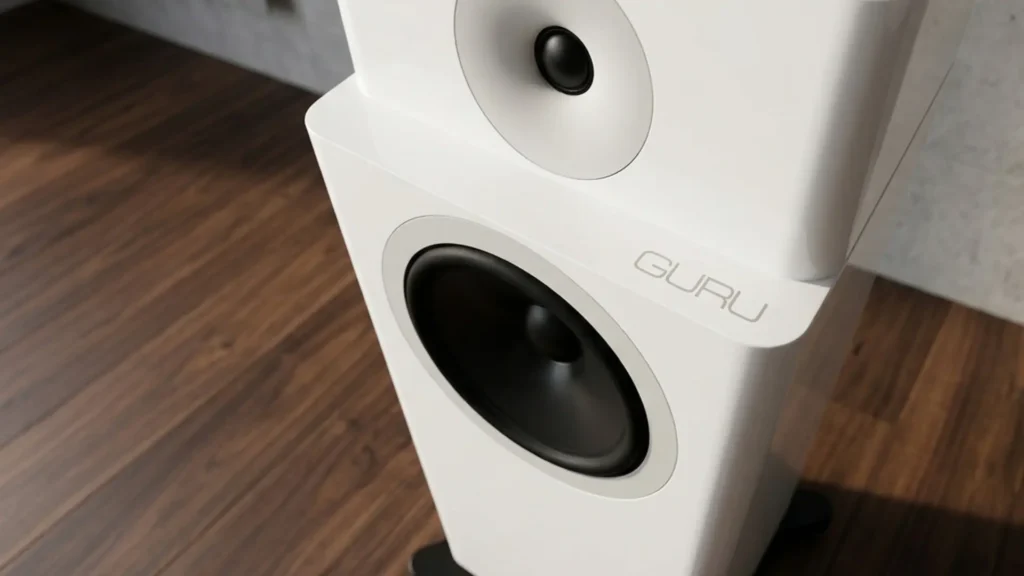
Guru QM60
My Guru Q60 speakers (which I bought cheap direct from Guru Audio as a pre-production model) and the Ragnarok 2 got along famously. The Gurus can sometimes come off as a bit dark. The Ragnarok 2 tore right through that, making them play music with refreshing clarity and control. The tone was crisp and natural; the imaging pinpoint, and the soundstage wide.
The Gurus aren’t hard to drive, but they do have big woofers. There was a slight sense of softness in the bass that my Croft combo doesn’t exude; the Ragnarok 2 perhaps played it a touch too loose down low. Conversely, the Ragnarok 2 has a wonderful, crisp midrange that suits my Gurus perfectly. Voices, guitars, and drums sounded more direct, present, and vibrant than they did via the Crofts.
Streaming direct from a USB-tethered iPad is almost nostalgic, and it’s incredibly family-friendly. I find the onboard DAC to be a fine specimen. I also find that it doesn’t sound quite as resolving or organically natural as the standalone Schiit Gungnir Multibit ($1,299). Quelle surprise!
I didn’t spend much time trying other DACs initially because the onboard option was so satisfying, and with the kids at home, convenience was the name of the game. However, I did sparingly drop in the Chord Electronics Hugo 2 with the 2go module (which costs quite a bit more than the Ragnarok itself), and the lift in fidelity was immediately apparent. There was an easefulness to the sound, alongside greatly increased resolution and separation, which tells me that this integrated amp will scale beautifully with better sources.
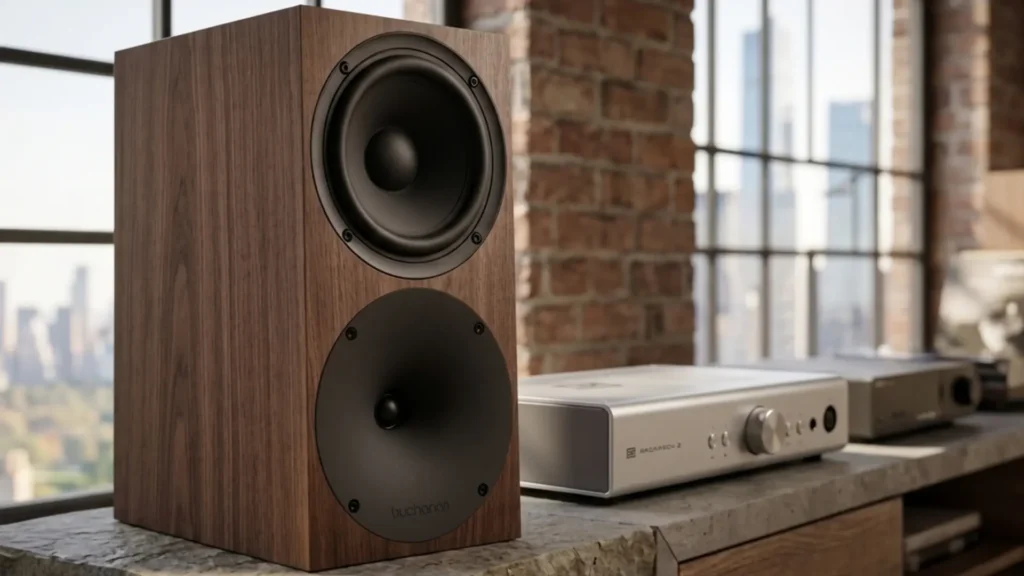
Buchardt S400
Moving the amplifier into a smaller room, I switched to the Buchardt S400s, which are 4-ohm speakers. The “Rag” made these incredible monitors absolutely sing. A very tight low end was the first thing I noticed, which is exactly the grip I felt was missing slightly on the Gurus. The extra wattage stepping up into that 4-ohm load clearly paid dividends.
The National’s secret weapon is neither Matt Berninger nor the Dessners. The rhythm section of Scott Devendorf on bass and especially Bryan Devendorf on drums is where it’s at. The guys in the spotlight might write the songs, but the drumming in The National is always inventive and commanding, and somehow beautifully at odds with the otherwise brooding mood of the tracks. “Frenetic” is how I might describe Devendorf’s style.
The Ragnarok 2 and the Buchardts make his drumming on High Violet snap right out into the room. The kick drum was dead center and right in my chest; the toms spread out vividly to either side. The believability is tangible. This tangibility is one of the standout qualities of the Ragnarok 2. Listen to the drumming on “Sorrow”: it’s simple, but features a great, clean thwack on the snare drum that provides massive momentum. The next song, “Anyone’s Ghost,” is the same; his work on the snare is exemplary.
The Croft combo also sounds great here, but rounder and less chiseled. While I liked the Ragnarok 2 with my Gurus, with the Buchardt S400s, the Ragnarok 2 is simply stunning. A rare, standout match.
Analogue & Headphones
While the digital side is convenient, the phono stage that Schiit has put in this amplifier is genuinely impressive. It is one of the true standout qualities of the Ragnarok 2. It is highly resolving, fitting the clean, neutral tonality of the rest of the amp, not too hot, not too cold, with excellent transparency. I think this internal phono stage is significantly better than the internal DAC module. It makes me wonder what Schiit could pull off if they built a standalone phono stage at around the $500 mark…
Which brings us to another headline feature: the headphone output. Man, oh man, listening to records through the Ragnarok 2 lit up my Audeze LCD-Xs like nothing else.
Using the balanced output, the sound was visceral, punchy, dynamic, and transparent. It was even more rewarding than through my Cayin HA-1A, which is no slouch. It is not the absolute quietest background on high gain, but dropping down the front-panel gain setting sorts that out completely.
Running the Hugo 2/2go directly into the Ragnarok 2 to power the LCD-X made the music sound incredibly alive. There was more grip and better clarity without feeling overly tamed or clinical. The headphone output has an unfiltered way of playing music; it’s as if nothing comes between you and the album.
Conclusion:
The uptick in fidelity when plugging in high-class external ancillaries confirms that while the onboard options are great for the money, this amp is clearly capable of scaling to greater things if you choose to buy it “Just An Amp” and add your own source components.
If you’ve read any of our reviews, you know that modularity is something we highly value here at AmpReviews. It makes a component future-proof rather than turning it into what Schiit accurately calls “dumpster-fodder.” How many great integrated amplifiers have been resold or discarded simply because an onboard DAC or phono stage couldn’t keep up with shifting technology?
The Ragnarok 2 is a wonderful amplifier. Being able to physically upgrade the internal cards as technology advances means you might never actually have to buy another speaker amplifier.
Once again, sustainability walks hand-in-hand with modularity. Designing a single box that beautifully meets all our needs- speaker amplification, DAC, phono stage, and a seriously heavy-duty headphone amp- while remaining affordable.
Pros And Cons:
Pros:
- Sounds amazing – super clear, detailed, and punchy.
- Drives tough headphones (like planars) with ease – they come alive.
- Modular design means you can swap cards later, so it won’t get outdated.
- Built-in phono stage is surprisingly good for vinyl lovers.
- Made in the USA with local parts – better for the environment.
Cons:
- Only one digital input (USB-B) – older gear without USB can’t connect.
- Bass can feel a bit loose or soft on some 8-ohm speakers.
- Power switch is on the back – annoying if it’s tucked away.
- Pre-outs stay active when headphones are plugged in – you’ll have to manually turn off your subwoofer.
Ragnarok 2 Specifications.
| Parameter | Specification |
| Power Output (Speakers) | 60W RMS per channel into 8 Ohms 100W RMS per channel into 4 Ohms |
| Power Output (Balanced Headphone) | 24W RMS per channel into 32 Ohms 1.5W RMS per channel into 600 Ohms |
| Power Output (Single-Ended Headphone) | 6W RMS per channel into 32 Ohms 375mW RMS per channel into 600 Ohms |
| Amplifier Topology | Nexus™ differential current feedback with nested differential stages |
| Volume Control | 128-step microprocessor-controlled relay-switched stepped attenuator |
| Selectable Gain Settings | 3 settings: 1 (0dB), 8 (18dB), or 25 (28dB) via front panel or remote |
| Frequency Response | 20Hz–20kHz, -0.1dB (3Hz–350kHz, -3dB) |
| THD / IMD | less than 0.01%, 20Hz–20kHz, at 100W RMS into 8 Ohms |
| Signal-to-Noise Ratio (SNR) | greater than 115dB, A-weighted, referenced to full output |
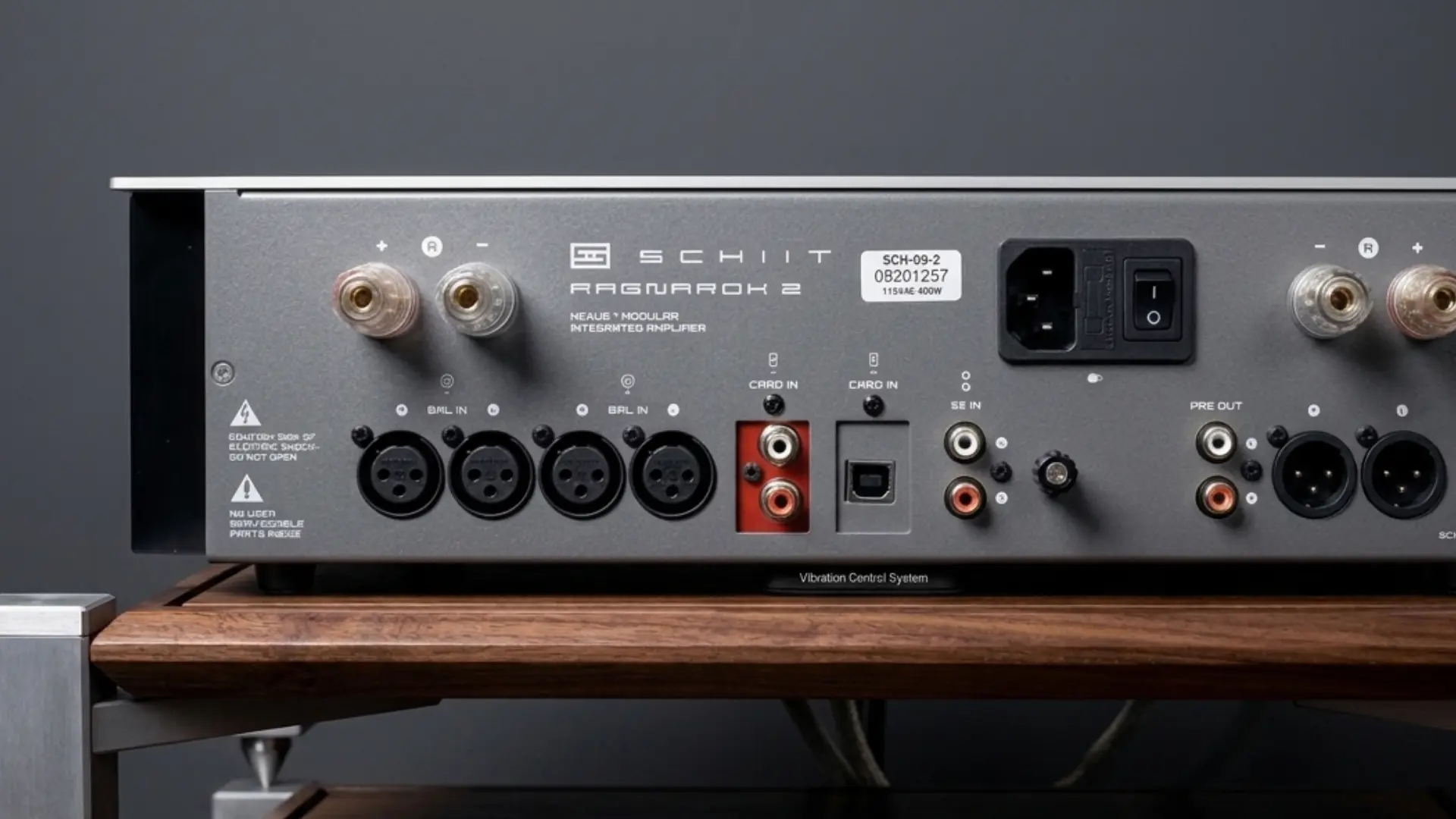
| Standard Analog Inputs | 2 pairs XLR Balanced, 1 pair RCA Single-Ended |
| Fully Loaded Additions | 1 x USB-B Input (Multibit DAC), 1 x RCA Phono Input (MM Phono Card) |
| Pre-Amplifier Outputs | 1 pair XLR Balanced, 1 pair RCA Single-Ended |
| Dimensions & Weight | 16” W x 13” D x 3.875” H |