
What if the best subwoofer for your small room is the one nobody ever notices?
That’s the pitch behind the Velodyne MicroVee X. It’s a compact aluminum cube built around three 6.5-inch drivers, with passive radiators doing the heavy lifting instead of a noisy port. It sounds almost too good to be true for apartments and small rooms, so I put it through its paces.
Deal alert: The Black Friday 2026 price is $1,619 (10% off the $1,799 RRP) in the US via Playback Distribution and House of Stereo. The offer runs through December 1, 2026.
Why Is a Subwoofer Smaller Than a Sheet of Paper Built Like This?
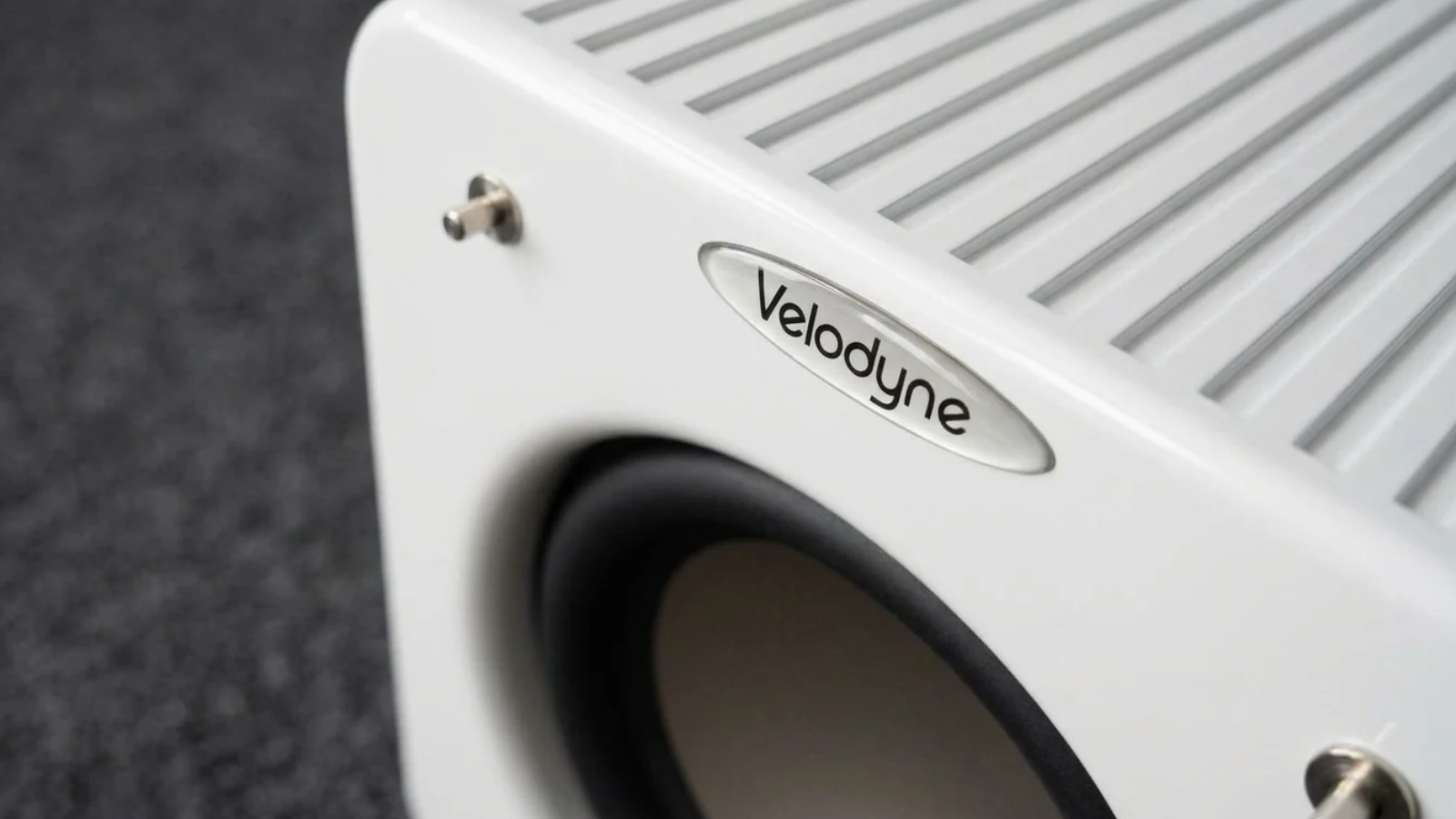
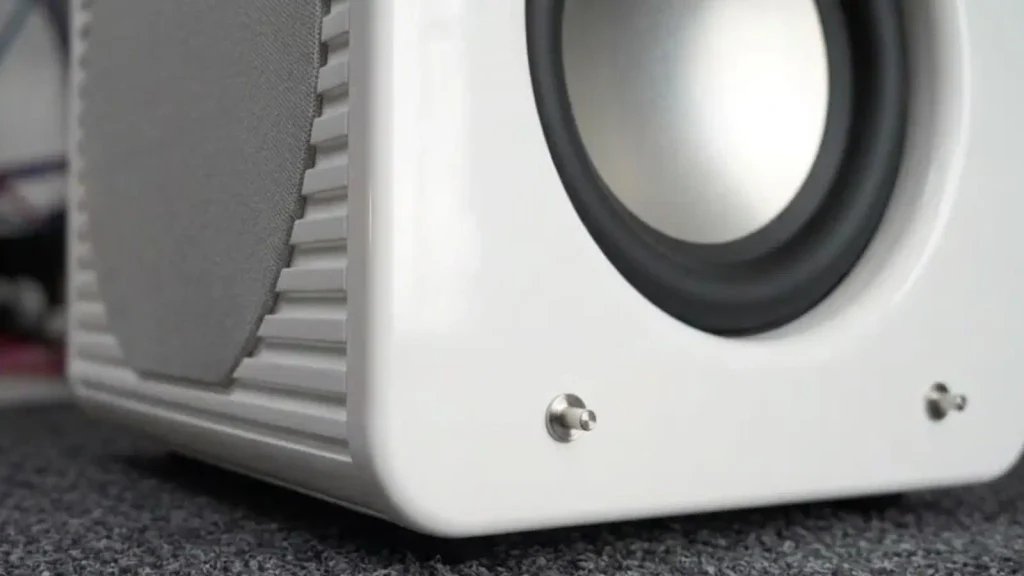
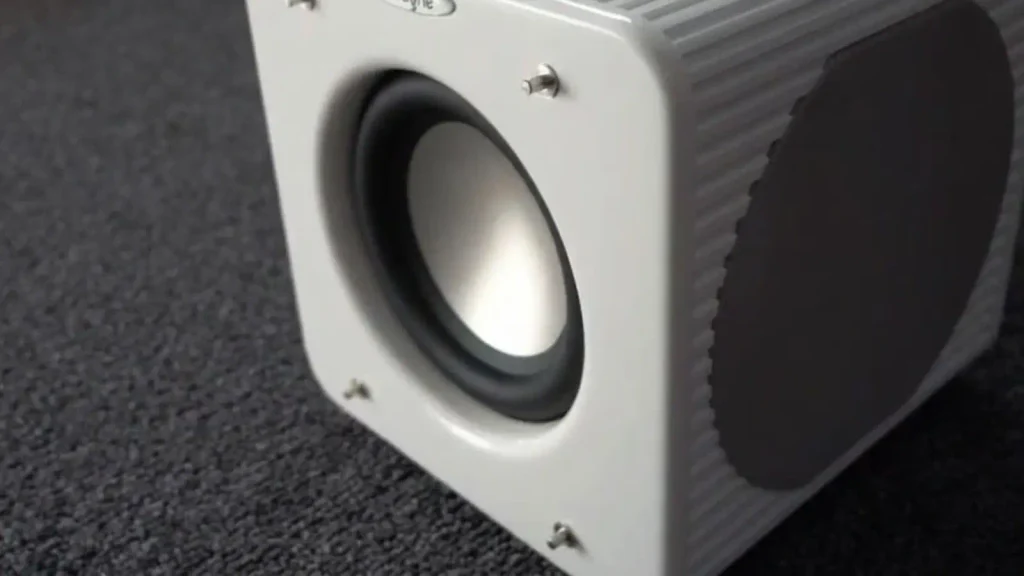
Everything about the MicroVee X is small but sturdy. The footprint is 23 x 25 cm (about 9 x 10 in), which is less than an A4 sheet. All three drivers measure at least 6.5 inches (16.5 cm), and the net membrane diameter is almost exactly the size of a CD (12 cm). The oversized surround is made of flexible nitrile rubber, so it holds up under heavy loads.
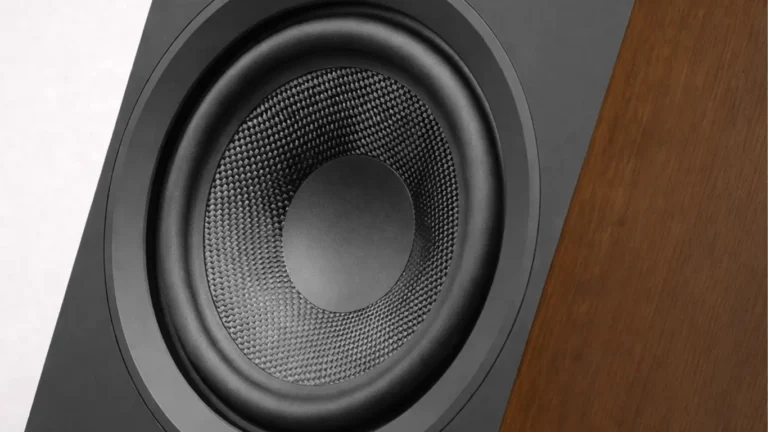
Unlike its predecessor, the membranes on all three drivers are now carbon fiber composite instead of metal. The two side drivers are passive radiators that vibrate freely. Compared with a bass reflex port, that means no flow noise and better-controlled distortion at higher levels. Only the front driver is active. It uses a quadruple voice coil in a neodymium magnet weighing about three kilograms, all anchored in an extremely rigid extruded-aluminum housing.

What Powers It? (And Why 800 Watts Matters in Such a Tiny Box)
The small cabinet volume makes the air inside very stiff, so the driver needs real muscle to stay in control. That comes from a Class A/B amplifier rated at up to 0.8 kW.
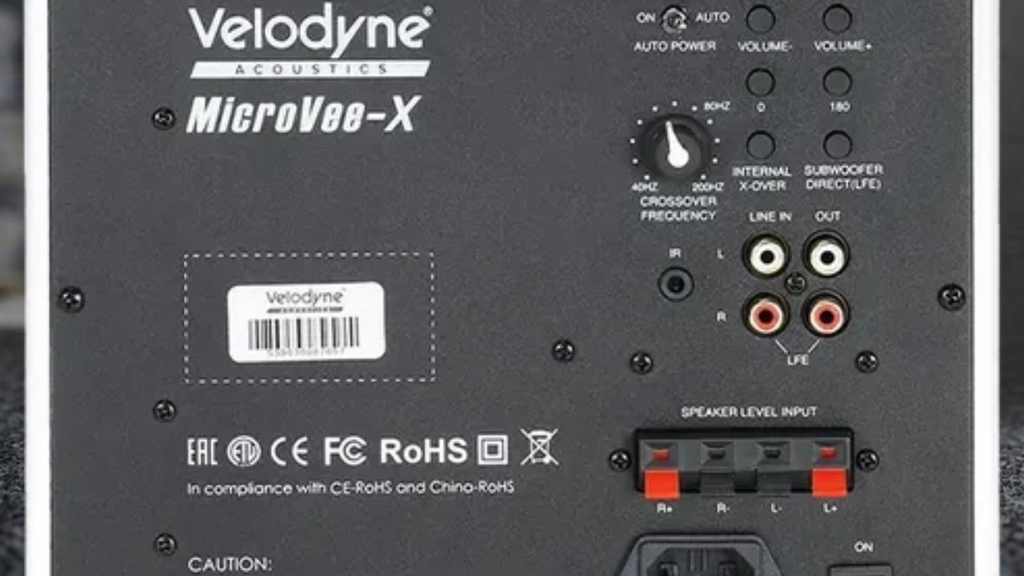
The electronics are completely redesigned:
- RCA sockets for looping through to other subwoofers (the old model had only mini jacks)
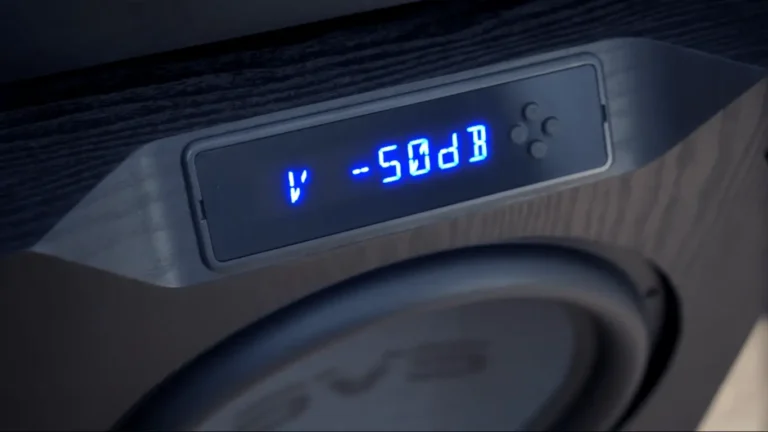
- Digital volume control with an LED chain for rough level indication
- Buttons for phase inversion and switching off the internal filtering
- A remote control, new for this model
The Hidden Trick That Stops It From Overdriving
The new Analog Devices DSP handles equalization and filtering. Its most useful job is dynamic limiting. Small membranes can’t reach THX levels, so pushing too hard risks mechanical limits, heavy distortion and a shorter driver lifespan.
Instead of clipping abruptly, the DSP lets the music ease gently into saturation. In my measurement series, the Velodyne simply stops getting louder past a certain point, protecting itself and your ears. It’s seamless and unobtrusive, and it sounds the way the measurements look. [Add measurement graph here.]
Can You Really Hide It? The Remote Trick That Makes It Possible
A sub this small tempts you to tuck it behind furniture or a curtain, which usually kills infrared control. Velodyne includes an external IR receiver on a cable with a double-sided adhesive pad, so you can mount it wherever it has a clear line of sight to the remote. From the couch you can adjust level, flip phase and toggle the internal filtering.
Setup is simple. The cube sits on rubber-tipped cones that decouple it from carpet, parquet or tile without wobbling. The only control on the unit is the rear crossover dial. My one minor gripe is the coarse 3 dB volume steps.
How Does It Actually Sound? (Spoiler: No Rattle)
I don’t know of another subwoofer this size performing at this level. Most ultra-compact subs rattle, push mechanical noise out of the port, and distort even at low volume. The MicroVee X does none of that. Played solo, it sounds sparkling clean. Only past roughly 90 dB [state distance and room] do harmless low-frequency disturbances appear, a sign the driver is nearing its linear excursion limit. You won’t notice them once music is playing through your main speakers.
It can’t move the air of a flagship like the Velodyne DD-15 we reviewed, but it carries over the same tight, distortion-free character in a fraction of the space.
Crossover tip: Don’t set it too high. With the dial at maximum, the -3 dB point sits below 150 Hz, even though the scale reads 200 Hz. Its filter curves are smooth and well matched, so blending it with your speakers is easy.
Which Speakers Pair Best With the MicroVee X?
It’s an ideal match for:
- Refined compact speakers that lack deep extension, such as the ProAc Tablette 10, Harbeth LS3/5a or KEF LS50 Meta
- High-end desktop monitors
- Compact, music-focused soundbars
With the Velodyne added, you gain roughly an extra octave of depth. It also adds spatiality and a smoother midrange, so it improves more than just the bottom end.
If you have floor space and want room-shaking cinema output for less money, a larger ported sub such as the Klipsch SPL-120 we tested makes more sense. If your priority is disappearing aesthetics and fast, musical bass, the MicroVee X is in a league of its own.
Is the Velodyne MicroVee X Worth $1,799?
Velodyne has improved the MicroVee MKII in the right places. Three carbon-fiber drivers in an ultra-stiff cabinet run with very low distortion. The 800 W amp keeps control, the DSP manages saturation gracefully, and the remote with its cabled receiver is a real everyday convenience.
At $1,799 RRP ($1,619 during the Black Friday sale), it’s expensive. But if you want maximum musical performance from an ultra-compact footprint, I haven’t found a better option.
Verdict: Highly recommended for small rooms, desktop systems and anyone who wants bass without the box.
Pros and Cons:
Pros
- Build Quality
- Clean, controlled bass
- 800W dynamic amplification
- remote controll
Cons
- Price
- Limited output compared with larger subwoofers
- Not designed for extreme home cinema bass
Velodyne Acoustics MicroVee X Specifications
| Specification | Details |
|---|---|
| Type | Active compact subwoofer |
| Active driver | 1 x 6.5-inch |
| Passive radiators | 2 x 6.5-inch |
| Diaphragm | Carbon-fibre composite |
| Amplifier | Class A/B |
| RMS power | 300 watts |
| Dynamic power | 800 watts |
| Frequency response (±3 dB) | 32 Hz–180 Hz |
| Overall frequency response | 18 Hz–300 Hz |
| Low-pass crossover | 40–200 Hz |
| Crossover slope | 12 dB/octave |
| Phase adjustment | 0–180 degrees |
| Cabinet | Extruded aluminium |
| DSP | Digital Drive Control System |
| Inputs | Stereo RCA, LFE, speaker-level |
| Outputs | RCA / LFE pass-through |
| Remote control | Included |
| Finish | Black / White |
| Dimensions (W × H × D) | 23 × 23 × 25 cm |
| Weight | Approximately 9 kg |