
Wharfedale Diamond 12.2 Review: Did Karl-Heinz Fink Get the Formula Right?
Wharfedale decided it was time to give its famous Diamond speaker range a serious overhaul. This was not simply a cosmetic update. The British manufacturer introduced substantial changes to the cabinet construction, driver technology and overall acoustic design. More importantly, the company brought in renowned speaker designer Karl-Heinz Fink to help develop the new generation.
The result was the Diamond 12 series, a completely redesigned family of loudspeakers with some interesting engineering decisions behind it. And now, the Wharfedale Diamond 12.2 bookshelf speakers are in front of me, looking rather impressive under the studio spotlights. So, what has changed, and more importantly, how do they sound?
Wharfedale and several other respected industry sources describe the Diamond range as one of the most popular loudspeaker series in its price category. That is hardly surprising when you consider its history. The original Diamond speakers appeared in 1980, and the family has gone through numerous generations and refinements since then.
However, the Diamond 12 generation represents a particularly important chapter in that history. Karl-Heinz Fink, whose engineering company has worked on successful loudspeaker projects for several well-known Hi-Fi manufacturers, was brought in to help develop the new range.
The result is an entirely refreshed lineup designed to cover everything from conventional stereo listening to complete home cinema systems.

The series includes the floorstanding Diamond 12.3 and Diamond 12.4, the Diamond 12.C centre channel speaker, and three bookshelf models: the Diamond 12.0, Diamond 12.1 and Diamond 12.2. The latter sits at the top of the bookshelf range, making it an interesting choice for anyone looking for a relatively compact loudspeaker without sacrificing too much in terms of bass performance.
So, let’s take a closer look at what Karl-Heinz Fink and Wharfedale have brought to the table.
Wharfedale Diamond 12.2: Design and Construction
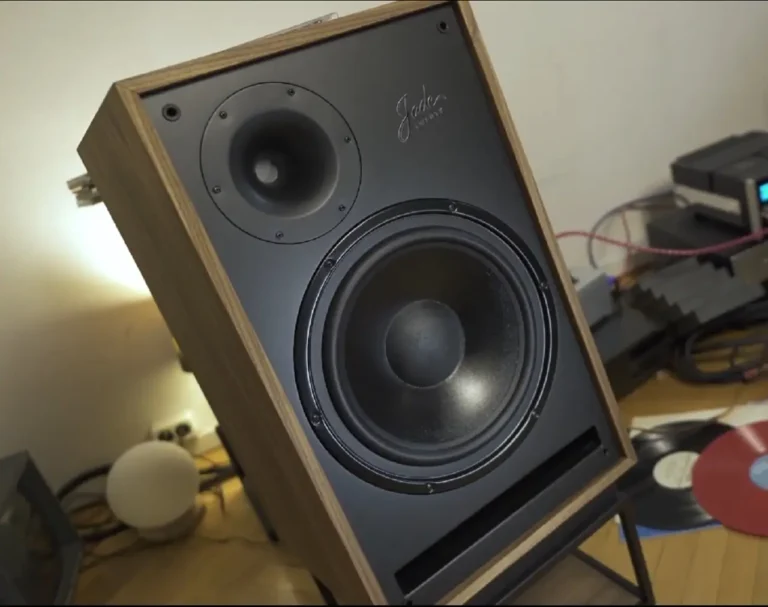
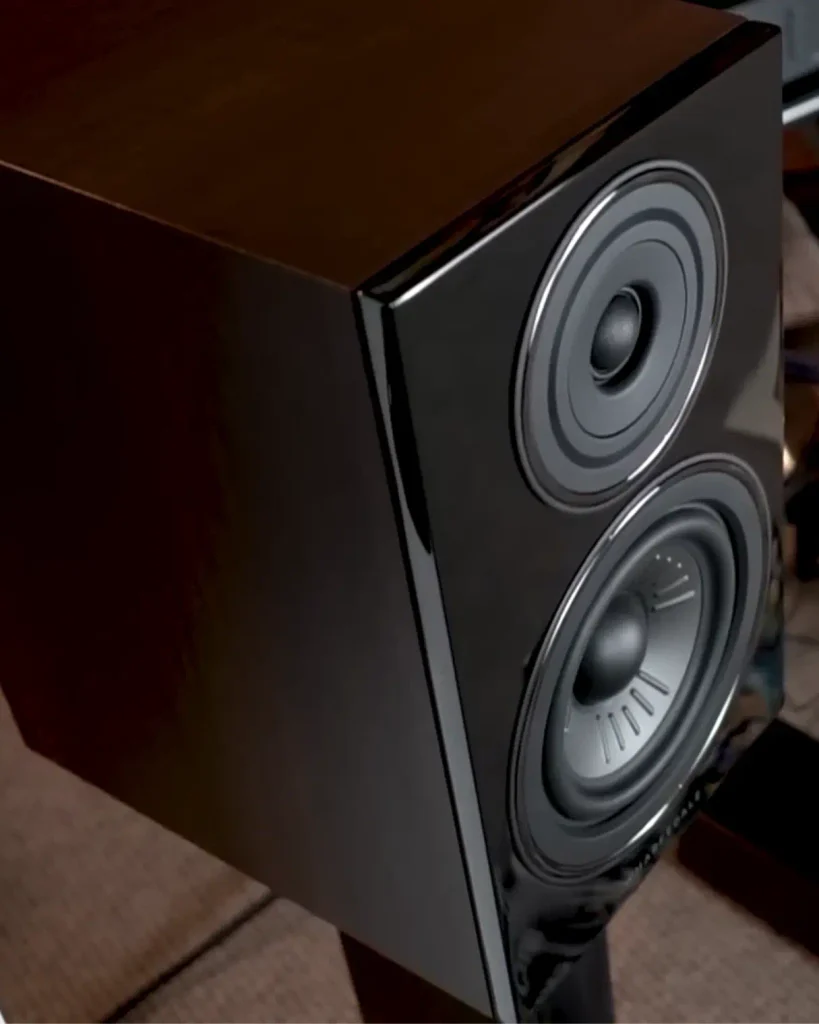
The Diamond 12 series is available in four finishes: black, white, light oak and walnut. My review samples arrived in walnut, and I must say they look rather attractive.
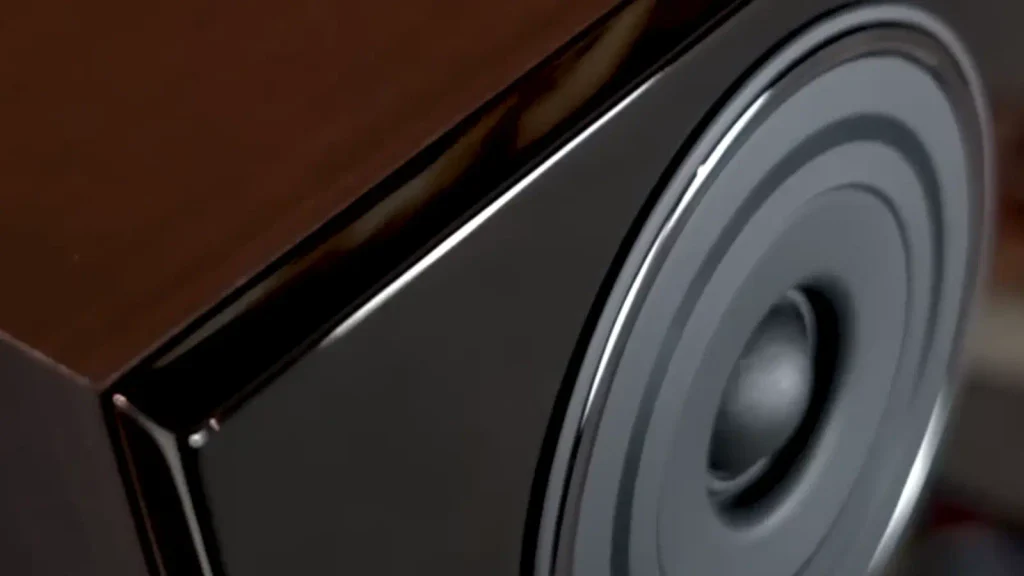
The front baffle features a black gloss finish, while the drivers and their surrounding trim have a more subdued graphite-like appearance. The thin decorative rings around the drivers are glossy, providing a little contrast against the otherwise matte surfaces.
However, the cabinets deserve more attention than their appearance alone might suggest.
Wharfedale has paid considerable attention to cabinet construction. The manufacturer uses a multilayer sandwich-type construction for the cabinet walls, designed to improve rigidity and reduce unwanted resonance.
The engineers also used computer simulations to identify areas inside the enclosure where additional internal bracing would be most effective. These locations were then reinforced by connecting opposing cabinet walls, helping to control structural vibrations.
The objective is straightforward: reduce unwanted cabinet movement and prevent it from introducing additional coloration into the sound. Wharfedale has even provided computer simulation results illustrating the difference between the cabinet before and after the reinforcement work.
This is a serious approach to cabinet engineering, particularly for a bookshelf speaker in this price category.

A New Klarity Mid/Bass Driver
One of the most interesting developments in the Diamond 12 series is its completely new mid/bass driver. This is not simply another variation of a familiar Wharfedale design. The driver was developed specifically for the new generation.
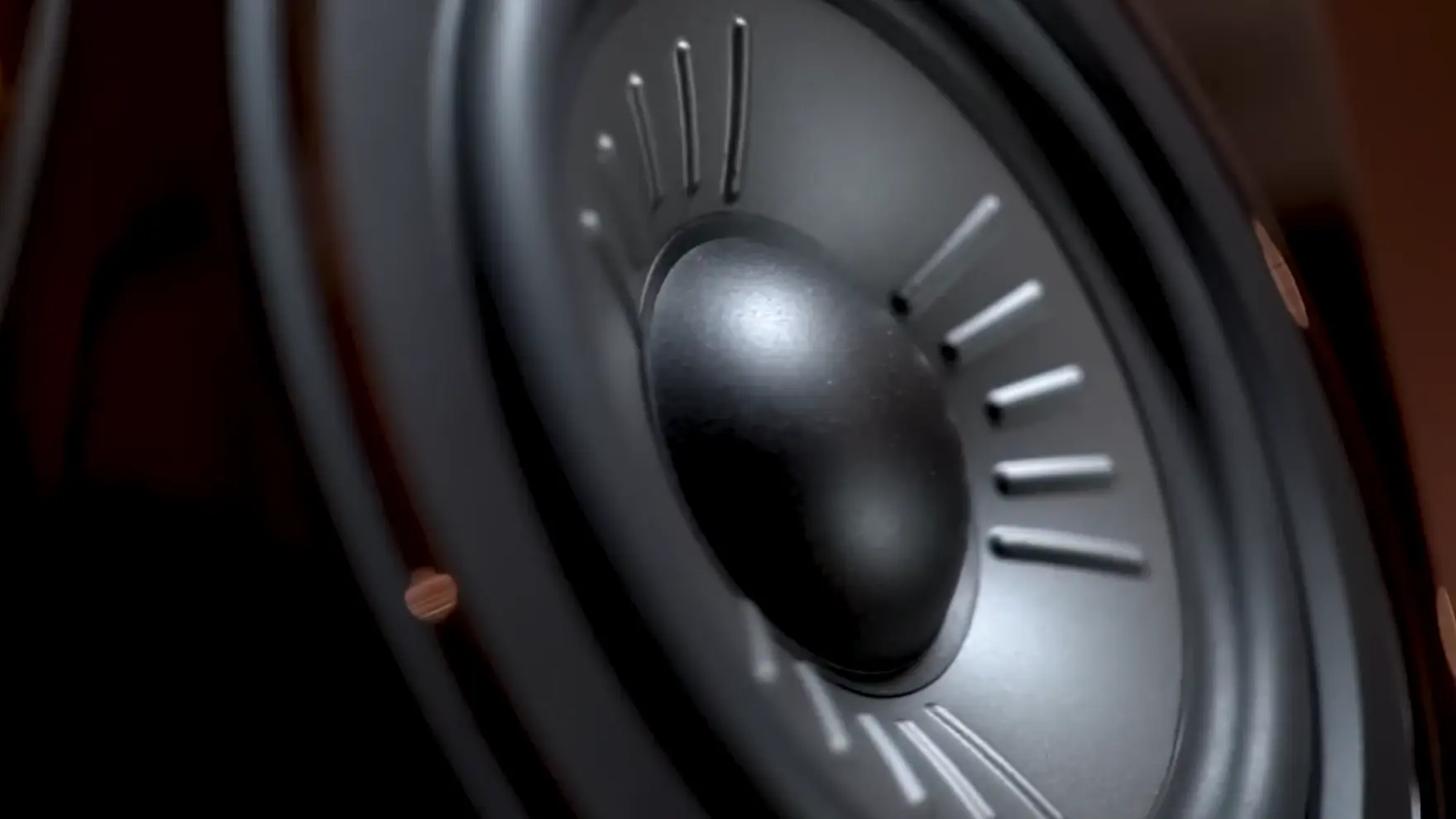
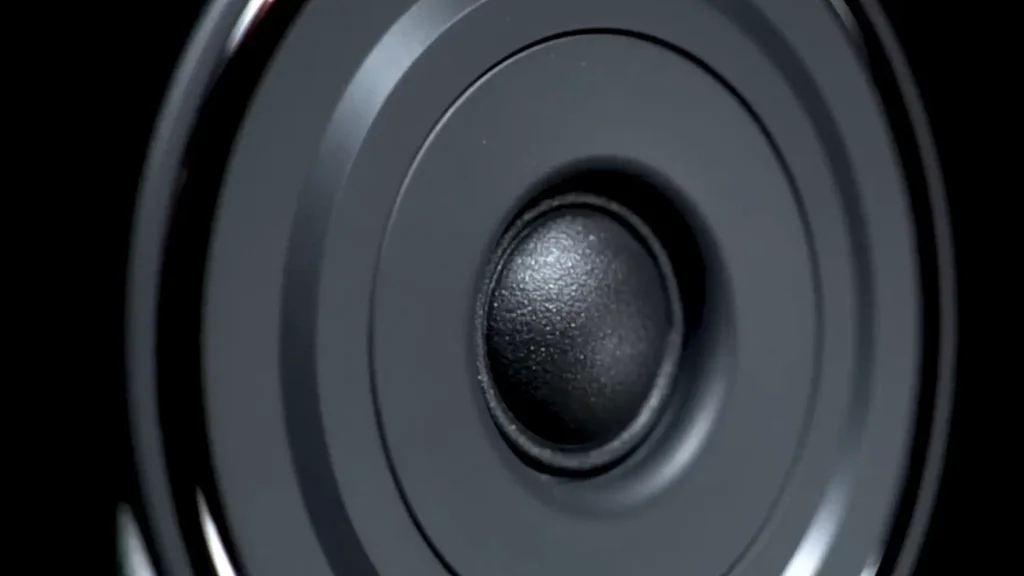
The Diamond 12.2 uses a 6.5-inch mid/bass driver with a cone made from Klarity, a composite material combining polypropylene and mica.
The choice of material is particularly interesting. By combining these materials, Wharfedale aims to achieve an effective balance between stiffness and low mass. The idea is to maintain good control over cone movement while avoiding unwanted resonances and coloration.
According to the manufacturer, Klarity also offers a particularly neutral character, allowing the loudspeaker to reproduce different musical genres without imposing too much of its own personality.
The cone features a central dust cap and several raised sections that appear to provide additional rigidity. They also give the driver a distinctive appearance.
Despite looking rather delicate, the cone felt reasonably robust during handling. Pressing it gently demonstrated that the suspension moved smoothly and returned the cone to its original position without any obvious deformation.
There is also plenty of engineering behind the motor system. Wharfedale uses a precision magnet assembly incorporating an epoxy-coated glass-fibre voice coil former and an aluminium demodulation ring.
These components are intended to reduce unwanted magnetic effects and improve driver control, helping maintain stability during demanding musical passages.
It is an impressive collection of engineering decisions for a speaker that belongs to the Diamond family.
A Carefully Designed Tweeter and Rear Panel
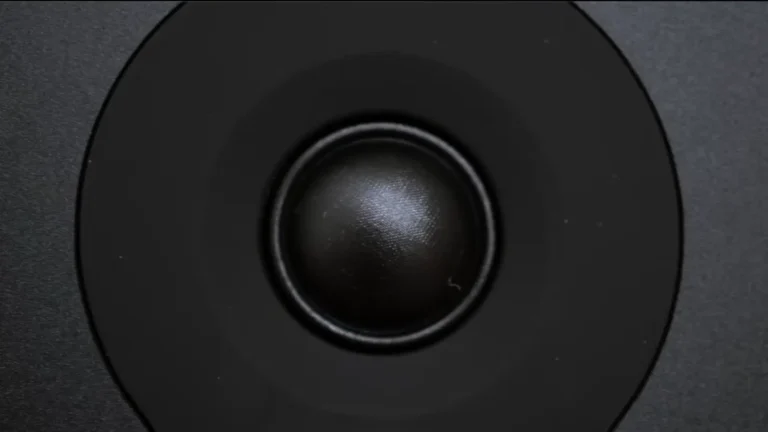
The high-frequency driver is positioned in its conventional location above the mid/bass unit. It features a 1-inch woven polyester dome surrounded by a relatively wide waveguide.
Wharfedale’s intention is to achieve smooth, open high-frequency reproduction while controlling how the sound is distributed towards the listening position.
The waveguide is an important part of this arrangement, helping the tweeter integrate with the mid/bass driver and maintain a consistent presentation across the listening area.
Moving to the rear panel reveals another interesting feature.
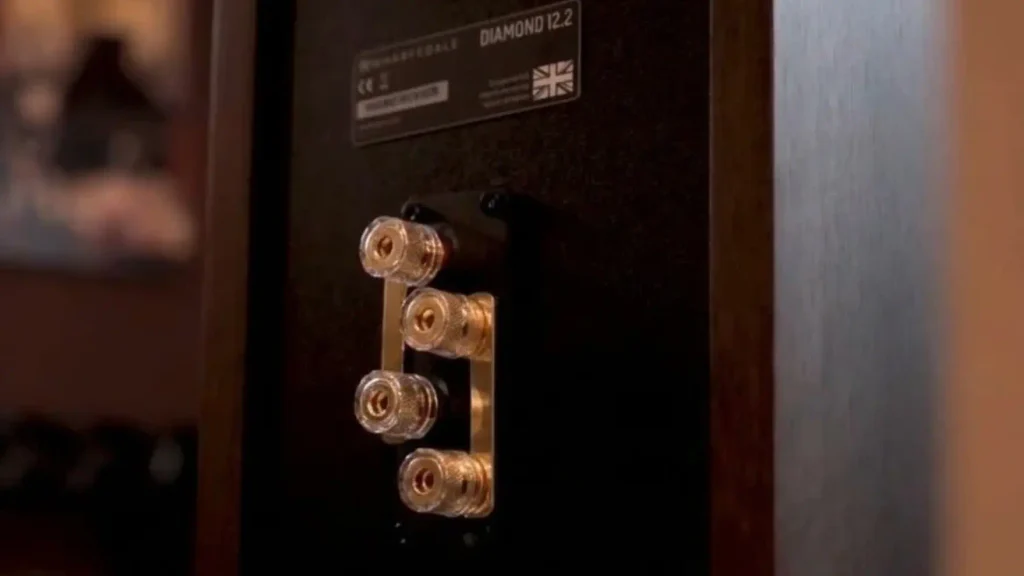
The Diamond 12.2 has two pairs of speaker terminals arranged vertically. This allows owners to experiment with bi-wiring or bi-amping, something that is not always available on bookshelf speakers in this price category.
Above the terminals is a small identification plate carrying the model name and serial number. Higher up, there is a relatively narrow but fairly deep bass reflex port.
Overall, the Diamond 12.2 looks like a thoughtfully engineered bookshelf speaker. Wharfedale has clearly invested considerable effort in the details, rather than simply changing the appearance of an existing design.
Wharfedale Diamond 12.2 Sound Quality: Deep and Powerful Bass
The listening sessions did not take place with an entirely price-matched system. While the Cambridge Audio CXA61 integrated amplifier could reasonably be considered a suitable partner for speakers in this category, the Naim NDX 2 used as the digital source belongs to a considerably higher level.
Nevertheless, the combination allowed me to explore what the Diamond 12.2 could deliver.
The first thing that becomes apparent, regardless of musical genre, is the surprisingly powerful bass presentation.
Wharfedale, is that you?
I was genuinely surprised by the amount of low-frequency energy these relatively compact bookshelf speakers could produce. However, this is not a case of excessive bass being used to impress listeners during a quick demonstration.
The bass is deep, dense and powerful, but it generally knows its place. It does not overwhelm the other frequency ranges or turn every recording into an unnecessarily heavy experience.
Consider the track “Toute Seule” performed by Marie Plassard. Its synthetic bass line contains different levels of depth and noticeable tonal variations. Some loudspeakers struggle to distinguish these differences, reducing everything to a rather monotonous boom-boom presentation.
The Diamond 12.2 handled this material surprisingly well. It reproduced the different bass notes with convincing depth and tonal variation, maintaining control even when the volume was increased.
More importantly, I could not identify any obvious unwanted resonances from either the cabinet or the bass reflex port. Judging by the movement of the driver cone, the loudspeakers were working reasonably hard, yet the sound remained composed. “Bravo, Wharfedale! Bravissimo, Karl-Heinz Fink!”
There is, however, one small reservation regarding bass performance.
The Diamond 12.2 is not the last word in speed. There is a certain relaxed character to its presentation, and extremely fast metal recordings can expose this limitation. The bass does not always have the sharpest attack or the fastest recovery.
However, with classic rock, nu-metal and electronic music, the situation is considerably better. The speakers have enough speed for most familiar musical material, and their ability to produce substantial low-frequency energy makes listening particularly enjoyable.
I could certainly spend more time discussing the finer aspects of bass speed, but considering the intended market and the overall performance, that would risk turning a relatively straightforward observation into unnecessary audiophile nitpicking.
My listening notes have a double plus next to the word bass. That should tell you something.

Midrange and Vocals: Comfortable Rather Than Analytical
The midrange presentation of the Wharfedale Diamond 12.2 is generally controlled and restrained, particularly in the upper portion of the vocal range.
Returning to Marie Plassard’s “Toute Seule”, there was little to complain about. However, the vocal recording itself is not particularly demanding, despite its interesting French accents.
Things become more revealing with Halie Loren and her interpretation of “C’est Si Bon”.
Here, the vocal performance is considerably more varied and playful, offering more opportunities to examine timbre, articulation and the subtle changes in vocal expression.
This is where evaluating the Diamond 12.2 becomes a little more complicated.
One of my reference systems has already established itself firmly in my auditory memory when it comes to this particular recording. And, naturally, that system belongs to a completely different price category.
Unfortunately, auditory memory does not care about price differences. Once you become accustomed to a certain level of vocal refinement, it is difficult not to look for the same qualities in less expensive equipment.
With the Diamond 12.2, I occasionally wanted a little more information from these subtle passages. Certain vocal nuances and small variations in articulation were not as clearly revealed as they are through more sophisticated loudspeakers.
However, there is another way of looking at this.
Imagine someone hearing “C’est Si Bon” for the first time through the Diamond 12.2. Would the performance provide enough emotion, character and convincing vocal expression? Absolutely.
The speakers communicate the musical character successfully, even if they do not reveal every last detail hidden in the recording.
That is an important distinction.
The upper midrange also reveals something about Wharfedale’s tuning philosophy. The Diamond 12.2 has a slightly comfortable presentation, particularly around the frequencies responsible for vocal sibilants.
In practical terms, this means that recordings with harsh or aggressive upper-midrange energy can be played at higher volumes without becoming particularly uncomfortable.
The trade-off is a small reduction in vocal airiness and some of the finest details in this region.
Is that a serious problem? Not really.
The reduction does not feel like an obvious frequency response problem. Instead, it seems more like a deliberate attempt to make the speakers forgiving and enjoyable across a wide range of recordings.
Listeners who regularly encounter poorly recorded or aggressively mastered music may actually appreciate this characteristic.
High Frequencies: Clean, Detailed and Easy to Enjoy
The high-frequency performance of the Diamond 12.2 is not particularly spectacular, but that does not mean it deserves criticism.
There is good transparency; the presentation is clean, and the tweeter provides enough detail to keep musical performances engaging.
Rather than trying to impress with excessive brightness or artificial sharpness, Wharfedale has opted for a more balanced approach.
This becomes particularly interesting when listening to jazz.
I would argue that jazz is one of the most revealing musical genres for evaluating loudspeakers, especially when recordings contain acoustic instruments, percussion, and fast-moving bass lines.
For this reason, I chose a demanding recording: “Hallelujah Time” performed by the Christian McBride Trio.
The track offers excellent percussion work alongside a fast and energetic double bass performance. Surprisingly, the Diamond 12.2 handled the double bass with impressive clarity, avoiding the unnecessary smearing or tonal inaccuracies that can make this instrument sound rather unconvincing.
The percussion also deserves attention.
Because the upper midrange is slightly restrained, the high frequencies can initially appear more prominent. However, after spending more time listening, it becomes clear that the treble is not excessively elevated.
Instead, the midrange and high frequencies are presented at fairly similar levels, both in terms of quantity and overall character.
There is also a reasonably convincing soundstage.
The imaginary stage has a good sense of depth and scale, although individual instruments and performers do not always have the sharpest outlines. This is a relatively minor observation, and the result can also depend on the recording, room acoustics, and positioning.
Nevertheless, the Diamond 12.2 creates an enjoyable listening environment without making the presentation feel artificially spacious.

Final Verdict: Are the Wharfedale Diamond 12.2 Worth Buying?
After spending time with the Wharfedale Diamond 12.2, my initial assumptions have largely been confirmed. These are thoroughly British loudspeakers in the traditional sense, with a presentation that prioritises musical enjoyment, comfortable listening and a satisfying tonal balance.
There is little doubt that a similar approach can be found in other established British Hi-Fi loudspeakers. The interesting part is that Wharfedale has managed to bring many of these qualities into a considerably more accessible product category.
Bringing Karl-Heinz Fink into the development of such an important product family was a significant decision for Wharfedale. The Diamond name carries considerable expectations, and the manufacturer clearly understood that simply updating the appearance would not be enough.
The Diamond 12.2 demonstrates that the engineering effort went considerably further.
The speakers are not completely neutral, despite the impressive technical intentions behind their new Klarity cones. Instead, they offer a lively, engaging, and slightly forgiving sound that remains enjoyable during extended listening sessions.
The bass performance is particularly impressive for a bookshelf design, with excellent depth, convincing tonal variation and good control. The midrange is comfortable and pleasant, although listeners searching for the last word in vocal refinement may want a little more. The high frequencies are clean, transparent and detailed without becoming unnecessarily aggressive.
Perhaps the biggest achievement is the overall balance. The Diamond 12.2 does not attempt to impress by exaggerating one particular frequency range. Instead, it offers a coherent presentation that makes a wide variety of musical material enjoyable.
If you appreciate powerful bass, a relaxed tonal character and speakers that remain comfortable during long listening sessions, the Wharfedale Diamond 12.2 deserves a place on your shortlist.
Pros And Cons:
Pros:
- Powerful and well-controlled bass
- Musical and engaging sound
- Bi-wiring and bi-amping support
Cons:
– No critical deficiencies identified
Wharfedale Diamond 12.2 Specifications:
- Type: two-way passive acoustics
- Acoustic design: phase inverter
- Woofer: 6.5″ Klarity driver
- HF driver: 1 inch, woven polyester film
- Sensitivity: 88 dB
- Recommended Amplifier Power: 20-120W
- Rated impedance: 8 ohms
- Minimum impedance: 4 ohms
- Frequency response: 50Hz – 20kHz (±3dB)
- Crossover frequency: 2 kHz
- Case Volume: 11.8 L
- Dimensions: 200x335x285 (313 mm with terminals)
- Weight: 8.2 kg/piece