
This Little Speaker Surprised Me: Wharfedale Diamond 11.1 Full Test & Verdict
I’ve known about Wharfedale speakers forever; they’re a classic brand for music lovers. For a while there, they seemed to disappear, but now they’re definitely back. For years, I’d only gotten a quick listen to their new stuff at audio shows, but I finally decided to really get to know them properly. I started with a classic: their Diamond series. I went with the Wharfedale Diamond 11.1 model. It’s a bookshelf speaker, kind of in the middle of that line, and honestly, it’s pretty compact overall.
Details & Engineering
Hi-Fi manufacturers are sometimes surprisingly stingy with technical comments, as if some terrible secret lies in the very names of materials and technological solutions. Fortunately, Wharfedale is not one of those: they talk more about their Diamond series than you sometimes hear about the most complex High-End acoustics. Studying all this is quite interesting, especially since the eleventh series is noticeably different from the previous tenth generation and everything that came before. Naturally, the developer presents all changes in an exclusively positive light, as obvious improvements, but we know better than to just take their word for it.


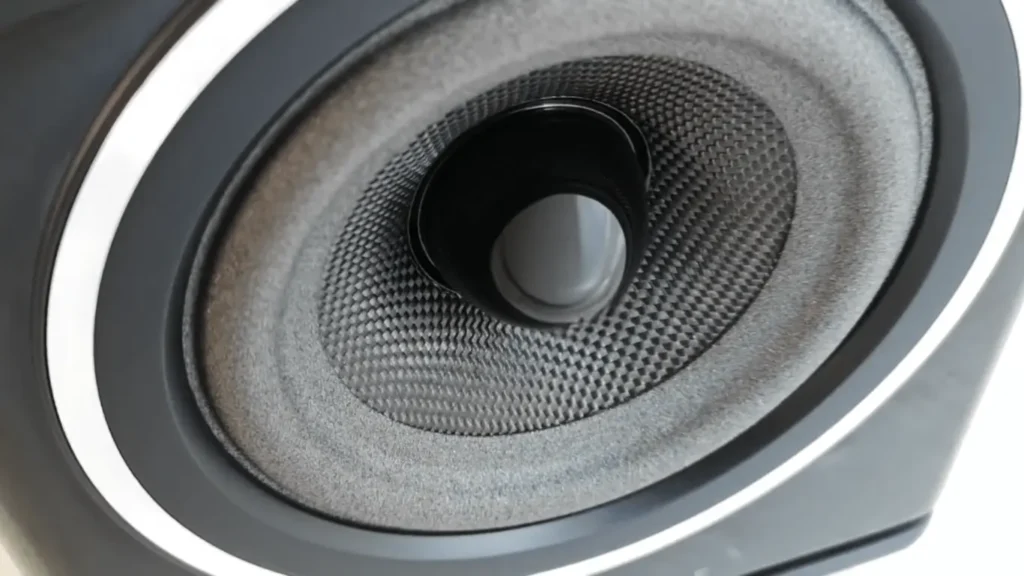
Without the grilles, the new Wharfedale Diamond 11s look somewhat like the previous Diamond 10s. The appearance remains quite recognizable: curved cabinet walls and mid/bass drivers with woven cones. The design is typical for the brand. The cone is made of the classic Kevlar fiber for Diamonds, but the surround is completely new—using a specialized foam instead of standard rubber. According to the developers, this allows for a larger excursion (stroke) without distortion, maintaining a piston-like mode of operation. Accordingly, the voice coil is also long, and the core of the magnetic system is equipped with a copper Faraday ring to equalize the field intensity in the gap. The magnet itself is remarkably large for such a compact driver. The basket design features large windows to provide high rigidity while maximizing airflow transparency to handle the air pressure from the cone’s intensive movement
Check Out: Wharfedale EVO 5.4: What Changed in This Fifth Generation?
The tweeter also uses a core with a copper Faraday ring to equalize the magnetic field, but its central part has a through-hole. This vents air from under the soft dome back into a special rear chamber, designed to reduce distortion and compression effects during intensive high-frequency operation. The crossover is assembled according to principles clearly borrowed from the High-End sphere. Engineers didn’t just select values; they carefully chose the specific types of crossover components and even corrected the board topology for the best sound.
The cabinet engineering is rather complex. In addition to using curved sides, which minimize internal standing waves and increase structural rigidity, the walls are multi-layered, glued together from materials with different internal damping coefficients. A special material lines the walls to absorb sound vibrations across a wide frequency range.
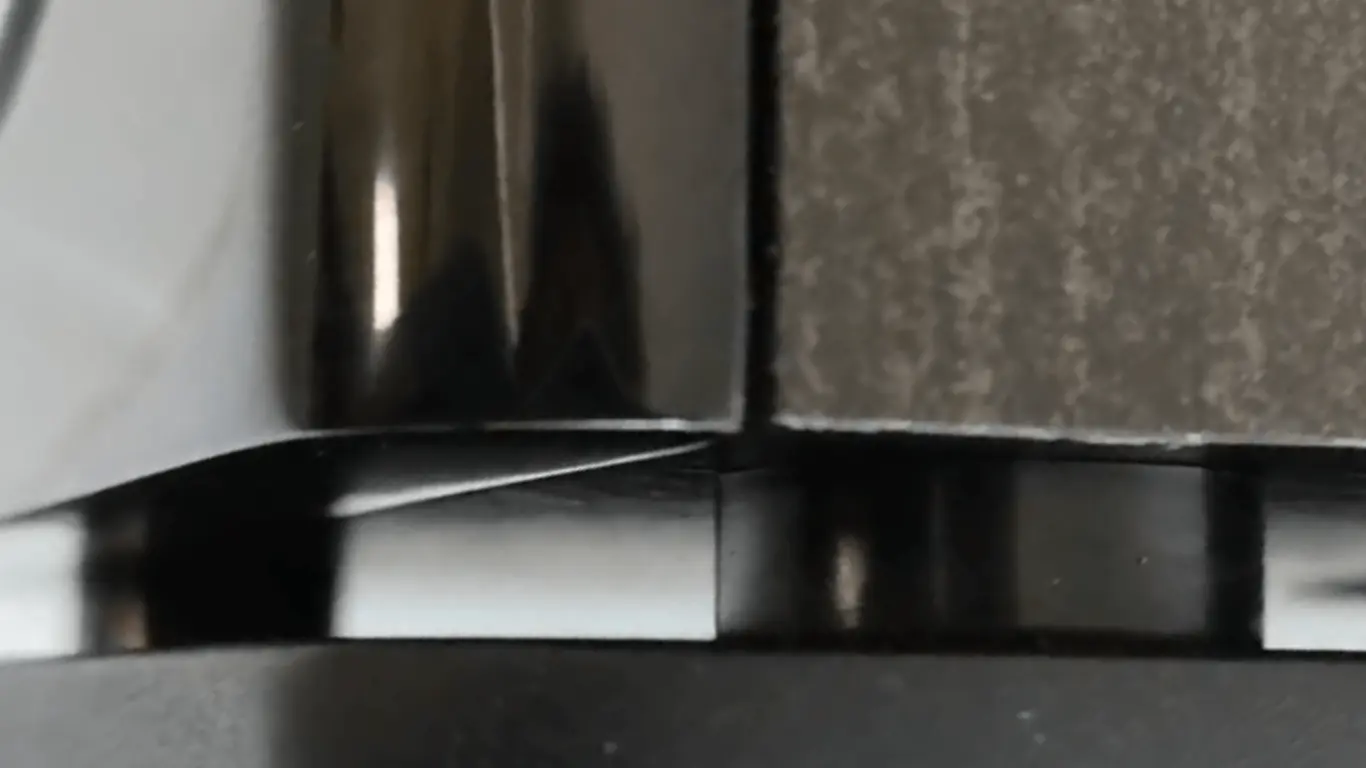
A point of special pride is the complex acoustic design. The bass reflex port is directed downward (down-firing), radiating into the gap between the bottom of the cabinet and the plinth rigidly fixed to it. Thus, inside the case, there is a tube that acts as a port, but outside, we have a slot-loaded port with 360-degree dispersion. Similar solutions can be found in large floorstanding speakers, but in miniature (and even budget) bookshelf speakers, this is a completely unexpected solution.
Practice & Impressions
Against the background of such detailed descriptions, it seems like we are dealing with acoustics worth 5-10 times their actual cost. The declared technologies are serious, but let’s not forget that this is a budget model, which means there are compromises. For example, the phase plug in the center of the mid/bass driver is plastic and glued into the cone like a dust cap. Also, in my opinion, the appearance is slightly spoiled by the way the surround is bonded to the Kevlar. With a diameter of 130 mm, the Kevlar texture is barely visible anyway, and the surround takes up significant space. Most likely, this is a purely technological necessity—bonding the surround from below might not have allowed the desired excursion amplitude. Finally, trying to cover all this with the grille caused me bewilderment: the grille has a ledge at the bottom that partially covers the logo. It feels as if the designers of the grille and the acoustics are different people who have never met or communicated.
However, the design of the back panel is implemented perfectly. A modest pair of terminals fixed on a narrow platform looks great. Someone had the bright idea to arrange them vertically, and it turned out stylish and unusual. The quality of the finish and assembly did not disappoint: the glossy black lacquer, although slightly out of fashion, looks neat and premium.
You might like: Wharfedale Diamond 12.3 Review
But speaking about acoustics, we must nitpick the sound, not just the appearance. And here, everything is interesting and ambiguous. From the first notes, two things are surprising. First, how do developers manage to maintain a single and absolutely recognizable sound signature for decades? And second, how did they manage to squeeze so much bass out of these small speakers?!

My first acquaintance with Wharfedale Diamond acoustics took place in the early 2000s, and since then, their specific character-rich, full-bodied bass and beautiful, textured low-mids have been etched into my memory. I heard the same character now. The trademark “Wharfedale” sound was perfect for Leonard Cohen’s voice, which sounded so full and realistic that it was impossible to tell if it was a budget bookshelf speaker or a full-sized High-End floorstander. The bass notes in “In My Secret Life” sounded very convincing.
However, further listening put things into perspective. The female vocals of Zaz turned out to be less rich. On the track “On Ira,” the bookshelves proved to be in full compliance with their budget and size: the voice and live instruments played somewhat simplistically, with the main emphasis falling on the vocals and rhythm section. At the same time, the upper frequencies were rolled off, and as a result, the guitars were not as sonorous as I would have liked. But the Wharfedale trademark remained—energy and drive—which is so important for Zaz! So, the result is still positive.
With dance electronics and rap, things are ambiguous. The acoustic response in the bass region has a sharp drop-off. In fact, there is a clear boundary: below it, there is practically no bass, and above it, the bass is absolutely full and powerful. So, some tracks seem to be played on large floorstanders, while others (with a very low sub-bass line) reveal the compact nature of the speakers. The drive is transmitted in both cases, so if you add a subwoofer with a fast response, you get a great system even for parties.
As expected, the speakers do well with rock, especially blues-rock and rhythmic genres. Dire Straits hits sounded harmonious, although somewhat dark in character, warm and old-school. On the ZZ Top album La Futura, there were unexpectedly many high frequencies; at times, the cymbals even tried to solo. But the energy transfer is spot on—they pump from the first notes. The guitars are moderately sharp, and the bass is lax and dirty to the right extent (strictly by the nature of the recording, without any added coloration from the speakers). The depth of the low frequencies was lacking here, and again, I wanted to add a subwoofer.

But where the Wharfedale Diamond 11.1 turned out to be a full-fledged performer without an additional low-frequency link was with classical music. Symphonic works, of course, did not unfold in full scale, but the soundstage proportions still significantly exceeded expectations. Chamber music and opera arias earned these speakers an A-grade. I especially liked the way they handled the expressive and assertive vocals of Luciano Pavarotti. The sound was moderately sharp but did not cause discomfort; the orchestral accompaniment filled the space, creating a powerful foundation for the vocals.
Conclusion
The Wharfedale Diamond 11.1 bookshelf speakers left an ambivalent impression. Despite the 11th generation sounding smoother and more balanced than previous iterations, the signature sound remains pronounced, which inevitably makes these speakers genre-dependent. For connoisseurs of that “branded” sound, this will definitely be an interesting upgrade. Neophytes will certainly be attracted by the ability to serve music with good drive. For dance styles and rock, this is a suitable solution even in stereo mode, and with the support of a subwoofer (like an SVS SB-1000 or similar), you can arrange a completely competent party system. The main thing is to choose an amplifier to match—powerful and dynamic.

Pros And Cons
Pros:
- Excellent transmission of bass and lower mids
- impressive bass for its size,
- energetic and expressive sound.
Cons: Uneven response at high frequencies, genre-selective, and low sensitivity.
Wharfedale Diamond 11.1 Specifications
- Latest Price: Here
- Design: 2-way vented-box / standmount
- Enclosure Type: Bass-reflex (Slot-loaded distributed port)
- Frequency Range: 55Hz – 20kHz
- Tweeter: 25mm (1 inch) soft dome
- Mid/Bass Driver: 130mm (5 inch) Woven Kevlar cone
- Sensitivity: 87 dB
- Impedance: 8 Ohm compatible
- Recommended Amplifier Power: 25-125W
- Dimensions: 310mm (H) x 194mm (W) x 285mm (D)
- Weight: 6.8 kg per speaker