
Fezz Audio Torus 5060 Review: The New ‘Giant Killer’ for 2026?
Audiophiles usually have to choose: the warmth of tubes or the precision of transistors. But what happens when the most famous transformer manufacturer in Europe, Toroidy, builds a transistor amp using their legendary ‘Double Mono’ iron? The Fezz Audio Torus 5060 is disrupting the mid-range Hi-Fi market by offering flagship-level power delivery and a built-in Wolfson DAC that challenges standalone units. Is this the new ‘giant killer’ for 2026?
The Toroidy Heritage
“Here is a torus, there is a torus, and look here—another torus.” This is likely the soundtrack to a tour at the Polish facility of Toroidy. Whether it’s high-end musical equipment or the Polish defense complex, Toroidy ensures there is enough clean power for everyone.

While the defense sector is impressive, we are here for the music. Industry heavyweights like Audio Valve, Amare Musica, and Lampizator don’t just use Toroidy; they are modestly proud that these transformers are the beating heart of their boutique devices. Now, Fezz Audio (a subsidiary of the Toroidy family) has stepped out from the shadow of their famous vacuum tube amps to deliver something transistor fans have been waiting for: the Torus line.
Design and Aesthetics: Minimalist Aluminum
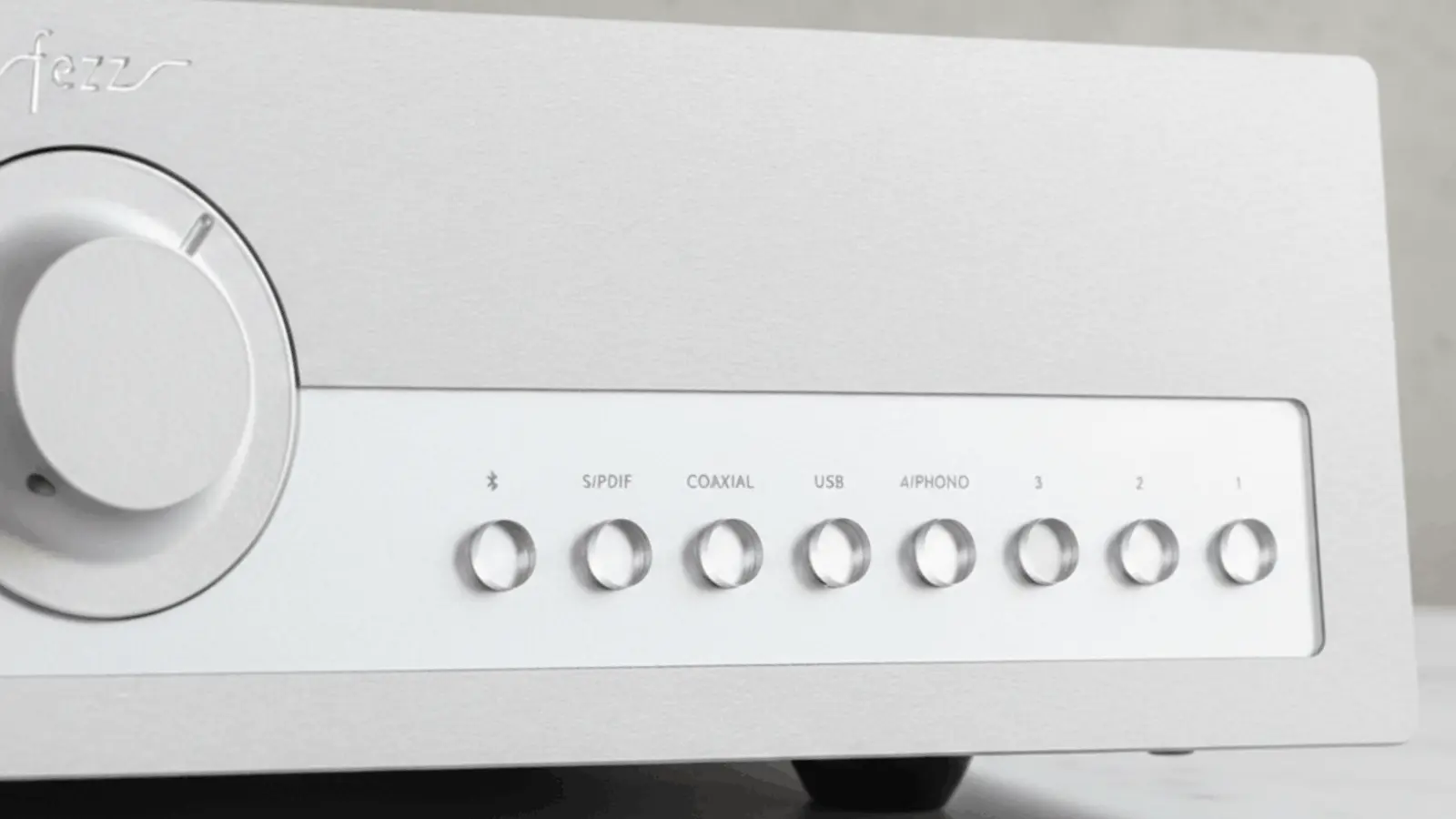
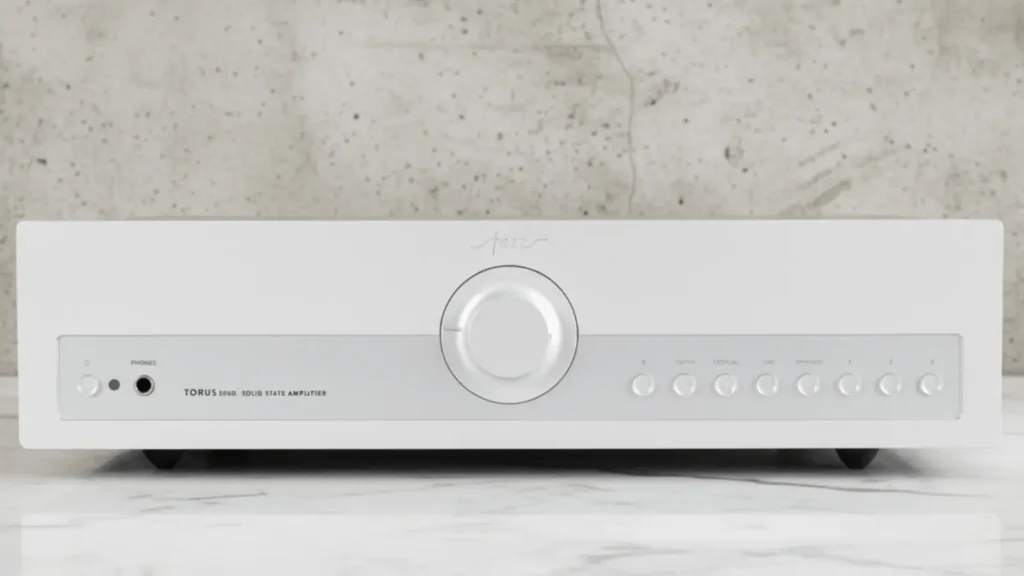
The Torus 5060 arrives with a laconic, industrial simplicity. It’s a departure from the “mid-century chic” of Fezz’s tube models, but the deep engraving on the front panel confirms its pedigree.
The volume knob is a highlight—finely machined to feel like a seamless extension of the chassis. A quick heads-up for new users: the regulator starts its course at the nine o’clock position, so don’t be alarmed by the unusual travel.
The front panel is crafted from noble aluminum, and the metal case features a beautiful “Made of Music” inscription between the top ventilation grilles. It is available in a strict black or a stunning silver finish that catches the light perfectly in a hi-fi rack.
Under the Hood: The “Double Mono” Secret
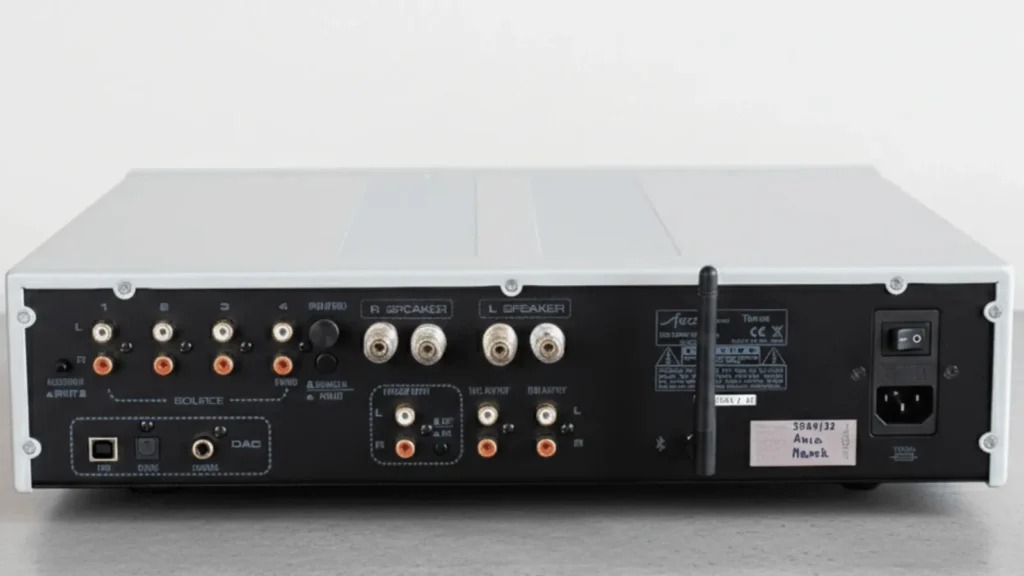
Fezz Audio doesn’t play around when it comes to internals. We’re talking gold-plated connectors, European assembly, and the tester’s actual signature on the back.
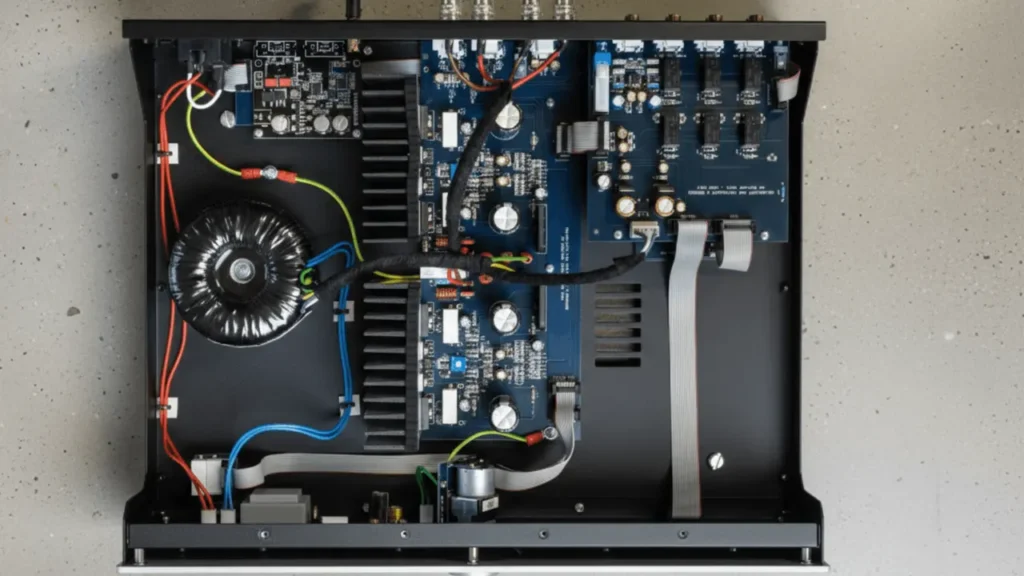
The 5060 utilizes a Dual Mono architecture. While it uses a single massive toroidal transformer, it features two separate windings, bringing power delivery as close to a true double-mono setup as possible.
Technical Specifications:
- Power Output: 90W (4 Ohms) / 65W (8 Ohms)
- Class: AB
- DAC Chip: Wolfson 8740
- Frequency Range: 5Hz – 100kHz
- Inputs: 4x RCA, 1x HT Bypass (Pre-in), Digital (USB, Coax, Optical)
Performance: From Ambient Textures to Electronic Pressure
I paired the 5060 with an Aurender A200 source and the Martin Logan Motion 35XTi bookshelf speakers, a high-resolution chain designed to see if Fezz Audio’s “transformer-first” approach actually delivers where it counts.
1. Transparency and Soundstage
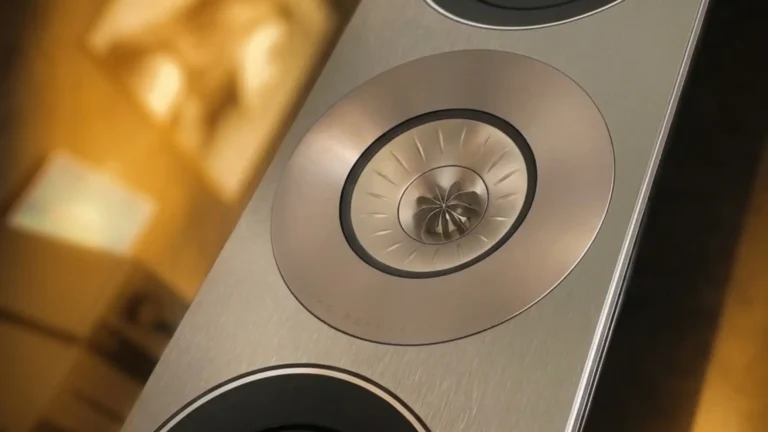
Starting with Nils Frahm’s “Says,” the 5060 lived up to the hype. The track begins with a delicate, pulsing synth that requires absolute silence and black backgrounds—something the Torus excels at. As the reverb-drenched piano enters, the Motion 35XTi’s Folded Motion tweeter sorts the complex harmonics with surgical precision. By the time the track reached its massive crescendo, the soundstage was so holographic that the room seemed to disappear entirely.
2. The Internal DAC: A Real Contender
Usually, a built-in DAC is a secondary “bonus.” The Torus 5060 changes that. When comparing its internal Wolfson 8740 to the high-end Aurender, the Torus DAC held its own with a “friskier,” more open character. Even with the compact 35XTi bookshelves, the bass felt incredibly deep and well-controlled, proving the DAC’s signal quality is top-notch.
3. Dynamic Control
On Com Truise’s “Futureworld,” the 5060 demonstrated incredible grip. It handles low-frequency transients with a level of authority usually reserved for much more expensive separates. The Motion 35XTi can be revealing and sometimes lean with the wrong amp, but the Torus provides a high-current “meatiness” that balances them perfectly.
4. High-Fidelity Power
When pushed with Com Truise’s “Futureworld,” the Torus demonstrated incredible grip on the lower frequencies. It doesn’t just play bass; it controls it with rhythm and volume that rivals amplifiers twice its price.
Final Verdict
The Fezz Audio Torus 5060 is a “devil of classics and a god of electronics.” It does everything right—to the point where you might miss the “wow” effect of a colored amp, only to realize later that you’ve been listening for five hours without fatigue. It is a sophisticated, transparent, and powerful heart for any modern Hi-Fi system.

Pros And Cons:
Pros:
High-current “Double Mono” power delivery
Built-in Wolfson DAC outperforms many standalone units
Superb stage depth and holographic imaging
Includes MM Phono and HT Bypass
Cons:
Reveals flaws in poor recordings instantly
No front-facing digital display
not a champion in terms of power
Fezz Audio Torus 5060 Specifications:
- Type: integrated transistor stereo amplifier
- Maximum output power: 90W (4 ohms) / 65W (8 ohms)
- Circuitry and design features: class AB, dual mono, audiophile quality toroidal transformers, gold-plated connectors.
- Output connectors: tape output (recording output), sub-out (for connecting a subwoofer)
- Analog Inputs: 4x RCA + 1x preamp input
- Digital Inputs: 1x S/PDIF (24bit/192kHz); coaxial (24 bit/192 kHz), 1x USB (24 bit/192 kHz)
- DAC chip: Wolfson 8740 with jitter suppression system
- Functionality: integrated stereo amplifier; two-channel power amplifier; Bluetooth; Headphone Amplifier; MM-type phono stage
- Signal-to-noise ratio: >100 dB
- Frequency range: 5-100000Hz (-3dB)
- Power consumption: 200W
- Weight: 7.5 k
- Dimensions (WxDxH): 430x330x97 mm
- Color: black, silver